About this research

KONDO Yoshifumi
- SANKEN (The Institute of Scientific and Industrial Research)
- Assistant Professor

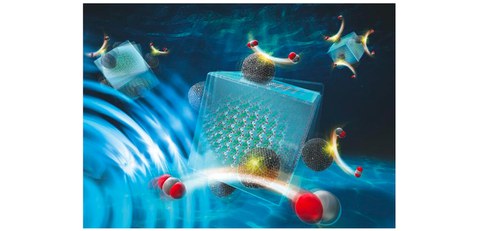
Turning vibrations into value - a new catalyst converts CO2 into useful CO
Single-atom nickel sites on a vibration-responsive material boosted CO2-to-CO conversion under ultrasonic vibration
Researchers at The University of Osaka have developed a catalyst that uses vibrational energy to convert carbon dioxide (CO2) into carbon monoxide (CO), an important industrial feedstock. The work demonstrates a new piezocatalytic route for CO2 conversion under mild conditions—at low temperature and ambient pressure, offering a potential path toward future low-energy carbon recycling technologies.
CO2 emissions are a major driver of global warming, and technologies that convert CO2 from a waste product into a useful carbon resource are becoming increasingly important for achieving carbon neutrality. CO is a useful product of CO2 reduction, but conventional production methods require high temperatures and substantial energy input. A promising alternative is to use catalysts that harness mechanical energy, such as vibration, to drive chemical reactions under mild conditions, although their efficiency and product selectivity for CO2 conversion have remained limited.
The research team designed a catalyst based on barium titanate (BaTiO3), a piezoelectric material that generates electric charges under mechanical stimulation. By depositing nitrogen-doped carbon containing atomically dispersed nickel on BaTiO3 nanocubes, the researchers created a material that efficiently reduced CO2 to CO under ultrasonic vibration at room temperature and ambient pressure.
In five hours of sonication, the new catalyst produced 377 mmol g−1 of CO, compared with 123 mmol g−1 for pristine BaTiO3, corresponding to a 3.1-fold improvement. No H2, CH4, or HCOOH were detected as carbon-reduction products under the tested conditions, indicating almost 100% selectivity for CO among the detected carbon products.
The study also clarified why the catalyst performed so well. The nitrogen-doped carbon helped promote charge separation and transfer, while the isolated nickel single-atom sites acted as highly active centers for CO2 reduction. Structural analysis showed that the nickel atoms were atomically dispersed in a Ni-N4 configuration within the carbon layer. The catalyst also remained stable over repeated cycles, suggesting that the nickel sites were firmly anchored during operation.
The work provides a new design strategy for combining piezoelectric materials with single-atom catalytic sites, opening a possible path toward sustainable CO2 conversion using underutilized mechanical energy. Dr. Yoshifumi Kondo, senior author of the study, commented, “Establishing technologies to recycle industrially emitted CO2 is essential for achieving carbon neutrality. In this work, we clarified part of the design guideline for reaction-active sites in piezocatalytic CO2 reduction. Going forward, we hope to develop new low-energy CO2 conversion methods that make use of underutilized energy, such as mechanical vibration and waste heat.”
Fig. 1
Caption: Schematic images of piezocatalytic CO2 reduction over Ni single-atom anchored on N-doped carbon deposited on BaTiO3.
Credit: Yoshifumi Kondo and Tohru Sekino from J. Mater. Chem. A, 2026, 14, 6858.
Fig. 2
Caption: CO production rates of developed catalysts under ultrasonic vibration.
Credit: Yoshifumi Kondo, Tohru Sekino
The article, “Ni single-atom doped N-doped carbon deposited on BaTiO3 for efficient piezocatalytic CO2 reduction,” was published in Journal of Materials Chemistry A at DOI: https://doi.org/10.1039/D5TA09053A