About this research

NAKATA Yoshiki
- Institute of Laser Engineering
- Associate Professor

World’s First Scalable Megawatt-Class Optical Vortex Array with 3,070 Vortices
Scientists have developed a novel method that dramatically enhances both the power and number of vortices, opening new avenues in advanced material processing and beyond.
Optical vortices—light beams carrying orbital angular momentum (OAM)—are characterized by helical wavefronts and phase singularities. While they have been widely studied in recent decades, two fundamental limitations have restricted their broader impact: generating large numbers of vortices simultaneously and achieving high peak power in such configurations. Until now, large vortex arrays have been limited to low-power systems, whereas high-power demonstrations have typically involved only single vortices.
In a new paper published in Light: Science & Applications, a research team led by Professor Yoshiki Nakata at The University of Osaka reports the world’s first experimental realization of a megawatt-class large-scale optical vortex array comprising 3,070 phase-coherent vortices at a peak power of 58 megawatts. The result represents more than three orders of magnitude improvement in both vortex number and peak power compared with previous approaches.
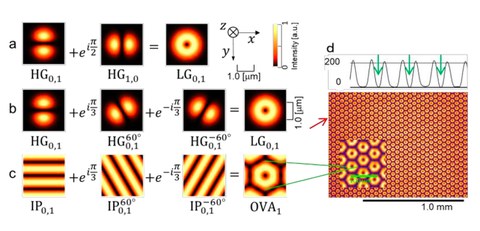
Conventionally, Laguerre–Gaussian (LG) modes are expressed as the superposition of two Hermite–Gaussian (HG) modes with a π/2 phase shift. This constitutes the first revision of the HG–LG mode-conversion framework in three decades. The team reformulated this description into a three-mode representation that naturally integrates with multibeam interference geometry.
“The key was not only revisiting the HG–LG mode conversion theory, but translating it into a concrete optical architecture,” explains Professor Nakata. “By designing a compact DOE–SPP–4f Fourier system that physically embodies this reformulated framework, we directly connected theory with scalable interference. That optical design was what enabled both large-scale parallelization and megawatt-class peak power within a single stable configuration.”
The compact architecture consists of a diffractive optical element (DOE) that generates six coherent beams, a spiral phase plate (SPP) that imposes controlled phase shifts, and a 4f Fourier optical system that recombines the beams into a triangular vortex lattice. Because the approach relies on coherent interference rather than power-limited spatial light modulators or metasurfaces, it is inherently scalable in vortex number, wavelength, and input laser power.
To verify high-intensity functionality, the team demonstrated orbital angular momentum transfer under megawatt conditions by generating chiral nanostructures on copper surfaces. The results confirm that structured phase singularities remain robust even in high-power regimes.
Beyond the immediate demonstration, the work establishes a new design principle for scalable structured-light generation. The ability to control thousands of phase singularities simultaneously at high peak power opens opportunities for broadband chiral photonics, parallel laser processing, and high-intensity OAM-based light–matter interaction studies.
Figure 1. Principle and experimental demonstration of large-scale optical vortex array generation.
a, Conventional Hermite–Gaussian (HG) to Laguerre–Gaussian (LG) mode conversion framework. b, Reconstructed HG–LG mode-conversion scheme introduced in this study, representing the first substantive revision in three decades. c, Integration of the reconstructed framework with multibeam interference to enable simultaneous generation of multiple optical vortices. d, Experimentally observed large-scale optical vortex array containing 3,070 phase-coherent vortices. The upper panel shows the cross-sectional intensity profile along the red arrow, and the green arrows indicate phase singularities.
Credit: Yoshiki Nakata et al., The University of Osaka
Figure 2. Optical architecture for generating the large-scale optical vortex array.
a, Overall experimental setup. The laser beam is divided into multiple beams using a diffractive optical element (DOE) and recombined through a spiral phase plate (SPP) and a 4f Fourier optical system to form the vortex array. b, Conceptual illustration of vortex-array formation via multibeam interference. c, Schematic representation of phase control using the spiral phase plate (SPP).
Credit: Yoshiki Nakata et al., The University of Osaka
Figure 3. High-power demonstration of optical vortex array interaction with a copper surface (5.76 MW peak power).
a-1, Overview of the processed copper surface overlaid with the corresponding simulated pattern. a-2, Magnified view of a region corresponding to a single optical vortex. a-3, Chiral nano-needle structure formed at the position of a phase singularity.
Credit: Yoshiki Nakata et al., The University of Osaka
The article, “Scalable optical vortex arrays enabled by the decomposition of Laguerre–Gaussian beams into three Hermite–Gaussian modes and multibeam interference,” was published in Light: Science & Applications at DOI: https://doi.org/10.1038/s41377-026-02254-0
