

Discovered a new feature: objects being touched are perceived to be cute
The study demonstrated a common principle shared by both Japan and the United States
- Uncovering a new psychological mechanism of cuteness through surveys conducted both in Japan and the United States.
- The researchers discovered that objects are perceived as cuter when they are touched by someone, and that not only the objects but also the people touching them are perceived as cuter.
- The study verified in both Japan and the United States that not only individual characteristics but also the relationships between individuals can be perceived as cute.
- The study suggests that in advertising and product development, incorporating situations in which people touch something may enhance the perceived appeal of both the products and the people interacting with them.
Outlines
Akane Ohashi (doctoral student) and Professor Hiroshi Nittono of the Graduate School of Human Sciences, the University of Osaka, revealed a new psychological mechanism of cuteness through surveys conducted in Japan and the United States.
It has long been recognized that objects widely perceived as cute possess physical features such as large heads and broad foreheads, known as the baby schema. However, recent studies indicate that perceptions of cuteness are influenced not only by individual characteristics but also by social relationships.
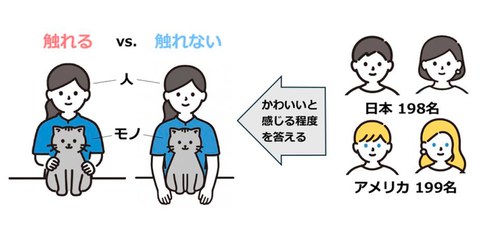
In this study, the researchers conducted a web-based survey both in Japan and the United States in which participants were asked to rate how cute they found photographs showing people either touching or not touching objects (stuffed animals and cushions) which differed in the degree of baby schema.
The outcomes showed that while objects with a high degree of baby schema (stuffed animal) were rated as cuter than objects with a low degree of baby schema (cushions), objects being touched by a person were rated as cuter regardless of the degree of baby schema. Furthermore, the researchers found that not only the objects, but also the people touching them, were evaluated as cute.
These results were consistent in both Japan and the U.S., and applied not only for kawaii in Japanese but also cuteness in English.
Cuteness (or kawaii) has generally been understood as being based on features of individual objects, such as baby schema. This study clearly confirmed the same tendency, and further clarified that people also perceive cuteness in affiliative relationships between the objects and individuals.
The results suggest that, in advertising and product development, by leveraging situations in which people are touching objects, it has the potential to further enhance the appeal of both products and people.
Kawaii, one of Japan’s most iconic forms of pop culture, is sometimes said to reflect a sensibility unique to Japan. However, this study indicates there is a common psychological mechanism across different cultures.
Fig. 1 Participants were shown photos of a person either touching a stuffed animal with both hands or not touching it, and were asked to rate how cute they perceived the object and the person to be in both Japan and the U.S.
Credit: Hiroshi Nittono
Fig. 2 Illustrations generated by AI based on the photos used in the experiment, showing four combinations of object baby‑schema level and human pose.
Credit: Hiroshi Nittono
Research Background
Kawaii is one of the Japanese words commonly used to describe the appeal of objects, people, and animals. The questions of “How can I be cuter?” and “How can something be made cuter?” are now key interests not only among young women but also among professionals in product development and marketing.
Until now, cuteness has been understood in relation to the physical features of the object itself. Objects that many people perceive as cute, such as babies, puppies, and kittens, typically have characteristics of large faces, short and rounded limbs, and broad, protruding foreheads. More than 80 years ago, the ethologist Konrad Lorenz named these characteristics the baby schema.
Recent studies suggest that not only the characteristics of an individual but also the relationships between individuals can influence perceptions of cuteness. However, previous studies have treated the effects of an individual’s baby schema and the effects of relationships between individuals separately. In this study, the researchers examined how perceptions of cuteness change by manipulating these two factors simultaneously.
Research Contents
The researchers conducted an online survey with 198 adult men and women who are native speakers of Japanese, and 199 adult men and women who are native speakers of English and hold U.S. citizenship.
Participants were shown four photos created by combining the object’s baby‑schema level (high vs. low) with the person’s pose (touching vs. not touching the object) and evaluated how cute they found the object and the person separately.
Two men and two women were photographed holding the four objects, with their faces were not visible.
As high–baby‑schema objects, stuffed animals of a panda and a triceratops were used, and as low–baby‑schema objects, gray and black bead cushions were used. The researchers set two poses: one in which the person touched the object from the side with both hands, and another in which both hands rested on the desk without touching the object. Participants viewed the four photos one at a time and rated their impressions of both the object and the person, using kawaii in Japan and cute in the U.S., on a seven‑point scale ranging from “1. Not at all” to “7. Very much.” Each object and each person was shown only once.
The findings showed that: (1) High–baby‑schema objects elicited stronger perceptions of cuteness than low–baby‑schema objects. (2) Although smaller than the baby‑schema effect, being touched by a person increased an object’s perceived cuteness. (3) Higher perceived cuteness of the object led to higher perceived cuteness of the person touching it. (4) These effects were consistent across both Japanese and American participants.
The results of this study support the idea that the perception of cuteness is linked not to caregiving or protective instincts toward infants, but to a motivation to approach and interact with something that poses no threat. Also, while kawaii is sometimes said to be unique to Japan, the underlying emotional response appears to be common across different cultures.
Fig. 3 Objects with a high baby‑schema level are perceived as cute, and they are perceived as even cuter when they are being touched. The error bars indicate 95% confidence intervals.
Fig. 4 Touching not only increases the perceived cuteness of the object but also enhances the perceived cuteness of the person. The error bars indicate 95% confidence intervals.
Social Impact
These results provide useful guidance for how product images can be taken in magazines and online ads to enhance their appeal. To make an object appear cuter, it is more effective to show it being touched by somebody.
For instance, for products intended to highlight cuteness, using a photo of a model holding the product, rather than showing the item alone, may be more suitable for advertising. Furthermore, as similar results were obtained in the U.S., it can suggest useful insights for expanding products overseas by leveraging the emotional value of kawaii.
Note
The article, “Beyond the baby schema: Objects being touched are perceived to be cute,” was published in online academic magazine PLOS ONE at DOI: https://doi.org/10.1371/journal.pone.0340903.
