About this research

MIZUNO Yumiko
- Graduate School of Medicine
- Specially Appointed Assistant Professor (Full time)

A New Discovery that Connects Cold Exposure to Disease
The coordination between blood vessels and neural systems determines immune responses under cold environment
- Discovered a new mechanism in which a molecule called semaphorin 6D (Sema6D), produced in vascular endothelial cells, regulates the distribution of sympathetic nerves in lymph nodes and controls immune responses under cold environment.
- Although it has been known that disease severity may change with environmental temperature, it remained unclear how distribution patterns of sympathetic nerve influence immune responses under cold environment.
- Going forward, the result of this study is expected to clarify the mechanisms by which cold exposure can worsen disease and may eventually contribute to the approaches for therapeutic and preventive strategies from a new perspective.
Outlines
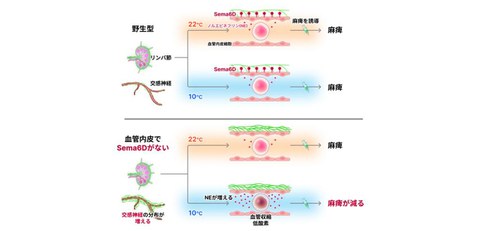
A research team of the Graduate School of Medicine, The University of Osaka, including Specially Appointed Assistant Professor Yumiko Mizuno, Department of Respiratory Medicine and Clinical Immunology, Researcher Hiroaki Matsushita, Joint Research Course for the Center for Medical Innovation and Translational Research, and President Atsushi Kumanogoh (Professor of Department of Respiratory Medicine and Clinical Immunology, at the time of research) has, for the first time in the world, discovered that semaphorin 6D (Sema6D), a molecule produced in vascular endothelial cells, regulates the number of sympathetic nerves and serves as a key factor in ensuring proper immune function under cold environment (Fig. 1).
Although autoimmune diseases such as rheumatoid arthritis and multiple sclerosis are known to worsen in cold environments, its detailed mechanisms have remained unclear.
In this study, the research group found that when Sema6D is absent in vascular endothelial cells, sympathetic nerves become excessively abundant. As a result, it was found that sympathetic nerves become excessively activated under cold environment, leading to tissue hypoxia and impaired immune function.
These results clarified one of the mechanisms through which environmental temperature affects autoimmune disease progression, and they are expected to advance further research on temperature and immune responses as well as the development of new approaches for disease control.
Fig. 1. Sema6D in vascular endothelial cells properly regulates the distribution of sympathetic nerves and maintains immune responses under cold environment
Credit: Yumiko Mizuno
Research Background
It has been known that cold environments increase susceptibility to infections and can worsen autoimmune diseases such as rheumatoid arthritis and multiple sclerosis. It is also known that cold environments activate the sympathetic nervous system, which mediates the body’s stress response. However, the detailed mechanisms by which sympathetic nerve distribution regulates immune responses under cold environment have remained unclear.
Research Content
The research group has elucidated a mechanism in which Sema6D, a molecule produced in vascular endothelial cells, regulates the positioning of sympathetic nerves and regulates immune responses under cold environment. In the absence of Sema6D in vascular endothelial cells, sympathetic nerves became excessively distributed in the lymph nodes, leading to increased norepinephrine (NE) levels under cold environment and resulting in tissue hypoxia. Furthermore, in the absence of Sema6D in vascular endothelial cells, immune cell activation was suppressed under cold environment, and the severity of paralysis induced experimentally was reduced compared with the control group. At room temperature, however, the degree of paralysis was similar to that observed in the control group.
Moreover, pharmacological inhibition of sympathetic nerve activity revealed that excessive sympathetic activation is the cause of immune suppression under cold environment. These findings show that neurovascular coordination mediated by Sema6D plays a crucial role in regulating immune responses under cold environments.
Social Impact
The study results are expected to deepen the understanding of why symptoms of autoimmune diseases tend to worsen in winter. In the future, these findings may lead to the development of new therapeutic strategies targeting neurovascular interactions, and they also open the possibility of applying sympathetic‑nerve–mediated immune regulation to the treatment of various immune‑related diseases.
Notes
The article, “Endothelial semaphorin 6D controls immune responses under cold stress through regulation of sympathetic innervation,” was published in American scientific journal of The Journal of Immunology (Online) at DOI: https://doi.org/10.1080/23294515.2025.2474928.
