About this research

GOTO Takayuki
- Graduate School of Human Sciences
- Associate Professor

Synergistic effects of collaboration and problem construction in generating diverse ideas
An experimental study comparing collaborative work in three-person groups with individual work
- The study demonstrated that groups that engaged in problem construction—reframing ambiguous problems with no single correct answer into more concrete ones—generated a greater quantity and wider variety of ideas.
- Previous studies have not clarified whether the effects of problem construction on enhancing the originality and quantity of ideas differ between individuals and groups. Moreover, it has been suggested that simply generating ideas in a group does not necessarily lead to creative outcomes.
- The outcomes are expected to contribute to developing ideation methods that leverage the strengths of groups in discussions aimed at creative problem-solving.
Outlines
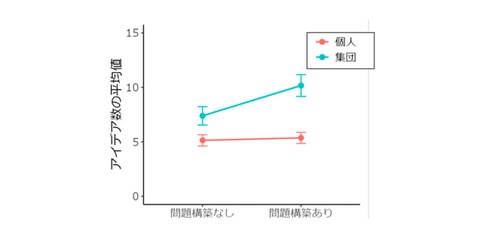
A research group including You Takatsu (doctoral student), Associate Professor Takayuki Goto at the Graduate School of Human Sciences, The University of Osaka, and Professor Roni Reiter-Palmon at the University of Nebraska has found that when groups engage in problem construction—a process of reframing a problem from multiple perspectives and generating new questions before attempting to solve an ambiguous problem with no single correct answer—they produce a greater number and wider variety of ideas. This effect was not observed when problem construction was performed individually (Fig. 1 and 2).
Previous studies have not clarified whether the effects of problem construction on enhancing the originality and quantity of ideas differ between individuals and groups. The study is the first to demonstrate that, in creative problem solving, problem construction carried out before idea generation offers synergistic effects when performed in groups, leading to enhanced idea production. These findings are expected to advance research on idea-generation methods that leverage the unique advantages of group interaction, enabling benefits that cannot be achieved by individuals working alone.
Fig. 1. Number of ideas generated with and without problem construction (Error bars represent standard errors.)
Credit: Takayuki Goto
Fig. 1. Number of ideas generated with and without problem construction (Error bars represent standard errors.)
Credit: Takayuki Goto
Research Background
When tackling ambiguous problems with no single correct answer, researchers have long recognized the importance of problem construction, in which a problem is viewed from various perspectives and new questions are generated before ideas for solutions are generated. However, whether this process is equally effective for individuals and groups has not been clear.
In corporate product planning and product development, as well as in inquiry-based learning in educational settings, people often engage in group discussions to generate creative ideas. However, previous research on creativity has shown that simply bringing multiple people together to discuss ideas does not necessarily lead to more creative outcomes.
Research Contents
In this study, the research group hypothesized that the effects of problem construction on the quantity and quality of ideas would be greater in groups than in individuals. This is because group-based problem construction can help participants share and organize the goals they should pursue, while also enabling them to draw on the diverse knowledge and experiences of group members. The hypothesis was tested through an experiment involving 175 university students working in groups of three, who were asked to generate a creative solution to the problem of “smartphone use while walking.”
Participants were also randomly assigned either to a condition in which they engaged in problem construction by reframing the problem from as many different perspectives as possible using the format “How can I…?” or “How can we…?” before considering solutions, or to a condition in which they did not.
As a result, the effect of problem construction on increasing both the number and variety of ideas was found to be greater in groups than in individuals. In contrast, the present study found no effect of group-based problem construction on creativity, a measure of idea quality.
Social Impact
The study suggests that problem construction—reframing problems with no single correct answer into more concrete ones—has a synergistic effect, enabling groups to generate a greater quantity and wider variety of ideas.
These findings provide important insights into idea-generation methods that leverage the strengths of groups in discussion-based settings, such as companies and educational environments, and may contribute to the design of environments that facilitate creativity.
Notes
The article, “Synergistic Effects of Collaboration and Problem Construction in Creative Problem-Solving: An Experimental Study Comparing Collaborative Work in Three-Person Groups with Individual Work,” was published in British Journal of Scientific Reports at DOI: https://doi.org/10.1002/jocb.70131.
