How ions flow like a liquid through a solid crystal
Researchers in Japan used a simple physical model and revealed a fundamental connection between sublattice melting and cooperative ion transport
A research team led by the University of Osaka, working with The National Institute of Advanced Industrial Science and Technology (AIST), RIKEN, and the Institute of Science Tokyo has uncovered a fundamental mechanism behind superionic conduction, in which ions move rapidly through a solid while its crystalline framework remains intact. Using a simple physical model, the researchers connected “sublattice melting” with cooperative and spatially heterogeneous ion transport. The findings offer a unified explanation for superionic conduction and could help guide the design of next-generation solid-state batteries.
Superionic conductors are solid materials in which certain ions move almost as freely as they do in a liquid, making them attractive for solid-state batteries. They have traditionally been studied on a material-by-material basis since real materials often possess complex crystal structures and chemical compositions. This has made it difficult to identify the essential physical mechanism underlying superionic conduction, independent of any single material’s chemistry.
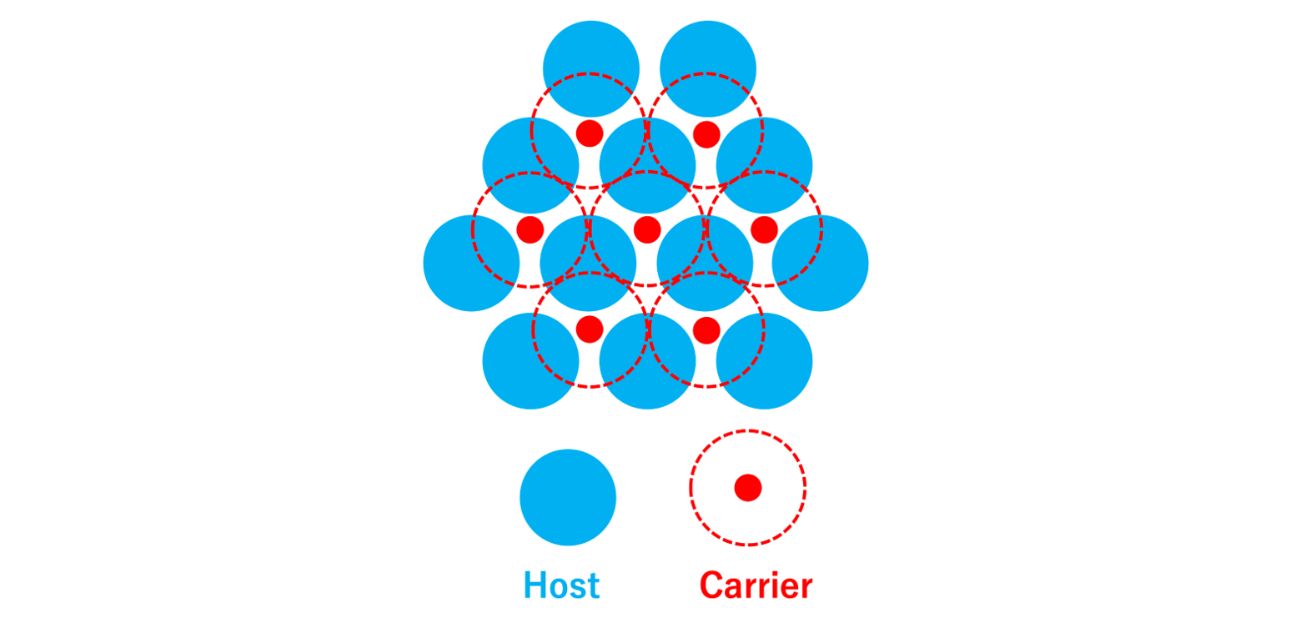
The team constructed a chemically neutral model containing a rigid lattice of host particles and smaller mobile carrier particles. It retained only the interactions considered essential for superionic conduction: strong, short-range repulsion that stabilizes the host framework and softer, longer-range interactions between carriers.
As the temperature increased, the carriers lost their ordered arrangement and began moving like a liquid while the host lattice remained crystalline. This selective loss of order is known as sublattice melting. Near the transition, carriers did not simply hop independently between fixed sites. Instead, they moved cooperatively in spatially heterogeneous, string-like patterns.
The researchers also found that increasingly anharmonic or non-spring-like lattice vibrations softened the carriers’ local environment and promoted collective motion. Adjusting particle density shifted the onset of sublattice melting, while simulations using a three-dimensional model of silver iodide reproduced similar transport regimes.
Because the model captures the essential physics without relying on any specific chemistry, its conclusions apply broadly across many materials. The findings are expected to provide design principles for next-generation solid-state battery and energy-conversion materials with high ionic conductivity, contributing to more efficient materials development.
“Superionic conduction has long been difficult to understand because of the complexity of real materials,” says senior author Takeshi Kawasaki. “By deliberately starting from a simple model, we identified broadly applicable physics that could guide the design of new ion-conducting materials.”
Fig. 1
Caption: Basic structure of the superionic conductor identified in this study: Host particles form a stable crystalline framework through strong steric repulsion. Carrier particles, on the other hand, exist at low density in the interstitial spaces between the host particles. Owing to weak long-range interactions (dashed lines), they form a crystalline structure at low temperatures. As the temperature increases, however, we found that the carrier particles melt prior to the host particles while the host crystalline framework remains intact; this process is known as sublattice melting.
Credit: Takeshi Kawasaki
Fig. 2
Caption: Particle dynamics in the superionic conducting state: This figure shows the diffusion coefficients (conductivities) of the host and carrier particles obtained from our model. In the superionic conducting regime, the carrier particles exhibit extremely high conductivity, whereas the host particles remain almost immobile while maintaining the crystalline framework.
Credit: Takeshi Kawasaki
Fig. 3
Caption: The trajectories of carrier particles in the superionic conducting regime in our model: The colors of the trajectory distinguish individual particles. The carrier particles move in a liquid-like manner through the interstitial spaces between the host particles forming the crystalline framework, clearly demonstrating their rapid transport.
Credit: Takeshi Kawasaki
Notes
The article, “Probing Anharmonic and Heterogeneous Carrier Dynamics Across Sublattice Melting in a Minimal Model Superionic Conductor,” was published in Proceedings of the National Academy of Sciences of the United States of America at DOI: https://doi.org/10.1073/pnas.2605867123