

Development of a new protective coating with high resistance to harsh space environments
Protecting satellites from degradation!
- Developed a next-generation coating material that enables satellites to withstand harsh space environments.
- In very low Earth orbit (VLEO), at altitudes of 300 km or below, where high-resolution Earth observation is expected to be realized, the high density of atomic oxygen (AO) in the residual atmosphere causes erosion and degradation of satellite surface materials.
- Potential application as a polymer protective coating for long-term, stable operation of VLEO satellites is expected.
Outlines
A research group including Assistant Professor Soichi Yokoyama and Professor Yutaka Ie of SANKEN (The Institute of Scientific and Industrial Research), The University of Osaka, in collaboration with the Japan Aerospace Exploration Agency (JAXA) and Kobe University, has successfully developed a new space coating material that protects the surfaces of very low Earth orbit (VLEO) satellites from degradation.
Satellites are covered with multilayer thermal insulation made of polymer films to protect the body from temperature fluctuations in the space environment. However, in very low Earth orbit (VLEO), at altitudes of 300 km or below, which holds great promise for high-resolution Earth observation and low-latency data communications, satellites are exposed to a harsh environment due to the extremely high density of atomic oxygen (AO), which erodes and degrades surface materials.
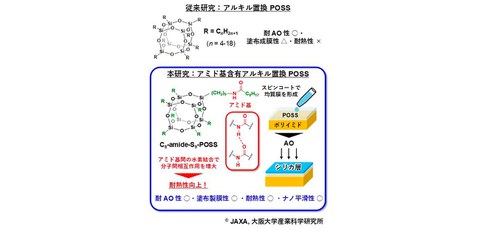
The research group focused on polyhedral oligomeric silsesquioxane (POSS) as a surface coating material with resistance to atomic oxygen (AO). Conventional POSS materials containing alkyl groups (hydrocarbon groups) have limited heat resistance. The researchers have now demonstrated that introducing amide groups (nitrogen-containing groups) capable of forming hydrogen bonds into the side chains of POSS simultaneously improves both heat resistance and AO resistance while maintaining good film-forming properties.
The result is expected to lead to the development of polymer protective coatings that support the long-term, stable operation of VLEO satellites, as well as improved reliability of organic and polymer materials used in space environments.
Fig. 1 New coating material and mechanism of atomic oxygen (AO) resistance
Source: Translated and adapted from Yukumatsu, K. et al., Prog. Org. Coat. 2026, 219, 110310.
Credit: Yutaka Ie
Research Background
Atomic oxygen (AO) is the primary component of the residual atmosphere in low Earth orbit (LEO) and is one of the major causes of degradation of satellite surface materials. LEO satellites orbit at high speeds of approximately 8 km/s and therefore collide with AO at high energies. As a result, polymer films used as multilayer thermal insulation on satellite surfaces undergo surface oxidation and erosion, leading to the degradation of their mechanical and thermo-optical properties.
In recent years, there has been growing interest in the use of very low Earth orbit (VLEO), which is even closer to Earth than LEO, for applications such as high-resolution Earth observation and low-latency communications. However, the AO density in VLEO is significantly higher than in conventional LEO, subjecting satellite materials to far more severe AO exposure. Therefore, the development of surface coating technologies that protect polymer materials from AO is essential for the long-term stable operation of VLEO satellites.
Research Contents
POSS-containing materials have attracted attention as AO-resistant surface coating materials. POSS consists of an inorganic hybrid materials composed of silicon (Si)–oxygen (O) bonds and organic side chains whose molecular structures can be modified. When exposed to AO, the Si components in POSS are oxidized to form a silica (SiO₂)-like protective layer, which acts as a barrier and suppresses further erosion of the underlying polymer film. However, conventional POSS materials containing alkyl groups, while exhibiting excellent film-forming properties, have relatively low melting points, posing challenges in terms of the heat resistance required for use in space environments. To this end, the research team designed a novel amide-functionalized POSS (C₈-amide-S₉-POSS), in which amide groups capable of hydrogen bonding were introduced into the alkyl chains to enhance heat resistance through intermolecular interactions while maintaining the good coatability provided by the alkyl chains.
C₈-amide-S₉-POSS could be uniformly deposited onto polyimide substrates used as exterior materials for satellites by spin coating, forming smooth coating films with nanometer-scale surface roughness. Furthermore, the mass loss after AO irradiation was only about 1–2% of that of the polyimide substrate before coating, demonstrating excellent resistance to AO erosion. Moreover, its ability to withstand temperatures of up to 100 °C demonstrated its effectiveness as a surface coating material with both heat resistance and AO erosion resistance.
Social Impact
The result demonstrates that introducing amide groups into the POSS side chains is an effective molecular design strategy for simultaneously enhance film-forming property, heat resistance, and resistance to AO erosion. These findings provide new design guidelines for the development of AO-resistant coating materials that support the long-term stable operation of VLEO satellites and are expected to contribute to improving the reliability of organic and polymeric materials for space applications.
Notes
The article, “Effect of Introducing Amide Groups into Alkyl Side Chains of POSS for Thermally Stable and Atomic-Oxygen Resistant Coatings,” was published in an academic journal by a Ductch publisher Elsevier, Progress in Organic Coatings (online) at DOI: https://doi.org/10.1016/j.porgcoat.2026.110310.
