

\Remarkable dielectric permittivity response to tiny mechanical stress!/ Pressure-induced nanodomain structures beyond ferroelectric size limits
Real-time observation of cascading nanodomainization in a millimeter-scale crystal
- Researchers discovered that the domain polarization within barium titanate crystals, a representative ferroelectric material, transforms into assemblies of nanoscale domains under mechanical stresses of only a few MPa.
- Successfully visualized the process in which giant domains within a millimeter-scale bulk crystal undergo a cascading nanodomainization into a fine domain structure. The nanoscale domain structure surpasses the limit of Kittel's law, which describes the size effect and dimensional effect of domains in the unloaded equilibrium state.
- This discovery is expected to offer a new perspective on ferroelectric material design, stress control in manufacturing processes, and the reliability evaluation of ferroelectric devices.
A research group including Professor Atsutomo Nakamura, Assistant Professor Yan Li, Visiting Associate Professor Fangping Zhuo, and Takeshi Shibamoto (a doctoral student at the time of the study) from the Graduate School of Engineering Science, The University of Osaka, together with Professor Takahiro Shimada and Kohta Kasai (a doctoral student at the time of the study) from the Graduate School of Engineering, Kyoto University, in collaboration with researchers from Technical University of Darmstadt (Germany) and Tsinghua University (China), has discovered a phenomenon in which giant ferroelectric domains with uniformly aligned polarization in barium titanate (BaTiO₃) crystals, a representative ferroelectric material, transform into assemblies of numerous nanometer-scale domains (nanodomain structures) under compressive stresses of only a few megapascals (MPa).
BaTiO₃ is a ferroelectric material capable of interconverting electrical and mechanical energy, and is widely used in electronic components, sensors, actuators, and other devices. Their properties are strongly governed by the domain state where polarization is uniformly aligned, and the domain walls between them.
Traditionally, domain polarization has been controlled primarily by electric fields. Although changes in domain polarization induced by mechanical stress had been known, room-temperature compression tests on bulk crystals had rarely been reported. As a result, neither the magnitude of the force required to induce domain switching nor the process of the accompanying dynamic structural changes had been fully understood.
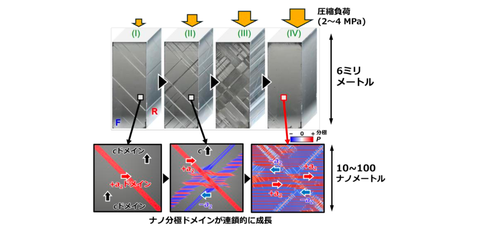
In this study, the research group successfully applied highly controlled compressive stress at room temperature to a BaTiO₃ single crystal containing a millimeter-scale single domain and achieved in situ observation of structural changes associated with domain polarization. As a result, polarization switching, in which the polarization direction of the domain rotates by 90°, was induced by an extremely small compressive stress of only 2-4 MPa (equivalent to a load of approximately 1.3-2.6 kg for a cross-sectional area of 2.5 mm × 2.5 mm). The study further revealed that the single-domain crystal eventually transformed into an assembly of nanodomain structures with characteristic sizes ranging from several tens to several hundreds of nanometers. This stress level is approximately two orders of magnitude lower than those previously reported to be required for polarization switching. These findings indicate that the critical stress required for mechanically induced polarization switching may also exhibit a size effect, with the switching threshold depending on the sample dimensions.
Furthermore, the research team successfully captured video footage showing the process by which linear contrast originating from domain walls propagated in a cascading manner across the crystal surface, transforming large domains into a nanodomain structure. Although the crystal in its final state appears nearly identical to the initial crystal, remaining colorless and transparent, a complex nanoscale polarization structure has developed inside the crystal. Nevertheless, despite the nearly unchanged appearance of the crystal, these internal structural changes were found to induce dramatic changes in its electrical properties, including the dielectric constant, by several tens of times under the application of only a few megapascals (MPa) of stress.
These findings suggest that the conventional understanding of size effects in ferroelectrics, whereby domain size is governed by the dimensions of the material itself, may be overcome through the application of mechanical loading. By indicating that nanoscale functional domain structures can be created within bulk materials without reducing their physical dimensions, this study provides a new perspective on the design of ferroelectric materials, stress control during manufacturing processes, and reliability evaluation.
Fig. 1 Formation process of a nanodomain structure in a millimeter-scale ferroelectric induced by compression
Credit: Atsutomo Nakamura
Research Background
Ferroelectrics are materials that possess spontaneous electric polarization within their structure. The direction of this polarization can be altered by external stimuli, enabling the interconversion of electrical, mechanical, and thermal energy. As a result, ferroelectrics have become essential materials for a wide range of electronic and mechanical systems, including capacitors, sensors, actuators, memory devices, and switching devices. A domain is a region within a ferroelectric in which the polarization is uniformly aligned, while the boundary separating neighboring domains is referred to as a domain wall. Domains and domain walls are the fundamental structural units that determine the functional properties of ferroelectrics, including permittivity, piezoelectric response, and the ease of polarization switching. Therefore, controlling domain polarization is a key issue in enhancing the functional performance of ferroelectric materials.
To date, electric fields and temperature have been the primary means of controlling domain polarization. On the other hand, because polarization is strongly coupled to crystal strain in ferroelectrics, mechanical forces can also induce structural changes in domain polarization, known as polarization switching. However, studies of mechanically induced polarization switching and domain-structure changes have been conducted primarily using small specimens with dimensions on the micrometer or nanometer scale. However, it has remained unclear what level of stress is required to induce polarization switching in millimeter-scale bulk crystals and how the switching process proceeds.
Furthermore, the domain size in ferroelectrics is known to depend on the size of the material itself. This phenomenon, known as the size effect or dimensional effect, has been understood through scaling laws such as Kittel’s law, which predicts that the size of ferroelectric domains tends to increase as the size of the material becomes larger. Consequently, according to conventional theories, forming nanoscale domain structures in bulk ferroelectric materials has been considered difficult.
In this study, the research team investigated how mechanical loading induces polarization switching in millimeter-scale, large single-domain crystals of BaTiO₃, a representative ferroelectric material.
Research Content
The research team prepared millimeter-scale BaTiO₃ crystals in which the polarization was uniformly aligned in a single direction, forming a single-domain state. The crystals were subjected to uniaxial compressive stress applied along the polarization direction at room temperature, while their mechanical response and the internal polarization-switching process were investigated simultaneously.
When a crystal is subjected to compressive stress, it normally first undergoes elastic deformation, in which stress and strain are proportional to each other. However, in the BaTiO₃ crystals examined in this study, an unusual phenomenon was observed during the early stage of compression: strain increased while the applied stress remained at a low level of approximately 2–4 MPa. This process corresponded to the difference in lattice parameters inherent to the crystal structure of BaTiO₃. Combined with the results of the subsequent internal structural analysis, it showed that 90° polarization switching was taking place.
In situ observations revealed the emergence of linear contrast features on the surface of the transparent crystal, corresponding to switched domains. These features were observed to intersect, grow, and merge, gradually propagating throughout the entire crystal. A significant achievement of this study is that it provides the first direct visual evidence of the cascading change from a giant single-domain state into a complex domain structure. Ultimately, all contrast from the complex polarization domain structure disappears, and the crystal reverts to its original transparent state. Therefore, such large-scale reorganization of the internal domain structure cannot be inferred from the sample’s final appearance alone. Therefore, this phenomenon has not been recognized until now.
Observations using piezoresponse force microscopy (PFM) confirmed the formation of a nanodomain structure, ranging in size from several tens to several hundreds of nanometers, near the crystal surface after the applied stress was removed. Furthermore, solid-state NMR measurement and X-ray diffraction analysis revealed that the polarization direction of the whole crystal had switched by 90 degrees. Furthermore, phase-field simulations successfully reproduced the polarization switching process from a single-domain state to a nanodomain structure, providing a mechanistic explanation for the nanodomain formation observed in this study.
Mechanical-load-induced polarization switching was also found to cause a significant change in the dielectric response. For example, in a typical specimen, the dielectric permittivity along the original polarization-axis direction increased by several tens of times after compression, whereas the permittivity in other directions decreased markedly. These results demonstrate that changes in the internal polarization structure are directly reflected in the electrical properties of the material. Furthermore, it was found that slight differences in the loading conditions led to different final domain configurations and dielectric responses, indicating the potential for controlling ferroelectric functionalities through the application of mechanical stress.
Previous studies have reported that polarization switching in micrometer- and nanometer-scale BaTiO₃ crystals requires stresses of several hundred megapascals (MPa). In contrast, the present study revealed that, in millimeter-scale bulk crystals, large-scale polarization switching and nanodomainization can occur under stresses as low as 2-4 MPa. The result suggests that polarization switching induced by mechanical stress may also exhibit size-dependent behavior.
Social Impact
The present result provides a new perspective on the fabrication, processing, and reliability evaluation of ferroelectric materials, including BaTiO₃. BaTiO₃ is a technologically important ferroelectric material, and its internal domain polarization structure is closely related to its functional properties, such as dielectric permittivity and piezoelectric response. The present findings indicate that domain polarization within bulk crystals can be substantially changed by stresses of only a few megapascals (MPa). This suggests that even relatively small stress generated during the fabrication, processing, packaging, or operation of materials may have a significant impact on their internal structures and functional properties, including electrical characteristics.
These findings indicate that the effects of mechanical stress need to be considered more carefully in the quality control and reliability design of ferroelectric materials. In particular, mechanical stresses can arise at various stages of component manufacturing from bulk materials, including processing, sintering, cooling, joining, packaging, and thermal stress generated during operation. This study provides a foundation for understanding how such mechanical stresses influence the domain structure of ferroelectric materials.
On the other hand, the significance of this study extends beyond reliability evaluation. The results demonstrate that mechanical loading can be used to create nanoscale polarization structures within bulk materials, without the need to fabricate the materials themselves into nanoscale forms. This represents a new direction in materials design. Instead of creating nanoscale functions by miniaturizing materials, it creates functional nanostructures inside bulk materials using mechanical force.
Future investigations of similar phenomena in polycrystalline materials, thin films, and practical device structures, in addition to single crystals, are expected to contribute to stress engineering, functional control, and enhanced reliability of ferroelectric materials. Furthermore, because the polarization structure and dielectric response can be modified with only a small mechanical input, this approach could open up new applications in actuators, elastocaloric cooling, and mechanically driven memory and sensing devices.
For example, intensive research is currently being conducted worldwide to reduce the operating energy required for polarization switching in ferroelectric memories, which are increasingly moving toward practical applications. While many previous studies have focused on reducing the electric coercive field required for polarization switching, the present study demonstrates polarization switching induced by an extremely small mechanical load. These findings suggest the feasibility of memory devices that operate using a fundamentally different mechanical switching mechanism from those employed in conventional technologies.
Notes
The article, “Cascading Nanodomainization of Bulk Tetragonal BaTiO3 Triggered by Mechanical Stress of a Few MPa,” was published in Materials Today at DOI: 10.1016/j.mattod.2026.103433.
