

\New insight into the mechanism of crystallization/World's first observation of the moment of glass crystallization under ultrahigh pressure
Perovskite-structured crystallization of CaSiO₃ glass at one million atmospheres
- By combining laser shock compression with an X-ray free-electron laser (XFEL), the researchers achieved the direct observation of the glass-to-crystal phase transition in calcium silicate (CaSiO₃) glass using ultrafast time-resolved X-ray diffraction.
- First demonstration that an ultrahigh-pressure calcium silicate phase corresponding to davemaoite forms within only 1.7 nanoseconds under extreme conditions of approximately 100 GPa (about one million atmospheres) and 5,000 K.
- The study results are expected to provide essential insights into the reactions and mechanisms underlying crystallization of amorphous materials, advancing the understanding in both materials science and Earth and planetary sciences.
Outlines
An international research team including Specially Appointed Researcher Alexis Amouretti (Full time) and Professor Norimasa Ozaki of the Graduate School of Engineering, the University of Osaka, together with Dr. Kohei Miyanishi of RIKEN and Dr. Toshinori Yabuuchi of Japan Synchrotron Radiation Research Institute (JASRI), has made the world's first direct observation of the rapid crystallization of calcium silicate (CaSiO₃) glass under extreme pressure and temperature conditions using femtosecond time-resolved X-ray diffraction enabled by laser shock compression and an X-ray free-electron laser (XFEL).
By irradiating a glass target with a high-power laser, the researchers generated an extreme-pressure state of approximately 100 GPa, comparable to conditions deep within the Earth's interior. Simultaneous irradiation with an X-ray free-electron laser (XFEL) enabled real-time observation of the crystallization process. As a result, the researchers found that compressed amorphous CaSiO₃ glass undergoes an abrupt transformation into a CaSiO₃ perovskite crystal phase (Pv-CaSiO₃) within an extremely short timescale of approximately 1.7 nanoseconds.
Observation and analysis of the temporal evolution of crystal grain size suggested that this crystallization process is a diffusion-controlled transformation, governed by atomic migration (diffusion). Furthermore, the rapid growth of these crystal grains was also suggested to be promoted by a release wave generated during the decompression of the ultrahigh-pressure state. These findings advance the understanding of the microscopic structural changes and chemical reactions involved in the still poorly understood glass-to-crystal phase transition. In particular, direct observations elucidating the mechanisms of ultrafast glass-to-crystal transitions remain extremely rare, and these findings will provide new insights for a wide range of fields, including materials science, Earth and planetary science, and laser science.
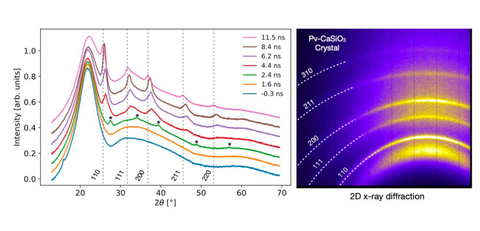
Fig. 1 Emergence and temporal evolution of crystal-derived diffraction peaks (*) from the characteristic glass-derived signals (blue and orange) (left). Original X-ray diffraction images showing ring patterns arising from the newly formed perovskite crystals (right).
Credit: Norimasa Ozaki
Research Background
Glass-to-crystal and crystal-to-glass transitions are among the most important unresolved problems in materials science. In particular, crystallization dynamics occurring on ultrafast timescales, such as nanoseconds, under extreme high-pressure and high-temperature conditions have been exceedingly difficult to observe experimentally, and their underlying mechanisms have therefore remained poorly understood.
Recent advances in time-resolved X-ray diffraction techniques using X-ray free-electron lasers (XFELs) have made it possible to observe structural changes under shock-induced transient compression on ultrafast timescales. While rapid crystallization has been reported in SiO₂ glass, studies of multicomponent silicate glasses, including MgSiO₃, have yielded completely contrasting results. They highlighted the need for studies of other silicate glasses with different physicochemical properties. Because CaSiO₃ is an important silicate material that is widely present in Earth’s deep interior and within rocky planets, understanding its crystallization dynamics under high-pressure and high-temperature conditions is also of great importance in Earth and planetary science.
Research Contents
In this study, CaSiO₃ glass was compressed to pressures of up to approximately 108 GPa using high-power laser shock compression, and the accompanying structural evolution was observed by time-resolved X-ray diffraction using an X-ray free-electron laser (XFEL). As a result, only diffraction features characteristic of the amorphous state were observed immediately after compression. However, after approximately 1.7 nanoseconds, distinct diffraction peaks corresponding to CaSiO₃ perovskite (Pv-CaSiO₃) emerged abruptly. These results demonstrate that the compressed glass underwent crystallization within an extraordinarily short period of time.
Furthermore, analysis of the temporal evolution of the crystal grain size revealed that the crystal grain grew rapidly to approximately 20 nm (nanometers), after which the growth transitioned to a slower stage. The onset of this rapid crystal growth was also found to coincide with the arrival of a release wave that decompresses the shock-compressed state. These findings suggest that the generation of crystal nucleation may be facilitated not only by simple compression, but also by the decompression process itself.
Social impact
This study provides unprecedented experimental data that advance the understanding of glass-to-crystal transition dynamics under extreme conditions. In particular, elucidating the temporal evolution of shock-induced crystallization may provide a foundation for the development of novel materials synthesis techniques and high-performance ceramic materials. Furthermore, as CaSiO₃ is a major component of Earth's deep interior and rocky planetary bodies, the study results are expected to contribute significantly to the understanding of phase transitions and mineral formation processes occurring during asteroid impacts and planetary accretion.
Notes
The article, “Abrupt crystallization from shock-compressed CaSiO₃ glass,” was published in Physical Review B (online) at DOI: https://doi.org/10.1103/szzh-4lv18.