

Elucidated the mechanism of encephalopathy caused by interferon overproduction
Toward the establishment of a treatment for Aicardi–Goutières syndrome (AGS)
- Using a mouse model of the congenital autoinflammatory disorder Aicardi–Goutières syndrome (AGS), the mechanism underlying encephalopathy, AGS’s major symptom, has been elucidated.
- Identified the cell populations that overproduce type I interferon (IFN) in the brain and clarified that IFN accumulated in the ventricle are essential for the development of encephalopathy.
- It is expected that blocking type I interferon (IFN) signaling pathways in the brain will lead to the establishment of a treatment for AGS.
Outlines
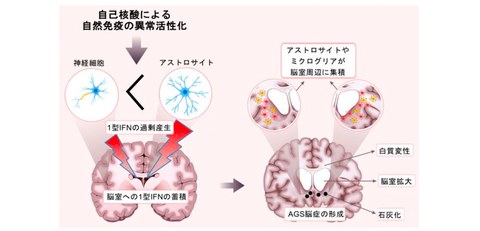
A research group from the University of Osaka consisting of Hyebin Yoo (doctoral student) from the Graduate School of Frontier Biosciences; Assistant Professor Taisuke Nakahama from the Graduate School of Medicine, concurrently affiliated with the Graduate School of Frontier Biosciences and an Exploratory Researcher; and Professor Yukio Kawahara, concurrently affiliated with the Graduate School of Frontier Biosciences, has, for the first time in the world, elucidated that encephalopathy—the major symptom of the congenital autoinflammatory disorder Aicardi–Goutières syndrome (AGS)—is caused by type I interferon (IFN) accumulated in the ventricles (Fig. 1). They also found that type I IFN is overproduced by astrocytes and neurons in the brain.
Although it has been known that type I IFN is overproduced in AGS, it has long remained unclear whether this contributes to the development of encephalopathy, AGS’s major symptom, and which cell populations are responsible for its production.
In 2021, the research group successfully developed a mouse model that recapitulates AGS-associated encephalopathy (Nakahama et al., Immunity, 2021), and through detailed analysis of this model, they identified the cell populations responsible for the overproduction of type I IFN. They also clarified that type I IFN accumulates in the ventricles and that the pathology progresses from the periventricular regions.
By using this mouse model, it has become possible to evaluate the effects of therapeutic agents, raising expectations for the efficient development of drugs that inhibit progression of encephalopathy by blocking the type I IFN signaling pathway.
Fig. 1 Mechanism of encephalopathy development by overproduction of type I IFN
Credit: Taisuke Nakahama
Research Background
When foreign substances such as viruses enter the body, a system known as innate immunity rapidly detects them. In mammals, including humans have sensor molecules that recognize foreign nucleic acids such as DNA and RNA. When viral invasion is detected, the innate immune system is activated, and the type I IFNs are secreted, which act to eliminate the virus. Such sensor molecules for foreign nucleic acids do not respond to the host's own nucleic acids, because self-nucleic acids carry distinguishing markers or are rapidly degraded. However, when these mechanisms are disrupted, sensor molecules for foreign nucleic acids may recognize self-nucleic acids, leading to abnormal activation of innate immunity. Aicardi–Goutières syndrome (AGS) is a congenital autoinflammatory disorder for which nine causative genes have been identified to date. All these genes are involved in nucleic acid metabolism, and dysfunction in the marking or degradation of self-nucleic acids leads to abnormal activation of innate immunity and type I IFNs are overproduced. Diseases characterized by overproduction of type I IFNs are collectively referred to as interferonopathies, among which AGS is primarily associated with encephalopathy.
AGS-associated encephalopathy is characterized by prominent periventricular involvement, including ventricular enlargement, periventricular calcifications, and white matter degeneration. However, previous attempts to introduce AGS‑causative gene mutations into mice had failed to reproduce the encephalopathies. Therefore, many remained unclear, including why encephalopathy predominantly affects the periventricular region, whether type I IFNs are involved, and, if so, which cell populations produce them. ADAR1, which encodes an RNA-editing enzyme, is one of the genes responsible for AGS, and numerous mutations have been identified particularly within a left-handed double-stranded RNA (Z-RNA). The research group produced mice harboring a mutation located near those identified in AGS within this domain, which abolishes Z-RNA binding, and successfully established a model that closely recapitulates AGS encephalopathy (Nakahama et al., Immunity, 2021). Using this model mouse, the researchers successfully elucidated the long-standing mechanism underlying the development of AGS encephalopathy.
Fig. 2 Reduced RNA-editing activity caused by ADAR1 mutations leads to AGS
Credit: Taisuke Nakahama
Research Contents
Using an AGS model mouse, the research group clarified that blockade of the type I IFN signaling pathway completely abolished encephalopathy, indicating that type I IFN is essential for the development of encephalopathy. Next, they demonstrated that type I IFN levels in the ventricle were higher than those in the serum, revealing that type I IFN is overproduced locally within the brain. They also found that the expression of type I IFN-induced genes was markedly elevated, particularly in the periventricular regions, where pathological changes such as cellular degeneration and loss were also most pronounced.
Finally, the research group produced mice with cell type–specific impairment of ADAR1 function in major brain constituent factors, including neurons and astrocytes, and clarified that both cell types contribute to type I IFN production, with astrocytes playing a particularly prominent role. This study not only elucidated the pathogenic mechanisms underlying AGS encephalopathy but also demonstrates that dysregulation of Z-RNA contributes to the development of disorders.
Social Impacts
These findings are expected to accelerate efforts toward establishing therapeutic strategies for AGS. Because there had been no model animal that recapitulated the pathophysiology, it had been difficult to evaluate the efficacy of candidate therapeutic agents. In particular, it remained unclear to what extent such agents could reach the brain and exert their effects when administered either orally or via intravenous infusion to block the type I IFI signaling pathway. By using the model mouse developed by the research group, it became possible to evaluate each candidate drug and determine the most effective route of administration.
Notes
The article, “Aberrant Multicellular Interferon Signaling Underlies Adar1 Mutation-Driven Aicardi-Goutières Syndrome-like Encephalopathy,” was published in American scientific journal of Cell Reports (online) at DOI: https://doi.org/10.1016/j.celrep.2026.117113.