About this research

KANEMOTO Daisuke
- Graduate School of Engineering
- Associate Professor

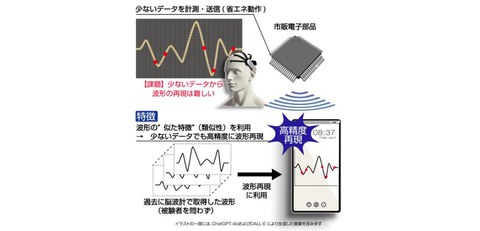
Energy-efficient, high-precision measurement system using waveform similarity
New system achieves world-leading energy efficiency using off-the-shelf components, paving the way for battery-free wearables and IoT devices
Osaka, Japan - A research team led by Associate Professor Daisuke Kanemoto from the Graduate School of Engineering at The University of Osaka has developed groundbreaking energy-efficient and high-precision measurement system leveraging the inherent similarity between waveforms generated by the same type of signal source. Unlike black-box approaches such as generative AI, the system is built on the explicit theoretical framework of compressed sensing.
In a practical demonstration using EEG (Electroencephalogram) signals and only commercially available integrated circuit components, the team achieved ultra-low power consumption of 72 μW—surpassing the previous benchmark of 90 μW from custom-designed circuits. This breakthrough paves the way for sustainable sensing technologies, including battery-free operation and maintenance-free devices powered by energy harvesters.
The research was presented at the prestigious IEEE International Symposium on Circuits and Systems (ISCAS 2025) in May 2025.
The proliferation of wearable devices and IoT sensors has highlighted the critical challenges of battery life and charging requirements. Achieving high-precision measurements while minimizing energy consumption has proven particularly difficult, demanding new technological breakthroughs. Conventional methods of reducing energy consumption in sensors often compromise waveform reproduction accuracy. Addressing this trade-off, The University of Osaka research group built upon their 2023 waveform similarity-based measurement theory to develop a system that achieves both energy efficiency and high precision.
The core of this innovation lies in exploiting the inherent similarity between waveforms emanating from a common source. This allows for significant data reduction while maintaining high-fidelity signal reconstruction. Unlike black-box approaches such as generative AI, the system is built on the explicit theoretical framework of compressed sensing. The researchers implemented an EEG measurement system using readily available components, including a general-purpose microcontroller (nRF52840). This system minimized power consumption to an impressive 72 μW for all measurement operations, from analog-to-digital conversion to wireless transmission. By leveraging waveform similarities between previously recorded EEG data from other subjects and the current subject's data, the system achieved high-accuracy waveform reproduction, demonstrating a Normalized Mean Squared Error (NMSE) of 0.116 averaged over 500 measurements.
The successful demonstration of this energy-efficient, high-precision measurement system using off-the-shelf components for EEG measurement has far-reaching implications. It opens exciting new possibilities for wearable devices capable of continuous, long-term bio-signal monitoring powered by compact, lightweight batteries. Furthermore, it enables the development of self-powered, battery-free IoT devices and infrastructure monitoring sensors using energy harvesting technologies. These advancements promise significant contributions to sustainable development across diverse fields, including healthcare, elderly care, disaster preparedness, and environmental monitoring.
Fig. 1 Conceptual Diagram of a Low-Power, High-Accuracy Sensing System Utilizing Signal Similarity (Example based on a wireless EEG device)
The article“Development of Low-Power and High-Accuracy Wireless EEG Transmission System Using Compressed Sensing with an EEG Basis”was published at the International Symposium on Circuits and Systems (ISCAS 2025).