

Adopting the perspective of Imaginary Future Generations (IFGs) will change the public awareness of water supply infrastructure
Building a long-term maintenance and management plan of water supply infrastructure and consensus among residents
- It became clear that incorporating the perspective of Imaginary Future Generations (IFGs) leads to changes in public awareness toward water infrastructure policies.
- Considering from the perspective of the IFGs, it was confirmed that there was a significant change in each of the items "Pros and cons of water rates increases" and "Pros and cons of regional collaboration" compared to when considering the future from the present, and opinions shifted to those in favor of each measure.
- It was found that patterns of describing a future society by residents themselves may also have an impact on the effectiveness of introducing the perspective of the IFGs.
- Regarding water infrastructure maintenance and management planning, it is expected that this finding will encourage more flexible policy proposals and promote consensus building from a long-term perspective.
Outlines
A research group including Taiga Ikenaga (a master's student at the time of the research) and Professor Keishiro Hara of the Graduate School of Engineering at the University of Osaka, Associate Professor Yukari Fuchigami of the Department of Culture and Information Science at Doshisha University (Guest Associate Professor at the Graduate School of Engineering at the University of Osaka), and Associate Professor Masashi Kuroda of the Department of Social and Environmental Studies at Tokoha University conducted a questionnaire survey targeting 2,000 residents (households) in Suita City, Osaka Prefecture, and revealed that introducing an Imaginary Future Generations (IFGs) system, which considers current decision-making from the perspective of future generations, resulted in changes in public awareness regarding pros and cons of introducing measures for water supply infrastructure maintenance and management. This result offers valuable suggestions for strategies for planning policy and building consensus in relation to water infrastructure maintenance and management from a long-term perspective by intentionally incorporating the IFGs method.
Specifically, when considering from the perspective of the IFGs, significant changes were observed for "Impression of the current level of water rates," "Pros and cons of water rates increases," and "Pros and cons of regional collaboration" compared to when considering the future from the present. The impression of the current level of water rates tended to be perceived as "cheap," and opinions leaned more toward "in favor" when asked whether "Pros and cons of water rates increases," and "Pros and cons of regional collaboration" were acceptable. It was also found that the patterns of describing a future society can affect the effectiveness of introducing the perspective of the IFGs and cognitive changes.
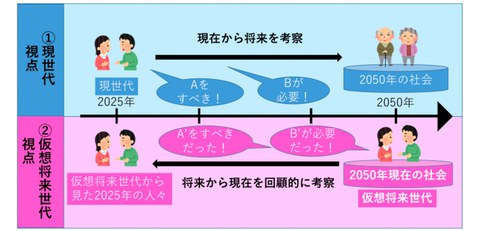
Fig. 1 Conceptual diagram of perspectives and thinking of the Imaginary Future Generations (IFGs)
Credit: Keishiro Hara
Research Background
Water supply is a fundamental social infrastructure, and its sustainable maintenance is a critical issue. Much of Japan's water infrastructure was developed intensively during the period of rapid economic growth. A large amount of Japan’s water infrastructure was installed during the high-economic growth years. Many decades have passed since then, much of Japan's water infrastructure is due for renewal at the same time, and many issues remain, including the prioritization of updates and the costs of renewal and maintenance.
In response to this situation, many Japanese local governments are promoting discussion about raising water rates and enhancing management efficiency and strengthening management foundations through regional collaboration among water supply utilities in order to improve water supply management and ensure sustainable maintenance and management of the water supply system. On the other hand, these directions and measures will lead to financial burdens on users of water supply and changes from the current system. Therefore, it is essential to understand and build consensus among those users. Furthermore, these water infrastructure maintenance issues are long-term challenges that involve intergenerational relationships and conflicts of interest. In other words, this is an issue that should be evaluated and considered from a long-term perspective, taking into account not only the interests of the current generation but also the interests of future generations. Against such background, there is a need for new methodologies for decision-making and consensus building that explicitly consider intergenerational relationships.
Recently, research into the Future Design has been progressing as a new approach to addressing these long-term challenges that span generations. In particular, a mechanism known as the Imaginary Future Generations (IFGs), which considers decision-making from the perspective of future generations, has been shown through economic experiments, field experiments, and practical applications to be effective in controlling the short-sighted judgments that people are said to be inherently prone to, and in encouraging thinking and decision-making from a long-term perspective. In this study, the research team applied a concept of the Future Design to investigate the impact that considering and evaluating policies from the perspective of the IFGs has on the awareness of citizens as water users regarding policies for updating and maintaining water infrastructure.
Research Contents
In collaboration with the Suita City Waterworks Bureau, a questionnaire survey was distributed to randomly selected 2000 Suita City residents (households) aged 18–79. The questionnaire was conducted over the period of July to August 2022, and the respondents were given the choice of answering the printed questionnaire distributed by postal mail or responding online using the QR code included with the questionnaire. The total number of valid returned questionnaires was 696 (collection rate: 34.8 %).
The questionnaire consisted of questions about individual (personal) attributes and questions about water utilities and related future policies. In the question of “Images of the future state of Suita City in 2050 (Question 1)”, the research team presented eight aspects (indicators) of the future society vision and asked participants to rate each one on a scale of 1–5 to express their vision of the city’s future. In this study, in addition to Question 1, the answers to seven questions, “Amount of payment for water supply service (Questions 2)”, “Impression of the current level of water rates (Question 3)”, “Pros and cons of water rates increases (Question 4)”, “Allowable increase in water rates (Question 5), “Pros and cons of regional collaboration (Question 6)”, and “Decision criteria about water pipe renewal (Question 7), were analyzed.
The questionnaire was structured to verify the effects of introducing the IFGs perspective. First, the research group asked participants to answer each question from a present-day perspective looking into the future (i.e., from the perspective of the current generation). Next, participants were asked to read the instructions about the Future Design and the IFGs, and then answer each question again from the perspective of the IFGs in 2050. To obtain the perspective of the IFGs, participants were asked to imagine a situation in which they traveled back in time to 2050 at their current age, and to think about the situation as if they were living in Suita City in 2050. In order to verify how participants' awareness changes as a result of considering the issue from the perspective of future generations, the researchers compared the results of responses from the perspective of the current generation and the perspective of the IFGs for the six questions other than Question 2. They performed a statistical analysis by means of a t-test using the statistical analysis software suite SPSS (IBM), treating the five multiple-choice options as equally spaced scale values.
The results of the t-test showed that there were significant differences in the responses between generations for three items: "Impression of the current level of water rates," "Pros and cons of water rates increases," and "Pros and cons of regional collaboration". Compared to responses from the perspective of the current generation, responses from the perspective of future generations tended to feel that water rates were "cheap," and when asked about the questions of "Pros and cons of water rates increases," and "Pros and cons of regional collaboration", they were significantly in favor. Regarding the acceptable amount of future increases in water rates compared to the amount currently being paid, the average amount was higher when answered from the perspective of the IFGs, but no statistically significant difference was observed.
This study also clarified that the expected image pattern of future society in 2050 also influences the effect of introducing the IFGs. When considering from the perspective of the IFGs, the research group conducted a cluster analysis by dividing participants into two groups: one group with an optimistic (positive) picture of the future society and one group with a pessimistic (negative) picture, and examined the relationship with the effects of introducing the IFGs. As a result, statistically significant differences were observed between the clusters for two items: “Pros and cons of water rates increases (Question 4)” and the “Allowable increase in water rates (%)”—calculated from the “Amount of payment for water supply service (Question 2)” and the “Allowable increase in water rates (Question 5).” For example, compared with the group that envisioned the future society optimistically, the group with a pessimistic view of society showed a significantly greater tendency to be in favor of raising water rates (Question 4).
Social Impact of Research
The renewal and maintenance of water infrastructure is a long-term challenge that will affect not only modern society but also future generations. The results of this study suggest that by considering the perspective of people in the future (IFGs), water users themselves may be able to view water supply issues from a long-term perspective and consider what measures should be taken from now on. This study also provides important insights into the need for effective approaches to planning and consensus building for sustainable water supply utilities. In the future, it will be important to compare the results of this study with findings from other studies (e.g., Hara et al., Futures, 171, 103618, 2025), such as the effects of the Future Design practices on creating water supply visions by government officials, in order to develop methodologies for planning and consensus building for sustainable water infrastructure maintenance and management.
Table 1. Changes in public awareness toward water services (comparison of responses from the perspective of the current generation and the IFGs based on survey results)
Credit: Keishiro Hara
Notes
The article, “Thinking from the perspective of imaginary future generations changes the public perception of sustainable management of water supply infrastructure – A large-scale questionnaire survey in a municipality of Japan,” was published in Futures at DOI: https://doi.org/10.1016/j.futures.2025.103709.
