
\New development in circular fashion/ Separating elastic fibers from blended fabrics in stretch materials
Recycle a variety of blended fabric and contribute to a recycling-oriented society
The research team has developed a technology using microwave heating, which is the same principle as a microwave oven, to decompose and remove only the elastic fiber (polyurethane) from blended cotton and stretch material in just a few minutes, recovering the cotton in high quality without damaging it.
Following on from the cotton and polyester separation technology developed last year, the research team has achieved the separation of blended fabrics containing polyurethane, which are used in functional clothing in recent years, making it possible to recycle more complex materials.
By circulating resources and reducing environmental burden through simple and highly efficient clothing recycling, it is expected to achieve a sustainable apparel industry and a recycling-oriented society.
Outlines
A research team including Professor Hiroshi Uyama of the Graduate School of Engineering at the University of Osaka has developed a new technology that efficiently decomposes and removes only the elastic fibers (such as polyurethane) used in stretch materials from blended fabrics, and recovers the remaining cotton in a recyclable form. When cotton and elastic fibers are blended, the cotton is recovered in a state suitable for material recycling, and the elastic fibers are decomposed and removed in a short period of time (patent pending).
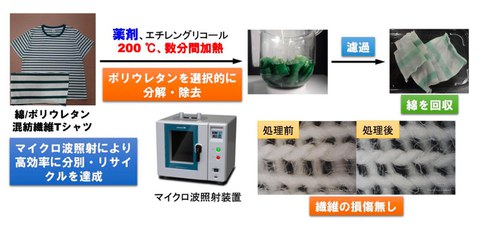
By using microwave heating, which is the same principle as a microwave oven, and irradiating the blended fabrics with a chemical at approximately 200°C for a few minutes, this technology allows the elastic fibers to be selectively decomposed. The cotton fibers remain intact and can be recovered in a reusable form (Fig. 1). As a result, it is now possible to separate and recycle blended fibers, including stretch materials.
The apparel industry has been said to have the second largest environmental burden after the oil industry, and fast fashion is a symbol of this. Clothing that is mass-produced and mass-consumed at low prices is discarded within a short period of time. In Japan alone, approximately 470,000 tons of those are discarded annually, and 95% of which are incinerated or disposed of in landfills (Ministry of the Environment data, 2022). One of the factors that has hindered recycling is the cotton/polyester blended fibers that make up nearly half of clothing, as well as the presence of trace amounts of stretch material (elastic fibers), which has been getting in the way of sorting and recycling.
This study builds on the foundation of "Rapid sorting and recycling technology for cotton/polyester blended fibers" (published on March 26, 2024) presented by Professor Uyama, and makes it possible to handle more complex materials and recover a high percentage of materials, marking a new development toward solving the diverse recycling challenges facing the apparel industry.
Fig. 1 Innovative sorting and recycling technology for cotton/polyurethane blended fibers
Credit: Hiroshi Uyama
Research Background
The apparel market is expanding worldwide and has reached approximately US$1.8 trillion in 2024 and is expected to reach approximately US$2.3 trillion in 2030. With population and economic growth as a backdrop, demand for clothing is also increasing in emerging countries centering on Asia, and the fashion industry is thought to keep occupying an important position in the global economy.
In Japan, the market size reached approximately 10 trillion yen in 2021, and new clothing supply exceeded approximately 820,000 tons in 2022. Of the clothing discarded by households, approximately 510,000 tons was discarded in Japan without being reused or recycled, and many of them were combustible or non-combustible waste. Furthermore, if industrial waste of approximately 50,000 tons generated by businesses are added, a total of approximately 560,000 tons is being discarded in Japan without being used (Ministry of the Environment data, "Clothing Material Flow 2024 Edition," Fig. 2). These figures clearly show the reality that most of the clothing supplied domestically is not recycled as material recycling and is instead incinerated or disposed of in landfills.
However, the apparel industry faces structural challenges such as mass production, mass consumption, and mass waste, and its environmental burden is a major concern not only in Japan but also worldwide.
Approximately 92 million tons of clothing are discarded worldwide every year, and large amounts of greenhouse gases are emitted when it is incinerated or landfilled. Furthermore, approximately 93 billion m³ of water resources are consumed during the manufacturing process, which is equivalent to the domestic water used by millions of people. Additionally, with the increased use of synthetic fibers, it is estimated that approximately 500,000 tons of microplastics are released into the ocean every year, and global marine pollution is worsening. This accumulation of environmental burden is directly linked to climate change and ecosystem degradation, making it an urgent task for the international community to reconsider the entire life cycle of clothing.
Fig. 2 Clothing material flow in Japan (2024 edition)
Credit: Hiroshi Uyama
On the other hand, the reuse market and second-hand clothing trade are expanding rapidly, and the spread of online platforms and sharing services is also helping to drive this. However, these trends only extend the use of clothing temporarily, and a fundamental solution is essential: "fiber-to-fiber" recycling technology, which turns used fibers back into raw materials. Recognizing this challenge, major apparel companies in Europe and North America have set ambitious goals, such as switching to recycled materials for more than half of the materials they use by 2030, and are accelerating efforts to transform their entire supply chains.
In recent years, consumer needs have shifted toward "comfort" and "functionality," and there is a growing demand for stretchy and well-fitting clothing. By mixing polyurethane and other elastic fibers into clothing, it becomes easier to move in, is flexible, and is less likely to lose its shape, so its application is increased rapidly in a wide range of products, including T-shirts, jeans, sportswear, and underwear. While these products provide essential functionality with modern lifestyles, they also create new challenges in terms of recycling. Even if the blended fibers contain only a slight percentage of elastic fibers, the elastic fibers hinder efficient sorting and become a bottleneck in material recycling.
Research Contents
The research group focused on a new sorting method that utilizes microwaves to develop a technology that can efficiently decompose and remove elastic fibers (polyurethane) while retaining cotton.
Until now, blended fabrics such as cotton/polyester and cotton/elastic fibers have been difficult to separate because multiple materials are intricately intertwined, which has been a major obstacle to recycling. In particular, elastic fibers have been considered the "final barrier" to recycling, even when they are present at only a slight percent in a blend.
The technology developed by the research group overcomes this issue. By mixing the blended fibers with chemicals and heating them for a short time in a microwave at around 200°C, they succeeded in selectively decomposing and removing only the elastic fibers. Microwaves can heat inside the fibers evenly, allowing the reaction to proceed within a few minutes. As a result, the elastic fibers were decomposed, while the cotton remained without significant damage, and the material was extracted in a state suitable for material recycling with a recovery rate of over 95%. Even at this stage, the results indicate the possibility of reuse as fiber, and it is expected to serve as the foundation for practical use.
The major advantages of this technology are its simplicity and safety. The process is simple: mix the fibers with chemicals and heat them in a microwave. No special high-pressure containers or dangerous solvents are required. The chemicals used are inexpensive and easily available, allowing for efficient sorting while minimizing environmental burden. In addition, the use of microwaves reduces energy consumption, making this method more energy-efficient than conventional methods that require high-temperature heating or long reaction time.
Furthermore, this technology is confirmed to be applied to ternary blended fibers such as cotton/polyester/polyurethane (Fig. 3) and composite fibers including wool, demonstrating its high scalability.
Currently, the research is in the university laboratory-scale verification stage, but going forward, the researchers will continue to further optimize the reaction conditions and improve the process design, and aim to scale up the process through collaboration with apparel companies and the recycling industry.
In the future, it is expected that a huge amount of clothing, including stretch materials, which has previously been incinerated or landfilled, will be incorporated into material recycling, significantly advancing the sustainability of the apparel industry.
Fig. 3 Sorting and recycling of cotton/polyester/polyurethane blended fabrics
Credit: Hiroshi Uyama
Social Impact of the Research
The results of this research are significant because they have made it possible to separate cotton/stretch material blends, which have traditionally been considered extremely difficult to recycle. Due to rising consumer demand for comfort and a good fit, clothing containing elastic fibers has rapidly become popular, but their existence has become the "final barrier" in material recycling. This technology overcomes the challenge and opens up a new way to incorporate clothing, which has traditionally been incinerated or landfilled, into material recycling.
This technology is also scalable and can be applied to composite fibers such as cotton/polyester/polyurethane ternary blended and wool blended fibers. It also has a potential to greatly expand the scope of recycling throughout the apparel industry. If process development and scale-up progress through industry-academia collaboration are developed in the future, it is expected to be an important step toward realizing a sustainable apparel industry and a circular society.