About this research

IKAWA Masahito
- Research Institute for Microbial Diseases
- Professor

Elucidated the mechanism by which sperm meet eggs in the body
- It is discovered that the sperm protein GALNTL5 is responsible for the final step in the pathway by which sperm bind to and pass through the utero-tubal junction (UTJ) and then bind to the glycoprotein layer surrounding the eggs (zona pellucida).
- It was shown that GALNTL5 interacts with GalNAc in the sugar chains present in the UTJ and the zona pellucida, allowing sperm to bind to and pass through the UTJ and to bind to the zona pellucida.
- This gene may be used for testing and diagnosis as a causative gene for male infertility, and it may also be applied in the development of contraceptive drugs.
Outlines
In order for sperm to meet an egg inside the body, they must travel from the uterus to the oviducts (Fig. 1). Although approximately 30 genes expressed in male reproductive tissues such as the testis are involved in sperm migration to the oviducts, the molecular mechanism underlying this process was not well understood. Furthermore, when sperm that cannot migrate from the uterus to the oviducts are co-cultured in vitro with eggs from which the cumulus cells have been removed, the sperm are barely able to bind to the zona pellucida. These results suggested that there may be a common molecular mechanism underlying sperm migration into the oviducts and their binding to the zona pellucida.
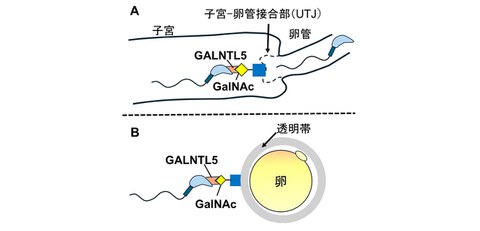
Associate Professor Taichi Noda and graduate student Reika Uriu of the Institute of Resource Development and Analysis (IRDA), Kumamoto University, in international collaborative research with Professor Masahito Ikawa of the Research Institute for Microbial Diseases, the University of Osaka, and Professor Martin M. Matzuk of Baylor College of Medicine, discovered that the mouse sperm protein GALNTL5 interacts with N-acetylgalactosamine (GalNAc) in the sugar chains present at the utero-tubal junction (UTJ) and on the surface of the zona pellucida, allowing sperm to migrate from the uterus to the oviduct and then bind to the zona pellucida (Fig. 2). The results of this research are expected to lead to the testing and diagnosing the causative genes for male infertility, and to be applied to the development of contraceptive drugs.
Fig. 1 The process of sperm to meet the egg in the body
Sperm ejaculated into the body pass through the utero-tubal junction (UTJ) and finally meet the egg at the ampulla of oviducts where fertilization occurs. Credit: Masahito Ikawa
Fig. 2 Overview of the results of this research
Through the interaction between GALNTL5 present on the sperm surface and N-acetylgalactosamine (GalNAc) in the sugar chains present in the UTJ and the zona pellucida, sperm can bind to and pass through the UTJ (A) and bind to the zona pellucida (B) Credit: Masahito Ikawa
Research Background
Sperm ejaculated into the body travel from the uterus to the oviducts, where they meet and fertilize the egg in the ampulla of oviducts (Fig. 1). It has been reported that the sperm of mice lacking (knockout; KO) approximately 30 genes that are expressed in male reproductive tissues such as the testes are unable to pass through the UTJ, despite having normal morphology and motility, and that KO male mice are almost always infertile.
However, the molecular mechanisms by which these factors are involved in sperm passage through the UTJ were not well understood. Furthermore, when KO sperm, which cannot pass the UTJ, were co-cultured with eggs, the sperm were unable to bind to the zona pellucida. These results suggest that there may be a common molecular mechanism for sperm passage through the UTJ and sperm binding to the zona pellucida.
Research Contents
The research group used the genome editing technology CRISPR/Cas9 to establish mice in which the glycosyltransferase-like gene Galntl5, which is highly expressed in the testis, was knocked out (KO). Galntl5 KO male mice were nearly infertile, although sperm morphology and motility were normal. Therefore, the researchers fluorescently labeled sperm from Galntl5 KO male mice with red color and observed the behavior of live sperm through the uterine wall in the female reproductive tract after mating. As a result, although Galntl5 KO sperm were present in sufficient numbers in the uterus, they were rarely present in the oviducts (Fig. 3A). Furthermore, when they focused on the UTJ, it was found that Galntl5 KO sperm hardly bound to the UTJ compared to control sperm (normal sperm) (Fig. 3B).
Fig. 3 Expression analysis of Galntl5 KO sperm
The research group observed the behavior of red and green fluorescently labeled control sperm and Galntl5 KO sperm in the female reproductive tract. Galntl5 KO sperm were present in the uterus but were barely observed in the oviducts (A). Then, when the researchers looked at the UTJ, they found that Galntl5 KO sperm were barely able to bind to the UTJ compared to control sperm (B). Furthermore, Galntl5 KO sperm were barely able to bind to the zona pellucida (C). The figure has been quoted and modified from this research paper.
From the consideration above, it was found that Galntl5 KO sperm cannot bind to the UTJ, and as a result, they cannot migrate to the oviducts and meet the egg, and therefore Galntl5 KO male mice are almost infertile. Furthermore, when eggs from which cumulus cells had been removed were co-cultured in vitro with Galntl5 KO sperm, the KO sperm were unable to bind to the zona pellucida (Fig. 3C).
As mentioned in the Research Background section, when approximately 30 genes expressed in male reproductive tissues are individually knocked out, KO sperm show defects in UTJ passage and zona pellucida binding. In most of these KO sperm, the sperm membrane protein ADAM3 is lost. On the other hand, sperm membrane protein Lypd4 KO sperm showed failure to pass the UTJ or bind to the zona pellucida, despite retaining ADAM3. Thus, it was suggested that there are ADAM3-dependent and ADAM3-independent pathways for sperm to pass through the UTJ and bind to the zona pellucida. Therefore, the research group examined the abundance of known UTJ-associated factors (such as the sperm membrane proteins ADAM3 and LYPD4) in Galntl5 KO sperm and found no significant difference compared to control sperm (Fig. 4A). On the other hand, GALNTL5 was almost completely absent in Adam3- or Lypd4-KO sperm (Fig. 4B). These results indicate that GALNTL5 is a downstream factor commonly required for both the ADAM3-dependent and ADAM3-independent pathways.
Credit: Masahito Ikawa
Fig. 4 Detection of UTJ-related factors in KO sperm
ADAM3-dependent and ADAM3-independent pathways exist for sperm to pass the UTJ and bind to the zona pellucida. The research group therefore examined the sperm proteins ADAM3 and LYPD4, which are required for those pathways, but found no significant difference in abundance between control sperm and Galntl5 KO sperm (A). On the other hand, GALNTL5 was almost completely absent in Adam3 KO and Lypd4 KO sperm (B, yellow arrows). These results indicate that GALNTL5 is a downstream factor commonly required for both ADAM3-dependent and -independent pathways. The figure has been quoted and modified from this research paper.
To clarify how GALNTL5 is involved in sperm UTJ binding and passage and zona pellucida binding, the research group focused on the glycosyltransferase domain present in GALNTL5. They used sugar-chained lectins to examine whether GALNTL5 loss altered the sugar chain pattern in sperm, but found no significant differences between control and Galntl5 KO sperm. Meanwhile, biochemical techniques have revealed that mouse and human GALNTL5 binds to N-acetylgalactosamine (GalNAc), a type of monosaccharide, using this glycosyltransferase domain (Fig. 5).
Credit: Masahito Ikawa
Fig. 5 Binding of GALNTL5 to N-acetylgalactosamine (GalNAc)
A protein such as a lectin is placed in a column equipped with GalNAc-binding beads. During the column washing process, most proteins other than those trapped on the beads are removed. Then, by adding an inhibiting sugar (GalNAc), the trapped proteins can be extracted by competitive inhibition (A). When the GALNTL5 synthetic protein was loaded in a column equipped with GalNAc-binding beads, GALNTL5 was detectable in the extract (B). The figure has been quoted and modified from this research paper.
Furthermore, immunofluorescence using a GalNAc-binding lectin revealed the presence of GalNAc-modified proteins on the surface of epithelial cells in the UTJ and the zona pellucida. They have also found that blocking GalNAc present in the UTJ and zona pellucida reduced the number of sperm binding to the UTJ and zona pellucida (Fig. 6). The researchers found that GALNTL5 interacts with GalNAc present in the UTJ and the zona pellucida, and allows sperm to bind to and pass through the UTJ and bind to the zona pellucida.
Credit: Masahito Ikawa
Fig. 6 Blocking GalNAc in the UTJ and zona pellucida reduces sperm binding
GalNAc present in the UTJ and zona pellucida was blocked using DBA lectin, which specifically binds to GalNAc, and then co-cultured with sperm. As a result, fewer sperm were able to bind to the UTJ (top photos) and the zona pellucida (bottom photos). The figure has been quoted and modified from this research paper.
Future Developments
In Japan, approximately one in 4.4 couples have undergone infertility testing or treatment, and approximately half of infertility cases are said to be caused by men. Although reports vary, the cause of male infertility is unknown in 40 to 50 % of cases. In order to solve this problem, elucidating the molecular mechanism by which sperm fertilize in the body is expected. GALNTL5, which was focused on this study, is also found in humans, and this study revealed that human GALNTL5 also can bind to GalNAc. Thus, the research group believe that the sperm UTJ binding and passage and zona pellucida binding mediated by the GALNTL5-GalNAc bond observed in this study are conserved in many animal species, including humans.
Several mutations have already been found in the human GALNTL5 genomic DNA sequence, including missense mutations that result in amino acid changes. Further detailed analysis of the correlation between these mutations and male infertility may lead to the possibility that GALNTL5 may become a new target for diagnosis and testing as a causative gene for male infertility. Furthermore, based on the results of this research, which show that sperm bind to GalNAc at the UTJ, allowing them to travel to the oviducts and fertilize, it is expected that this will lead to the development of contraceptives and other drugs.
Notes
The article, “GALNTL5 binds GalNAc and is required for migration through the uterotubal junction and sperm-zona pellucida binding,” was published in Nature Communications at DOI: 10.1038/s41467-025-63805-4.
