About this research

ISHITANI Tohru
- Research Institute for Microbial Diseases
- Professor

Identified CDK9 variants, the causative genes of retinal dystrophy which influence the development of multiple-malformation syndrome
- The researchers demonstrated that CDK9 variants are the novel cause of multiple-malformation syndrome.
- In addition to multiple-malformation syndrome involving the eyes, this syndrome may or may not have CHARGE syndrome-like feature.
- It has been revealed that the occurrence of CHARGE syndrome-like feature depends on the degree of reduction in the kinase activity of CDK9 variants.
Outlines
A research group including Sachiko Nishina, the Department head of Ophthalmology, the ophthalmologist Tomoyo Yoshida, Deputy Director Maki Fukami, Vice Director Kenji Kurosawa of National Center for Child Health and Development (located in Okura, Setagaya-ku, Tokyo; President: Takashi Igarashi), Assistant Professor Kaoruko Torii of the Department of Ophthalmology, Professor Hirotomo Saitsu, Department of Biochemistry, Professor Yoshihiro Hotta, Department of Ophthalmology (at the time of the research, now Professor Emeritus), of Hamamatsu University Hospital, Specially Appointed Assistant Professor Shizuka Ishitani and Professor Tohru Ishitani of the Research Institute for Microbial Diseases at the University of Osaka, and Professor Kenjiro Kosaki of the Keio University School of Medicine, worked to identify the causative genes of retinal dystrophy with CHARGE syndrome-like feature, and retinal dystrophy without multiple-malformation syndrome, and to elucidate their characteristics.
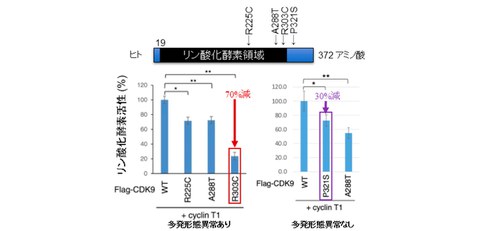
As a result, they found that both cases may be caused by CDK9 variants, which encodes a kinase essential for regulating gene expression. They also found that the degree of reduction in CDK9 kinase activity determines whether or not multiple-malformation syndrome develop. They found that variants in which the kinase activities of CDK9 are reduced by approximately 70% compared to normal CDK9 are associated with the development of multiple-malformation syndrome, while variants in which the activities are reduced by only approximately 30% are not associated with the development of multiple-malformation syndrome. This result will be an important research achievement in deepening understanding of CDK9-related diseases.
Fig. 1 Phosphorylating ability of CDK9 variants and pathological status
Credt: Tohru Ishitani
Fig. 2 Reduction in kinase activity
Credt: Tohru Ishitani
Research Background
Among serious eye diseases in infants and young children, there are some, such as congenital cataracts and congenital glaucoma, that can lead to the development of good visual function if detected and operated on early. On the other hand, there are still incurable diseases for which no treatment has been established, such as early-onset severe retinal dystrophy (EOSRD), which develops before the age of one, and the early-onset severe retinal dystrophy, which develops between the ages of two and six. These are a group of diseases that cause extremely serious, progressive visual impairment in children, and elucidating their pathogenesis is a challenge. Some established treatments can be expected to increase retinal sensitivity if administered during childhood, but only a small percentage of patients are suitable for treatment. The researchers are continuing their research aimed at developing early diagnosis and gene therapy for retinal dystrophies and other intractable visual diseases that occur in infancy, and this research is part of that effort.
Research Contents
Genomic DNA was extracted from the peripheral blood of the patient and his parents, and the causative gene was identified by whole-exome sequencing of the three. Additionally, the detected genetic variants were validated by Sanger sequencing. The CDK9 A288T/R303C variant was identified in a retinal dystrophy with multiple morphological abnormalities with CHARGE syndrome-like feature (first report).
On the other hand, the CDK9 A288T/P321S variant was identified in a retinal dystrophy without multiple-malformation syndrome (second report). Compared to normal CDK9 kinase activity, the A288T/R303C variant reduced the activity by approximately 70%, and the A288T/P321S variant reduced the activity by approximately 30%. In other words, it was suggested that the presence or absence of multiple-malformation syndrome with CHARGE syndrome-like feature is determined depending on the degree of reduction in kinase activity (Second report).
Notes
The article, “Biallelic CDK9 variants as a cause of a new multiple-malformation syndrome with retinal dystrophy mimicking the CHARGE syndrome,” was published in Journal of Human Genetics at DOI: 10.1038/s10038-021-00909-x.
The article, “Novel biallelic CDK9 variants are associated with retinal dystrophy without CHARGE-like malformation syndrome,” was published in Journal of Human Genetics at DOI: 10.1038/s10038-025-01395-1.
