About this research

OTANI Tomohiro
- Graduate School of Engineering Science
- Associate Professor

Can MRI directly measure fluid flow in the brain?
Development of new theories through the fusion of MRI and fluid engineering
- Established a new theoretical framework that enables direct estimation of fluid flow in the brain using MRI.
- It has been difficult to accurately quantify slow flows such as liquid in the brain by using conventional measurement methods. However, by reconstructing MRI signal theory from the viewpoint of fluid engineering, it has become possible to extract flow information contained in MRI signals.
- This research result is expected to help elucidate the cerebrospinal fluid flow and the brain's waste excretion system and may lead to the development of new diagnostic methods for dementia and neurological disorders in the future.
Outlines
A research group consisting of Associate Professor Tomohiro Otani and Professor Shigeo Wada of the Graduate School of Engineering Science, the University of Osaka, Specially Appointed Lecturer Yoshitaka Bito of Hokkaido University, Associate Professor Shigeki Yamada of Nagoya City University, and Professor Yoshiyuki Watanabe of Shiga University of Medical Science has succeeded in establishing a general-purpose theory for quantitatively estimating fluid flow within the skull and brain, such as cerebrospinal fluid, from MRI.
Conventional flow measurements by using MRI have made it difficult to quantify slow flows such as those of cerebrospinal fluid. Therefore, diffusion-weighted imaging (DWI) MRI, a method for measuring the diffusion of water molecules, has been applied to indirectly evaluate the flow using the apparent diffusion coefficient. It has been attempted previously to extract flow information from the apparent diffusion coefficient, but most have been limited to assumptions under specific conditions, and there is no generally applicable theory, making it difficult to quantify the measured information.
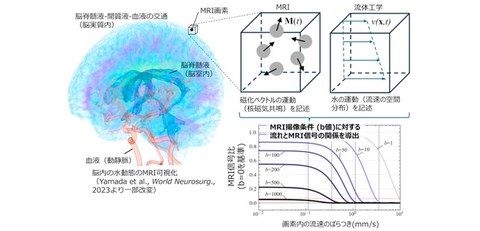
The research group reconsidered the formation of MRI signals based on fluid engineering and nuclear magnetic resonance (NMR) equations, which explain the properties of flow fields. The researchers demonstrated that the apparent diffusion coefficient corresponds to the variation in flow velocity distribution and succeeded in elucidating the flow information inherent in MRI signals. This result is expected to contribute to the elucidation of the movement of fluid within the brain, i.e., the flow of cerebrospinal fluid and the waste removal system, as well as the development of new diagnostic and therapeutic methods.
Fig. 1 Extraction of slow flow velocity distribution from MRI (conceptual diagram)
Credit: Tomohiro Otani
Research Background
The brain and its surroundings are filled with a clear, colorless liquid called cerebrospinal fluid whose flow is thought to play an important role in the removal of waste products from the brain. MRI is the only technology that can non-invasively measure three-dimensional fluid flow within the body, and a lot of research have attempted to measure cerebrospinal fluid flow. However, since its flow is slow, there are limits to the detection accuracy of conventional MRI flow measurements. Therefore, the researchers have applied diffusion-weighted MRI, which measures the molecular diffusion of water, and conducted evaluation by replacing it with the apparent diffusion coefficient. Attempts have been made previously to understand flow information from the apparent diffusion coefficient, but most of them assumed specific conditions, and there was no theory that could be generally applied, posing a major challenge to the quantitation of measurement data.
Research Contents
From the perspective of fluid engineering, which explains the properties of flow fields, the research group unraveled the structure of MRI signals by going back to the equations of nuclear magnetic resonance and theoretically identified that the apparent diffusion coefficient corresponds to the variation in the flow velocity distribution within the pixels that make up the MRI image. In particular, when measuring slow flows, the research group succeeded in elucidating the flow information inherent in MRI signals.
Social Impact of the Research
The results of this research provide a theoretical path to directly estimating slow water flow from MRI signals, which has been difficult to achieve until now. It is expected to provide a more accurate understanding of the flow of cerebrospinal fluid and how the brain removes waste products. In the future, this could lead to the early detection of dementia and neurological diseases and the development of new diagnostic and treatment methods.
Notes
The article, “A theoretical interpretation of diffusion weighted and intravoxel incoherent motion imaging for cerebrospinal fluid flow,” was published in Magnetic Resonance in Medicine (online) at DOI: https://doi.org/10.1002/mrm.70062.