

Topological superconductors that switch the magnetic flux quantum to a half-integer
Paving the way for new quantum computing devices
- It is discovered that magnetic flux quanta trapped within the ring switch from integers to half-integers (e.g., 1.5, 2.5, etc.) as the magnetic field is increased in a superconducting thin-film ring made of layered semimetal bismuth and ferromagnetic metal nickel,
- Superconducting quantum computers use superconductors with an isotropic superconducting gap, but superconductors with an anisotropic superconducting gap or topological superconductors have never been used.
- Comparison with theoretical calculations clarified that the behavior in which the magnetic flux quantum switches from integer to half-integer is a new phenomenon that occurs when the superconducting gap is anisotropic and spin-orbit interaction is at work, suggesting that the bismuth and nickel thin film are topological superconductors.
- The ability to change the number of magnetic flux quanta trapped within the ring from an integer to a half-integer number using a slight external magnetic field is expected to be applied to superconducting quantum computers in the future.
Outlines
A research group including Professor Yasuhiro Niimi of the Department of Physics, Graduate School of Science, the University of Osaka, in collaboration with Assistant Professor Kazushi Aoyama of the Department of Earth and Space Sciences, Graduate School of Science, the University of Osaka, Associate Professor Takeshi Mizushima of the Department of Materials Engineering Science, Graduate School of Engineering Science, the University of Osaka, Professor Junichiro Ohe of the Department of Physics, Faculty of Science, Toho University, Professor Teruo Ono of the Institute for Chemical Research, Kyoto University, Professor Xiaofeng Jin of Fudan University in China, and Professor Kensuke Kobayashi of the Department of Physics, Graduate School of Science, the University of Tokyo, has discovered a phenomenon in which the magnetic flux quantum trapped within a superconducting thin-film ring made of layered semimetal bismuth, which has strong spin-orbit interaction, and the ferromagnetic metal nickel, switches from a normal integer to a half-integer (e.g., 1.5, 2.5, etc.). This result suggests that the bismuth and nickel thin films are topological superconductors.
Topological superconductors are essential materials for realizing Majorana quasiparticles, which are attracting attention in the field of quantum information science. They have great potential to create the next-generation quantum computers as quantum bits that are highly resistant to environmental noise. Current superconducting quantum computers mainly use spin-singlet-wave superconductors with an isotropic superconducting gap, but those with an anisotropic superconducting gap or topological superconductors have not yet been used.
The research group passed an electric current through the superconducting thin-film ring they had created and swept the magnetic field penetrating the ring. Then they observed magnetic flux quanta changing from integer to half-integer at the boundary of a certain magnetic field. This phenomenon is a new physical phenomenon that arises from the combination of the anisotropy of the superconducting gap and spin-orbit interaction, suggesting that this thin film is a topological superconductor.
The ability to change the number of magnetic flux quanta trapped within the ring from an integer to a half-integer number using a slight external magnetic field is expected to be applied to superconducting quantum computers in the future.
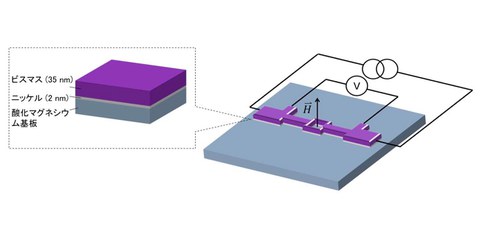
Fig. 1 (Left) A diagram of two-layerd thin film of ferromagnetic metal nickel (2 nm) and semimetallic bismuth (35 nm) grown on a magnesium oxide substrate
(Right) A diagram of the thin film ring device
H→ is the applied external magnetic field
Credit: Yasuhiro Niimi
Research Background
In recent years, quantum computers based on superconductors have been actively researched. Such superconducting quantum computers mainly use spin-singlet -wave superconductors, such as niobium and aluminum, in which the superconducting gap is isotopically opened. However, superconductors with anisotropic superconducting gaps or topological properties have not yet been used.
Topological superconductors have attracted attention in recent years as a stage for realizing Majorana quasiparticles which are quantum bits that are highly resistant to environmental noise, so it is highly expected to realize quantum computers that utilize Majorana quasiparticles. With the advancement of superconducting quantum computers, research is being conducted worldwide to increase the number of qubits, as well as to search for topological superconductors that realize Majorana quasiparticles that are highly resistant to environmental noise.
The research group therefore focused on a two-layered thin film made of semimetallic bismuth and ferromagnetic metal nickel grown on a magnesium oxide substrate. Previous research has clarified that this two-layered thin film transitions to superconductivity at around 4 K (-269°C) and that the nickel's magnetism is maintained even after the superconducting transition, making it a promising candidate for a topological superconductor.
Research Contents
The research group processed a two-layered thin film of bismuth and nickel grown on a magnesium oxide substrate into a ring shape with a radius of about 1 μm. They then swept the magnetic field H penetrating the ring while applying an electric current small enough to prevent the superconductivity from being completely destroyed. In the small magnetic field range, the resistance oscillates with the period of the magnetic field H0 when one magnetic flux quantum enters the ring, and when an integer number of flux quanta enters, the resistance reaches a minimum value.
When a magnetic field is applied so that seven to eight magnetic flux quanta are within the ring (H = 7 to 8H₀), the resistance oscillation disappears. When a further magnetic field is applied, not only does the resistance oscillation return, but the resistance minimum shifts to a point where half-integer number of magnetic flux quanta enters within the ring (Fig. 2). This means that the magnetic flux quantum switches from an integer to a half-integer depending on the magnetic field region. Such switching of magnetic flux quanta is a phenomenon unique to the two-layered thin film of bismuth and nickel, and was not observed when using a simple niobium ring or a two-layered thin film ring of niobium and nickel. Comparing these results with theoretical calculations, the researchers found that the two-layered thin film of bismuth and nickel is a chiral p-wave superconductor, a type of topological superconductor, and that integer-to-half-integer switching of the magnetic flux quantum occurs only when spin-orbit interaction is present.
Fig. 2 Resistance oscillations observed in the ring in Fig. 1. When the external magnetic field H is small, the minimum resistance value is an integer multiple of H/H0 (black dotted line), but when there are seven to eight magnetic flux quanta inside the ring (arrows in the figure), the minimum resistance value changes to a half-integer multiple (red dotted line). The measurement was performed at 2.47 K, approximately 0.6 times the superconducting transition temperature.
Credit: Yasuhiro Niimi
Social Impact of the Research
This research not only demonstrated that a two-layered thin film of semimetallic bismuth and ferromagnetic metal nickel is a chiral p-wave superconductor, a type of topological superconductor, but also suggests that the use of two-layered thin films of bismuth and nickel may add new functions in research on superconducting quantum computers.
Notes
The article, “Observation of the crossover from quantum fluxoid to half-quantum fluxoid in a chiral superconducting device,” was published in American scientific journal of Science Advances (online) at DOI: https://doi.org/10.1126/sciadv.adw6625