About this research

KISU Takayuki
- Graduate School of Engineering Science
- Associate Professor

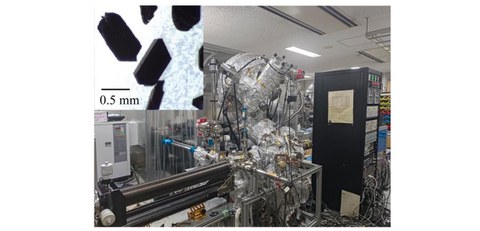
The electronic state of molecular conductors is captured by laser-based photoemission spectroscopy (PES)!
New technology to develop next-generation physical device material design
- Direct observation of superconducting gap using photoemission spectroscopy (PES) was achieved for the first time in a molecular conductor that can be applied to the development of next-generation materials.
- By developing a photoelectron spectrometer that uses a low-energy laser as excitation light, it has become possible to observe molecular superconductors by PES, which was previously impossible due to causes such as radiation damage by the excitation light.
- This is expected to accelerate research into the electronic properties of molecular conductors and lead to the development of device materials with novel properties.
Outlines
A research group including Associate Professor Takayuki Kisu, Koki Mizukami (doctor course), and Professor Akira Sekiyama of the Graduate School of Engineering Science at the University of Osaka, in collaboration with Professor Shintaro Ishiwata of the same graduate school, Assistant Professor Kazuya Miyagawa of the Graduate School of Engineering at the University of Tokyo, and Project Researcher Kazushi Kanoda of the Graduate School of Frontier Sciences at the same university, has succeeded for the first time in the world in directly capturing electrons in the superconducting state of a molecular conductor using photoelectron spectroscopy (PES).
Until now, research into the electronic structure of molecular conductors using PES, which allows direct observation of the electronic state, has been rarely conducted due to the large radiation damage caused by excitation light. In this study, the research group developed a photoelectron spectrometer that uses a low-energy laser as excitation light and succeeded in clearly observing the superconducting gap in a molecular conductor. This method will enable direct insight into the electronic structure of molecular conductors, which is expected to accelerate research into the development of device materials with novel properties, using molecular conductors, with the aim of realizing Society 5.0.
Fig. 1 A laser-based photoelectron spectrometer set at the Graduate School of Engineering Science, the University of Osaka. The upper left shows a single crystal of the molecular superconductor κ-(BEDT-TTF)2Cu(NCS)2 measured in this study
Credit: Takayuki Kisu
Research Background
Photoemission spectroscopy (PES) is an experimental technique that can directly observe the occupied electronic states in a material by irradiating the material with light and measuring the energy of electrons emitted into a vacuum by the external photoelectric effect. It is used to observe the electronic states of various materials.
There are few examples of research using PES on molecular conductors, and even in the few examples on metallic materials that have been reported, the characteristic electronic states that appear in metals were not observed, raising doubts about whether the results were fundamental. In addition, PES of molecular conductors is known to cause changes in the electronic structure due to radiation damage caused by excitation light. Depending on the energy of the excitation light, degradation may occur immediately after irradiation, and there are also significant difficulties in cooling the sample and preparing the surface, so PES of molecular conductors is generally recognized as extremely difficult.
Nevertheless, direct observation of the electronic state of molecular conductors by PES is essential for understanding the various physical properties created by electrons and for developing new device materials through their application. Therefore, there was great expectation that PES could be used to obtain the correct electronic state of molecular conductors.
Research Contents
The research group developed a photoelectron spectrometer suitable for studying molecular conductors, using a 6-eV-laser as excitation light, which causes minimal radiation damage, and performed surface treatment based on an appropriate cooling process and accumulated knowledge. By doing so, they succeeded for the first time in directly observing the Fermi edge in the normal state and the superconducting gap in the superconducting state of the molecular superconductor κ-(BEDT-TTF)2Cu(NCS)2. Furthermore, numerical analysis showed that the superconducting gap of this material has d-wave symmetry similar to that of copper oxide high-temperature superconductors. This success in "observing the superconducting gap of a molecular conductor using PES," which was previously impossible, indicates that PES will play an important role in future research into molecular conductors.
Social Impact of the Research
The results of this research have made it possible to directly determine the electronic state of molecular conductors using PES, which is expected to accelerate research into the electronic properties of molecular conductors. Furthermore, this will lead to applications in the development of next-generation materials using molecular conductors, contributing to realize a sustainable society.
Notes
The article, “Direct Observation of a Superconducting Electron Structure of k-(BEDT-TTF)₂Cu(NCS)₂ by Photoemission Spectroscopy Using a 6-eV-Laser,” was published in Japanese Scientific Journal of Journal of the Physical Society of Japan (JPSJ) at DOI: https://doi.org/10.7566/JPSJ.94.073701.