About this research

MIZUGUCHI Hiroyuki
- Graduate School of Pharmaceutical Sciences
- Professor

Elucidated the mechanism of antitumor effects of a new adenovirus that kills cancer cells
Lead to development of new OAd35-based drugs against intractable cancers
- The mechanism of antitumor effects of oncolytic adenovirus (OAds) serotype 35 is partially elucidated through immunological analysis.
- Conventional OAds are based on human Ad serotype 5 (OAd5), however most adults already have antibodies against OAd5, which may weaken the effectiveness of medical treatment, and highly malignant cancer cells have low expression of OAd5 receptors, making them unable to infect efficiently.
- In addition to the conventional antitumor mechanism of oncolytic viruses, that is to kill cancer cells by replicating within the cells, the researchers found that OAd35 exerts an antitumor effect by strongly activating NK (natural killer) cells and CD8+ T cells, which are important in cancer immunity.
- Due to its unique mechanism, it is expected to be utilized as a new anticancer drug that is effective against cancer types that have been considered intractable.
Outlines
A research group led by Professor Hiroyuki Mizuguchi, Graduate School of Pharmaceutical Sciences of the University of Osaka, and Guest Professor Fuminori Sakurai (Professor, Faculty of Pharmacy, Kindai University) has revealed that oncolytic adenovirus (OAds) serotype 35, which kills cancer cells, also exerts an anti-tumor effect by strongly activating immune cells that attack cancer cells.
The OAd35 developed by the research group in 2021 shows the same or greater cytotoxicity against various cancer cells compared to the conventional OAd5, and it is not inhibited by anti-type 5 Ad antibodies that many adults possess. In addition to the conventional antitumor mechanism of oncolytic viruses, in which the virus proliferates within cancer cells and kills them, the researchers have now elucidated part of the mechanism of the antitumor effect of OAd35, which is to strongly activate NK cells and CD8+ T cells, which play an important role in cancer immunity.
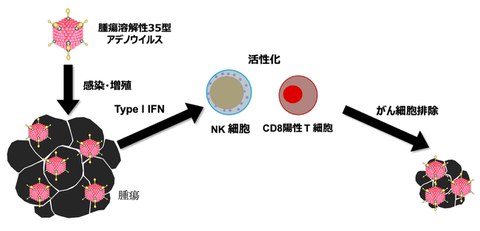
Furthermore, the researchers demonstrated that the antitumor effect of OAd35 is dependent on the type-I IFN signal, which is a key to antiviral responses (Fig. 1).
Fig.1 Overview of this research
Credit: Hiroyuki Mizuguchi
Research Background
Oncolytic viruses, which specifically infect and kill cancer cells, are attracting considerable attention as new anticancer drugs. In particular, Ad-based oncolytic viruses are actively being developed in clinical trials due to their excellent antitumor effects. Conventional OAds are based on OAd5, which belongs to group C, one of over 100 types of human Ad serotypes. However, many adults already have anti-type 5 Ad antibodies, so the effectiveness of medical treatment may be weakened by these pre-existing antibodies. Furthermore, the coxsackievirus-adenovirus receptor (CAR) for OAd5 is expressed at low levels in highly malignant cancer cells, meaning OAd5 cannot efficiently infect these cells.
On the other hand, for OAd35, which belongs to group B, the proportion of people who have antibodies to OAd35 is low at approximately 20% or less, so it is unlikely that existing antibodies will weaken the therapeutic effect. In addition, CD46, the infection receptor for OAd35, is expressed on almost all cells, and is known to be increasingly expressed particularly in highly malignant cancer cells.
Against this background, in 2021, Professor Mizuguchi and his team developed a new OAd based on OAd35 and demonstrated its effectiveness as an anticancer drug (Mol. Ther. Oncolytics, 20, 399-409, 2021).
Research Contents
In this research, the mechanism of antitumor effects of OAd35 is partially elucidated through immunological analysis. In addition to the conventional antitumor mechanism of oncolytic viruses, which is to kill cancer cells by replicating within the cells, the researchers found that OAd35 exerts an antitumor effect by strongly activating NK cells and CD8+ T cells, which are important in cancer immunity.
Furthermore, the researchers demonstrated that the antitumor effect of OAd35 is dependent on the type-I IFN signal, which is a key to antiviral responses (Fig. 1)
Social Impact of the Research
The OAd35 is expected to be a new anticancer drug that strongly activates cancer immunity, such as NK cells and CD8+ T cells, compared to OAd5.
Notes
The article, “Oncolytic adenovirus serotype 35 mediated tumor growth suppression via efficient activation of antitumor immunity,” was published in American scientific journal of Journal for ImmunoTherapy of Cancer (online) at DOI: https://doi.org/10.1136/jitc-2022-006558.
