

Lunar surface observations may solve the mystery of galactic cosmic rays
Next-generation MeV gamma-ray astronomy will be developed in new directions through collaboration with other fields
- By observing MeV (mega electron volt) gamma rays produced when galactic cosmic rays, the origin of which is still unknown, collide with material on the surface of the Moon, a new method has been introduced to indirectly measure the spectrum of MeV galactic cosmic rays, which have been extremely difficult to investigate until now.
- It has been impossible to directly observe MeV galactic cosmic rays near the Earth because they are easily affected by the solar magnetic field and geomagnetism.
- The spectrum of MeV gamma rays produced by nuclear reactions between lunar materials and galactic cosmic rays was theoretically calculated. The result showed that it will be possible to observe MeV galactic cosmic rays indirectly by using next-generation telescopes.
- It is expected that the origin and acceleration mechanism of galactic cosmic rays will be clarified, and observation of nuclear gamma rays specific to MeV gamma rays may lead to elucidation of the history of environmental changes in the solar system and galaxy. Furthermore, a better understanding of the radiation environment on the surface of the Moon may be applied to future lunar surface development and radiation protection design for astronauts.
Outlines
A research team led by Tatsuki Fujiwara (doctor course) and Associate Professor Yoshiyuki Inoue of the Graduate School of Science at the University of Osaka has demonstrated through theoretical calculations that observing the Moon using a next generation MeV gamma-ray telescope may measure previously unexplored spectrum of MeV galactic cosmic rays.
Even now, more than 100 years after their discovery, the origin of galactic cosmic rays remains unknown. In particular, the question of "how plasma in space is accelerated into galactic cosmic rays" is considered one of the greatest mysteries in cosmic ray research. The key to solving this problem is to clarify the properties of MeV galactic cosmic rays, which belong to the lowest energy band. However, MeV galactic cosmic rays are more susceptible to the influence of the solar magnetic field and geomagnetism than high-energy cosmic rays, and until now, direct observations near the Earth have not been conducted.
In this research, the researchers focused on the gamma-ray emission phenomenon that occurs when galactic cosmic rays collide with materials on the lunar surface in a nuclear reaction. By observing such gamma rays, the spectrum of the galactic cosmic rays that is the origin of the reaction can be learned indirectly. Conventional telescopes couldn’t capture the detailed MeV gamma rays that originate from nuclear reactions of low-energy cosmic rays on the surface of the Moon. Therefore, there has been little interest in using the Moon to observe MeV galactic cosmic rays. However, in this research, the researchers theoretically calculated the spectrum of MeV gamma rays produced by nuclear reactions between galactic cosmic rays and lunar materials and showed the possibility of observing them by using the next generation high-performance MeV gamma-ray telescopes. This study particularly demonstrated the possibility of investigating long-term variations in MeV galactic cosmic rays over a million-year scale by observing nuclear gamma rays specific to MeV gamma rays. This result presents a new method for indirectly observing MeV galactic cosmic rays from the Earth, and is expected to be a step toward elucidating the origin of galactic cosmic rays.
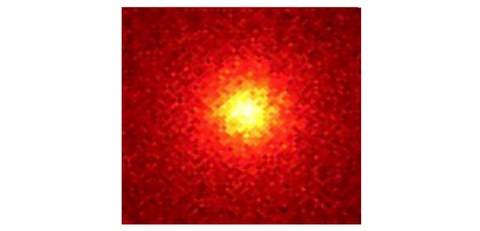
Fig. 1
The Moon seen in gamma rays (> 30 MeV). The yellower the image is, the brighter it is due to cosmic ray collisions
(Credit: Adapted from the original text of NASA/DOE/Fermi LAT Collaboration)
Research Background
So far, the MeV galactic cosmic ray spectrum has not been observable near the Earth. This is because MeV galactic cosmic rays are in the lowest energy range of cosmic rays, and these particles are greatly blocked from entering the heliosphere by the solar wind and the solar magnetic field as they travel from outside the solar system. Furthermore, even if it did reach to the Earth, it would be extremely difficult to make observations around the Earth because it would be blocked by geomagnetism.
On the other hand, there has been successful direct observation of the MeV galactic cosmic ray spectrum which was made by the Voyager spacecraft launched in 1977. It took more than 30 years for Voyager to reach the outer of the heliosphere, where it observed MeV galactic cosmic rays in an area unaffected by the solar magnetic field.
However, the MeV galactic cosmic ray spectrum obtained by Voyager does not match the MeV cosmic ray amount estimated from the degree of ionization of interstellar gas. In order to gain a deeper understanding of this phenomenon, new observations of MeV galactic cosmic rays were required.
Research Contents
In this study, the research group focused on the nuclear reactions that occur when galactic cosmic rays collide with lunar materials. This reaction produces gamma rays that are not affected by geomagnetism.
Fig. 1 shows an image of the Moon's gamma-ray emissions, captured by the Fermi Gamma-ray Space Telescope which are illuminated by nuclear reactions of galactic cosmic rays in the GeV range (=103 –105 MeV). Although the specific mechanism for producing gamma rays is different, a similar phenomenon occurs with MeV galactic cosmic rays. In other words, by examining the lunar gamma-ray spectrum, the underlying MeV galactic cosmic ray spectrum can be determined. The research group then theoretically calculated such gamma-ray spectrum of the Moon and demonstrated that MeV galactic cosmic rays can be measured through lunar observations in the future.
Fig. 2 shows the calculation results (horizontal axis: gamma ray energy, vertical axis: gamma ray amount). The black line indicates the gamma ray amount from all reactions combined, the other lines indicate the contribution of each gamma ray generation process, and the blue dots represent spectral data from the Fermi Gamma-ray Telescope. The calculation results (black line) based on a cosmic ray spectrum model that takes into account the effects of solar activity faithfully reproduce the entire observation data (blue dots), confirming the physical validity of the model. In the 0.1-10 MeV gamma-ray region, where the contribution of MeV galactic cosmic rays is important, in addition to the continuous spectral components, multiple clear peaks of nuclear gamma rays from different isotopes also appear. The conventional MeV gamma-ray telescopes could not detect lunar gamma rays. However, the results of this study show that by using the next-generation MeV gamma-ray telescope, which will be launched after 2027, it may be possible to observe both the continuum component and the nuclear gamma-ray component. Among these, the GRAMS mission led by the University of Osaka is promising to capture MeV gamma rays from the Moon. This theoretical calculation and comparison are expected to lead to a more accurate understanding of the MeV galactic cosmic ray spectrum.
Fig. 2
Theoretical model of the lunar MeV-GeV gamma-ray spectrum. The entire observational data (blue dots) is reproduced
Social Impact of the Research
The results of this research suggest that lunar MeV gamma rays may be used as a new means of observing MeV galactic cosmic rays. If it could observe nuclear gamma rays originating from radioactive isotopes, it might be possible to use the half-life of each isotope to explore how MeV galactic cosmic rays have changed over the past million years or so. This provides valuable information for understanding the history of the solar system and its nearby galactic environment. There is great expectation for future observations that will take advantage of the unique characteristics of the Moon, which has an abundance of a wider variety of elements than general outer space.
Furthermore, to understand the details of radiation environment on the surface of the Moon (including cosmic rays and gamma rays) will provide the scientific foundation for safely and sustainably promoting next-generation lunar exploration, such as the Artemis program. This research contributes to the scientific knowledge that supports such future exploration activities.
Notes
The article, “The Moon as a Cosmic-Ray Spectrometer: Prospects for MeV Gamma-Ray Observations,” was published in American scientific journal The Astrophysical Journal at DOI: https://doi.org/10.3847/1538-4357/add68b