About this research

NISHIMURA Takahiro
- Graduate School of Engineering
- Assistant Professor

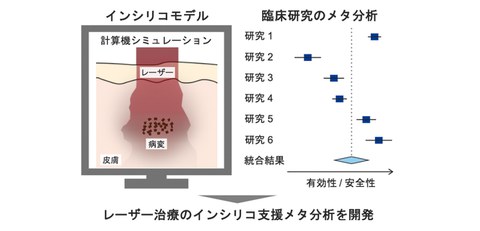
Comparing picosecond and nanosecond lasers by incorporating new laser irradiation conditions into the meta-analysis of birthmark treatment
- A new meta-analysis method has been developed to evaluate the effectiveness of treatment by determining the appropriateness of laser irradiation conditions, which hasn't been given much consideration in conventional meta-analyses until now.
- The researchers analyzed a laser treatment for nevus of Ota and demonstrated that picosecond lasers, under appropriate irradiation conditions, were more effective than conventional nanosecond lasers and equally safe.
- By using an index to determine the appropriate laser irradiation conditions, it is possible to provide effective and safe irradiation conditions for picosecond lasers.
Outlines
Nevus of Ota is a bluish-black birthmark that appears around the eyes and on the cheeks and is treated with laser irradiation. Meta-analysis, which integrates the results of multiple studies and objectively evaluates the effectiveness and safety of treatments, is essential for formulating treatment guidelines. Conventional meta-analyses did not consider the appropriateness of laser irradiation conditions, and therefore included treatment results in cases where irradiation was either too insufficient or too excessive, leaving a need for more accurate evaluations.
A research group including Postdoctoral Fellow Yu Shimojo, Specially Appointed Professor Toshiyuki Ozawa, Professor DaisukeTsuruta at Department of Dermatology, Graduate School of Medicine of Osaka Metropolitan University, Assistant Professor Takahiro Nishimura, Graduate School of Engineering of the University of Osaka, and Professor Taro Kono, Department of Plastic Surgery, School of Medicine of Tokai University, created an index for determining appropriate irradiation conditions calculated using a mathematical model on the calculator called an in-silico modeling, and developed an in-silico-supported meta-analysis that analyzes treatments within that index. When applied to the treatment of Nevus of Ota, the picosecond laser, under appropriate irradiation conditions, was found to be more effective than conventional nanosecond lasers and equally safe. It was also shown that by setting appropriate irradiation conditions, effective and safe picosecond laser irradiation conditions can be provided. The results of this study are expected to contribute to the standardization of laser treatment.
Research Background
In laser treatment, setting appropriate irradiation conditions is important for achieving high effectiveness, but conventional meta-analysis combined study results without considering the appropriateness of the irradiation conditions used in the treatment. In recent years, picosecond lasers have been increasingly applied in plastic surgery, dermatology, cosmetic dermatology, and cosmetic surgery. For such treatments where irradiation conditions have not yet been established, there is a possibility that meta-analysis may include results from studies using inappropriate irradiation conditions, which limits the reliability of the evaluation results.
Research Contents
In this study, the researchers developed an in-silico-supported meta-analysis that evaluates the appropriateness of irradiation conditions using an in-silico modeling of laser treatment and then performs a meta-analysis. First, the research group collected the results of studies reporting the effectiveness and complication rates after treating nevus of Ota with picosecond or nanosecond lasers. The researchers then introduced a new index called the Excessive Setting Index of Clinical Fluence (EICF) to determine whether the laser irradiation conditions were appropriate and analyzed only those research results in which the irradiation conditions used matched theoretical irradiation conditions. A comparison of picosecond and nanosecond lasers revealed that picosecond laser treatment, when used under appropriate irradiation conditions, exhibits higher efficacy and equivalent safety compared to conventional nanosecond laser treatment, making it the first choice for treating nevus of Ota (Fig. 1). Furthermore, it was shown that the EICF index can provide safe and effective irradiation conditions for picosecond lasers.
Fig. 1 The effect of a new meta-analysis considering the appropriateness of irradiation conditions
Conventional meta-analysis (above) found a slightly higher complication rate with picosecond lasers. In this study, the researchers introduced the EICF index to determine the appropriateness of irradiation conditions in an in-silico model and conducted an in-silico-supported meta-analysis (below) that included only studies with appropriate conditions. The results showed that the picosecond laser had an increased efficacy (0.83 → 0.91) and a decreased complication rate (0.18 → 0.12), comparable to that of the nanosecond laser (laser wavelength 755 nm).
Expected Achievements
This result provides scientific evidence from the perspective of irradiation conditions to answer questions such as "Why did picosecond laser treatment work?" and "Why did side effects occur?" Although further verification is needed, utilizing the EICF index will enable the selection of safer and more effective laser irradiation conditions.
Furthermore, the in-silico-supported meta-analysis proposed in this study provides a new method for more accurately integrating and interpreting the results of clinical studies using lasers, and provides a foundation for improving the quality of clinical practice guidelines. This meta-analysis method may also be applicable to the evaluation of treatments using other energy devices, such as ultrasound and radiofrequency, and is expected to contribute to the development of in-silico medicine, which uses mathematical and information science to improve the interpretation of clinical data.
Notes
The article, “Association between irradiation parameters and outcomes for picosecond laser treatment of nevus of Ota: An in-silico-supported meta-analysis” was published in JAAD Reviews at DOI: https://doi.org/10.1016/j.jdrv.2025.06.001.
