About this research
With the support of the Moonshot Research and Development Program, and Adopting Sustainable Partnerships for Innovative Research Ecosystem (ASPIRE), I worked on several research themes at Oxford University for one year. The results are the culmination of the technology and knowledge I have steadily accumulated by working with experimental equipment every day. I hope to bring these experiences and lessons back to Japan and contribute to the further development of trapped-ion quantum computers.

MIYANISHI Koichiro
- Center for Quantum Information and Quantum Biology
- Associate Professor (Lecturer)

Achieved the lowest error rate ever in single-qubit operations
Toward the realization of smaller, more economical, and more efficient quantum computers!
Key Findings
- For single-qubit operations required for quantum computers, the research group achieved the lowest error rate ever recorded: 0.000015% (one error in 6.7 million operations).
- In order to realize a practical quantum computer, it is necessary to control qubits stably and precisely.
- This time, the error rate was significantly reduced by using ⁴³Ca+ ions, which have a long-lifetime quantum state, and extremely stable and highly controllable microwaves.
- It is expected that controlling qubits with a low error probability will lead to smaller, less expensive quantum computers.
Outlines
Lecturer Koichiro Miyanishi of the Center for Quantum Information and Quantum Biology at The University of Osaka participated in a research group led by Professor David M. Lucas of the University of Oxford, which achieved a new world record for the precision of controlling single-qubit, achieving the lowest error rate ever: 0.000015% (one error in 6.7 million operations).
In order to perform useful calculations on a quantum computer, millions of operations must be performed across a large number of qubits. This means that if the error rate of qubit operations is high, the calculation results will be meaningless. Errors can be corrected by using quantum error correction, but this requires many more qubits. Therefore, reducing the error rate of qubits operations to the utmost is a critical issue that directly affects the scale, cost, and performance of quantum computers.
In this study, the research group has achieved this high-precision single-qubit control by using calcium ions (⁴³Ca+ ions), which have a long-lived quantum state trapped by an RF electric field, and microwave control.
It is expected that this achievement will lead to progress towards the realization of trapped-ion type error-tolerant quantum computers.
The result of this research was published in the American physics journal Physical Review Letters on Thursday, June 12th.
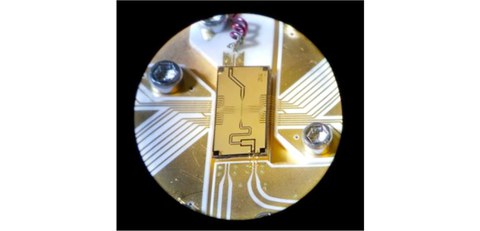
Fig. 1
The ion trap chip used in this study. The RF trapping field and the microwave control field are applied from both above and below.
Research Background
Research and development into quantum computers are underway around the world as a next-generation information processing technology that will be able to quickly solve problems with computational volumes that conventional computers cannot process.
In order to perform practical quantum calculations on a quantum computer, millions of operations must be performed with high precision on a large number of qubits. Therefore, even a small error can be fatal and ruin the entire calculation. To correct such errors, there is a technique called quantum error correction. However, this method requires a huge number of qubits depending on the error rate, which is a bottleneck in expanding the scale and improving the performance of quantum computers.
Therefore, minimizing the error rate of basic qubits operations is a major challenge that directly affects the scale, cost, and performance of quantum computers.
Research Contents
This study was performed by using a single ⁴³Ca+ ion in a trapped ion. The hyperfine structure level in ⁴³Ca+ ions is less susceptible to changes in the environment and can maintain a quantum state for a very long time. In addition, while conventional approaches use lasers to control the quantum state, in this study, the qubits were operated using microwaves, which are much more stable and less expensive to implement than lasers. The experiment was conducted at room temperature and without magnetic shielding, simplifying the technical requirements necessary for a quantum computer. The best error rate for a single qubit was achieved by the team at the University of Oxford in 2014 (T. P. Harty, et al. PRL 2014), which was 0.0001% (one error in one million operations). However, this time the research group has realized a qubit gate with an error rate about one order of magnitude lower: 0.000015% (one error in 6.7 million operations).
Although the result achieved in this research is a major milestone, it is only a step towards a practical quantum computer. Quantum computers require both one-qubit and two-qubit gates that operate with low error probability. Currently, the error rate of two-qubit gates is still high, with even the highest error rate being approximately one error in 2,000 operations, so further reducing this rate is key to realizing a computer with quantum error correction.
Social Impact of this Research Result
The result of this research shows a possibility of significantly reducing the number of qubits required for quantum error correction. This is expected to lead to size minimization, cost reduction, and higher efficiency of large-scale quantum computers. In addition, since the result can be applied to quantum technologies other than quantum computers, such as quantum communication and quantum sensing, it is expected to contribute widely to next-generation quantum technologies as a whole.
Notes
The article, “Single-qubit gates with errors at the 10-7 level ,” was published in American science magazine, Physical Review Letters at DOI: https://doi.org/10.1103/42w2-6ccy
Links
Technical Glossary
- Quantum computer
A computer that performs calculations using quantum mechanical phenomena that atoms and electrons follow. Algorithms have been proposed that use quantum computers to quickly solve problems that are thought to be difficult to handle by using conventional computers, such as simulations of the electronic state in materials and prime factorization. Toward the realization, research is being conducted using various methods, including superconductivity, neutral atoms, and light.
- Qubits
A basic information unit in a quantum computer. It has a property of being able to simultaneously have the states 0 and 1 (superposition state) that is unique to quantum mechanics.
- Quantum error correction
A method that detects and corrects errors by combining multiple qubits to form a single qubit, in order to ensure correct calculation results.
- Ion trap
A method or device to capture ionized atoms in a vacuum by using an electric or magnetic field. By using multiple ions trapped in a vacuum as qubits, the quantum operations required for quantum computers are possible.
- Hyperfine structure levels
An energy level arises from the interaction between the nucleus and electrons within atomic energy levels.
