

Louis Pasteur would have been amazed!? Suggests the possibility of controlling chiral crystallization using nano-optical tweezers that can distinguish left and right
Key Findings
- It was suggested that the chiral selective optical force generated by the excitation of a chiral optical field on a dielectric metasurface may affect the nucleation of chiral crystals.
- This result shows the possibility of sorting chiral nanocrystals using optical tweezers, like the chiral crystal sorting method using tweezers used by a French bacteriologist Louis Pasteur to create chirality.
Outlines
Chirality, the property in which two mirror images of different structures differ like the relationship between right and left hands, is ubiquitous in nature and is an important property that is also related to the origin of life, drug creation, and spintronics.
A research group led by Assistant Professor Hiromasa Niinomi and Professor Masaru Nakagawa of the Institute of Multidisciplinary Research for Advanced Materials at Tohoku University previously discovered that when chiral crystallization is induced from an aqueous solution on a Mie-resonant dielectric metasurface excited by irradiation with circularly polarized light, the handedness of the crystals is significantly biased compared to when circularly polarized light alone is used (See previous press releases at the end of the article.)
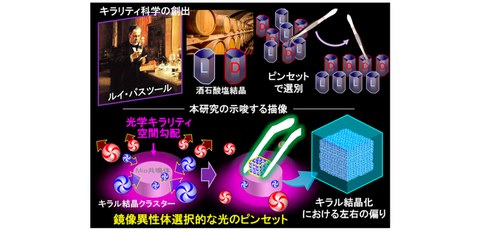
In this study, the research group used electromagnetic field analysis to reveal that the magnitude of the enantioselective optical force acting on chiral crystalline clusters before crystallization due to the excitation of a chiral light field may have a significant effect on crystal nucleation. Chirality began in 1848 when Louis Pasteur noticed that tartrate crystals precipitated in a wine barrel had two different shapes, and selected them with tweezers while looking through a magnifying glass. The result indicates the possibility of selecting chiral nanocrystals with optical tweezers (Fig. 1).
The result of this research was published online in The Journal of Physical Chemistry C, a scientific journal of the American Chemical Society, on June 10 (Pacific Standard Time).
This result was achieved through collaborative research with Associate Professor Kazuhiro Goto of the Graduate School of Science and Technology of Niigata University, Professor Miho Tagawa of the Institute of Materials and Systems for Sustainability (IMaSS) at Nagoya University, Professor Hiroshi Yoshikawa of the Graduate School of Engineering at the University of Osaka, and Associate Professor Ryuzo Kawamura of the Graduate School of Science and Engineering at Saitama University.
Fig. 1
The mechanism of chirality bias in chiral crystallization on Mie-resonant Si nanostructures, where optical chirality enhancement is expected in the near field as suggested by this study. Louis Pasteur noticed that tartrate crystals precipitated in wine barrels were mixed with two different shapes, and selected the two types with tweezers, thus creating the chirality. The analysis in this study suggests that the chirality bias occurs in chiral crystallization due to the enantioselective optical force acting on the chiral crystal clusters due to the existence of a spatial gradient of optical chirality. In contrast to Pasteur's macroscopic selection of chiral crystals using tweezers, this study suggests the selection of chiral nanocrystal clusters using optical tweezers.
Research Background
Chirality refers to the different properties of two mirror-image structures like the relationship between a right hand and a left hand. Chirality is found universally at various levels in nature, including elementary particles, the molecular structures of amino acids, the double helix structure of DNA, the crystal structure of quartz, the helical structures of snail shells and winding plants, and even the spirals of galaxies. Although left-handed and right-handed chiral substances show the same thermodynamic stability, the chiral molecules that compose life adopt only one of the two enantiomers. Such significant bias in chirality against thermodynamic stability has continued to attract many scientists as the homochirality problem.
Since the human body is homochiral, if the compound being injected exhibits chirality, it will react differently depending on the handedness of the substance. One side may be beneficial to the body while the other side may cause serious harm. For example, thalidomide, once used as a painkiller and now used to treat multiple myeloma, is a chiral crystal. It is known that the right-handed form is a drug, while the left-handed form will be a cause of birth deformities.
Chirality is important not only in life, but also in spintronics, which realizes energy conservation by utilizing the right-left degree of freedom of electron spin like the degrees of freedom of charge. It is known that the chirality of crystalline materials makes it possible to control electron spin by energetically distinguishing between electron spins in the crystal, and that chiral organic molecules act as efficient spin-polarized filters that sift through electron spins. There is a close relationship between the handedness of a chiral substance and the direction of electron spin. From the above, it can be seen that elucidating the factors that induce the bias of enantiomers is extremely important in the creation of chiral substances.
Previous research has tried to control the handedness of chiral molecules and chiral crystals by irradiating them with circularly polarized light, which is a representative example of light with chirality. However, it is known that the asymmetric interaction between circularly polarized light and chiral substance is generally very small, and the bias in handedness in the generation of chiral substances induced by circularly polarized light is negligible.
In this context, optical chirality, a conserved quantity that represents a measure of the chirality of light, has been attracting attention in recent years. While energy and momentum have long been known as conservation of light, optical chirality is a conserved quantity whose physical meaning was discovered relatively recently in 2010 by graduate student Yiqiao Tang and his colleagues at Harvard University in the United States. By using a light field that exhibits stronger optical chirality than that of circularly polarized light to generate chiral substances, it is expected that efficient control of chiral materials using light that exceeds the limits of circular polarization will be possible.
Previous research using numerical analysis of electromagnetic fields has shown that in the near-field of Mie-resonances, which are optical resonances inside high-refractive-index dielectric nanostructures, the optical chirality is significantly enhanced compared to circularly polarized light. With such background, the research group has demonstrated that when chiral crystallization of a substance called sodium chlorate (NaClO₃) is induced from an aqueous solution on a Mie-resonant dielectric Si nanostructure array, which is expected to excite a near-field that exhibits stronger optical chirality than circularly polarized light, a statistically significant and large crystal enantiomeric excess (chirality bias) that cannot be obtained with circularly polarized light alone is observed. However, the mechanism by which chirality bias occurs remains unknown.
In order to elucidate the mechanism, the research group focused on the enantiomer-selective optical force that is believed to act on chiral particles due to the presence of a spatial gradient of optical chirality. One well-known technology that applies optical force is optical tweezers. The importance of this technology is widely recognized because its developer, Dr. Arthur Ashkin, a physicist at AT&T Bell Laboratories (at the time of development), was awarded the Nobel Prize in Physics in 2018. Optical tweezers use a strongly focused laser to form a spatial gradient of the optical electric field near the focal point, and trap dielectric particles using the optical force caused by the spatial gradient of the electric field. This optical force is not enantioselective.
In contrast, the enantioselective optical force that we focus on in this study is an optical force that acts on chiral dielectric particles due to the formation of a spatial gradient of optical chirality. Both of these optical forces are based on the Lorentz force and are derived depending on whether the object on which the optical force acts is chiral or achiral. In the near-field of the Mie-resonance with enhanced optical chirality, the optical chirality is strongly localized in the nanospace and forms a spatial gradient, which is expected to exert an enantioselective optical force on nearby chiral particles.
Research Contents
In this study, we calculated the spatial distribution of optical chirality generated near Si nanostructures by electromagnetic field analysis, and estimated the magnitude of the enantioselective optical force acting on NaClO₃ chiral crystal clusters before crystal nucleation, thereby discussing its effect on chiral crystal nucleation.
The research group first calculated the enhancement of optical chirality, a quantity that represents a scale of the chirality of light, for incident circularly polarized light by electromagnetic field analysis using the finite-difference time-domain method (FDTD method). Figure 2 shows the analytical model and the corresponding spatial distribution of the enhancement of optical chirality. The analytical results are shown for a Si metasurface immersed in an aqueous solution, and for a Si metasurface formed on Pt-Pd nanoparticles immersed in an aqueous solution to more closely resemble the actual experimental conditions. It was found that in the Si nanostructure, an enhancement of optical chirality was observed, approximately 18 times that of circularly polarized light with a uniform handedness of the optical field. It means that the enhancement of optical chirality can also be observed on the surface of a nanostructure.
The researchers also found that the presence of Pt-Pd nanoparticles leads to inhomogeneity in the enhancement of optical chirality, which is expected to increase the spatial gradient of optical chirality. By setting appropriate parameters based on the calculated spatial distribution of optical chirality, it is possible to estimate the enantioselective optical forces acting on chiral crystal clusters in aqueous solution. The enantioselective optical force depends on the spatial distribution of optical chirality as well as cluster radius (r) and quantities of chirality parameter (κ). The chirality parameter is known to be proportional to the optical rotation of a substance, and previous studies have shown that the optical rotation of NaClO₃ crystals indicates that κ is approximately 5 × 10⁻⁴. Figure 3 shows the enantioselective optical potential acting on a NaClO₃ chiral crystal cluster with r = 20 nanometers (nm: n is one billionth) when the Mie-resonance is excited by irradiation with right-handed circularly polarized light. When a cluster exists in a position where this potential is small, the cluster is more stable than when it exists in a position where the potential is large. In other words, just as a ball on a slope rolls down due to gravity, when there is a gradient in the optical potential, particles move toward the side with the smaller potential due to the optical force. This enantioselective optical potential indicates that the closer the right crystal cluster is to the nanostructure, the more stable the right crystal cluster is, and the farther away the left crystal is from the nanostructure the more stable the left crystal cluster is. In other words, under irradiation with right-handed circularly polarized light, the right crystal cluster is selectively concentrated on the Si structure. It is known that crystal nucleation occurs more easily when the solute concentration is higher, and is much more likely to occur on surfaces than in space. Taking this into consideration, right-handed crystals are more likely to nucleate than left-handed crystals under right-handed circularly polarized light irradiation. This idea is consistent with the results of crystallization experiments, in which right-handed crystals crystallized preferentially under right-handed circularly polarized light irradiation and left-handed crystals crystallized preferentially under left-handed circularly polarized light irradiation.
Then, does the magnitude of the enantioselective optical force acting along with this enantioselective optical potential have a significant effect on chiral crystal nucleation? To address this question, we estimated the magnitude of the enantioselective optical force and compared it with previous studies. The vector distribution of the enantioselective optical force is shown in Figure 4. It shows that an enantioselective optical force of about one femtonewton (fN: f is one part per quadrillion) acts in the vicinity of the Si nanostructure.
Is this size sufficient to cause a difference in the nucleation frequency of both crystal enantiomers? Previous research has reported a phenomenon known as laser-trapping-induced crystallization, in which concentrating molecular clusters with laser tweezers can forcibly induce crystal nucleation even in unsaturated aqueous solutions. In other words, the magnitude of the optical force in this phenomenon is sufficient to affect nucleation. The dependence of the optical force on the cluster radius is shown in Figure 5. This dependence indicates that the enantioselective optical force estimated in this study is comparable in magnitude to the optical force in laser trapping-induced crystallization. In addition, previous research has reported experiments in which magnetic nanoparticles with a radius of 20 nm dispersed in a liquid simulating the cellular fluid of living cells were concentrated by using the magnetic-field gradient force generated by a magnet. The experiment showed that magnetic nanoparticles can be concentrated with forces as small as 2fN. Also, it has been experimentally demonstrated that diamond nanoparticles with a radius of 80 nm dispersed in water can be transported using optical forces of a few fN. These findings suggest that the enantioselective optical power estimated in this study is significant enough to enantioselectively concentrate chiral crystal clusters. Furthermore, it has been experimentally required that the magnitude of the force field generated by the formation and annihilation of ionic networks in supersaturated aqueous solutions is several fN. If a chiral ion network is repeatedly formed and annihilated in the NaClO₃ aqueous solution just before nucleation, the enantioselective optical force of 1fN may result in a difference between left and right in the nucleation frequency of both crystal enantiomers in the chiral nucleation.
Fig. 2
Overview of analytical model for FDTD electromagnetic field calculations (top) and spatial distribution of optical chirality enhancement for circularly polarized light in the near field of Mie-resonance excited by circularly polarized light irradiation, as revealed by the analysis (bottom).
This paper introduces two types of analytical models, both of which are under the condition of being immersed in an aqueous solution of NaClO₃, which causes chiral crystallization of the Si metasurface, shown in the top diagrams. The Si metasurface used in previous chiral crystallization experiments was sputtered with a Pt-Pd thin film (1 nm). In order to compare the effect of this thin film with and without it, the research group analyzed the degree of optical chirality enhancement of model without Pt and Pd nanoparticles (top left) and model with them (top right). Spatial distribution of optical chirality enhancement calculated using these two models in the x = 0 nm and y = 92.5 nm planes (surface 2.5 nm away from the top surface of the Si nanostructure), shown in the bottom. The spatial distribution of optical chirality enhancement was shown with the upper limit of the color map showing the enhancement set to five and ten.
Fig. 3
Enantioselective optical potential landscape acting on a chiral crystal cluster with |κ| = 5 × 10⁻⁴, r = 20 nm. The analysis under conditions without Pt and Pd is shown in the left, and the analysis under conditions with Pt and Pd is shown in the right.
Fig. 4
Vector mapping of the enantioselective optical force acting on a chiral crystal cluster with |κ| = 5 × 10⁻⁴ and r = 20 nm. It shows that an enantioselective optical force of about 1 fN acts near the Si nanostructure.
Fig. 5
Comparison of the dependence of the magnitude of the enantioselective optical force acting on chiral crystal clusters of |κ|= 5 × 10⁻⁴, 1 × 10⁻³ on the cluster radius, the dependence of the magnitude of the non-enantioselective optical force (electric field gradient force) acting on crystal clusters on the cluster radius in an experiment of laser capture-induced crystallization from an unsaturated aqueous solution, and the magnitude of the magnetic field gradient force in an experiment in which magnetic nanoparticles with a radius of 20 nm dispersed in a liquid simulating the cellular fluid of a living cell were concentrated by the magnetic field gradient force generated by a magnet.
Future Developments
This study suggests that the relationship between the optical chirality-enhanced light field and the crystal enantiomeric excess in chiral nucleation may be linked by the phenomenon of enantioselective optical force. Humanity has developed the science and technology that supports modern life by making full use of the conserved quantity of light and its relationship with substances. This research showed an example of the relationship between optical chirality, a relatively new and unexplored conserved quantity of light, and substances, in the concrete form of controlling chiral nucleation via enantioselective optical forces. The chirality began in 1848 when the French bacteriologist Louis Pasteur noticed chiral tartrate crystals precipitated in a wine barrel had two different shapes and separated the two crystals with tweezers. The result by this analysis is that nanoscale chiral crystal clusters can be sorted by optical tweezers (Fig. 1.) Such "Optical Pasteur Tweezers" are expected to develop new scientific advances related to chirality in nano-structure.
Notes
The article, “ Enantioselective Optical Force as a Potential Cause of Large Chiral Bias in Chiral Crystallization on a Mie-Resonant Metasurface,” was published in the Journal of Physical Chemistry C at DOI: https://doi.org/10.1021/acs.jpcc.5c01253
Links
Technical Glossary
- Dielectric metasurface
A metasurface is a surface that has optical properties not found in natural substances, which are achieved by artificially created pseudo-two-dimensional nanostructure arrays using techniques such as microfabrication. Specifically, metasurfaces that use dielectrics as the nanostructure material are called dielectric metasurfaces. So far, metasurfaces that utilize the optical properties of surface plasmon resonance excited by light irradiation of metal nanostructures have become widely known. In recent years, research has been focusing on expanding the diversity of optical properties of metasurfaces by utilizing the various optical resonance phenomena of dielectric nanostructures.
- Optical force
The general term for the force that substances receive from light. When a substance is irradiated with light, electrons are moved by the electric field of the light, resulting in a bias in electric charge, i.e. polarization, within the substance. The negatively charged part due to an excess of electrons and the positively charged part due to a deficiency of electrons are subjected to opposing forces by the electric field, and these forces cancel each other out. However, if there is a spatial bias in the strength of an electric field, there will be an uncancelled force that will move substances. This makes it possible to manipulate substances using optical forces.
- Nucleation
It is the initial process of crystallization. While molecules in the parent phase aggregate to form clusters in the pre-crystallization stage, an interface is formed along with the formation of clusters. Since the existence of an interface is energetically unfavorable, the system tries to eliminate the interface. As a result, there is an action that tries to destroy the cluster and it is believed clusters are repeatedly generated and annihilated in the parent phase before crystallization. On the other hand, once a cluster reaches a certain critical size, a stabilizing effect on the cluster occurs that overcomes the energy disadvantage posed by the interface, which leads to crystal formation. The process by which clusters reach this critical size and stabilize is called nucleation.
- Spintronics
The field in which not only the charge of electrons in solids but also the spin degree of freedom are applied to engineering purposes. Electrons in solids have a negative charge. Electronics is that utilizes the negative and positive degrees of freedom of electric charge to convert information. Electrons have a property called spin as well as an electric charge. Spin is a property that can be likened to the rotation of an electron, and the direction of rotation has degrees of freedom corresponding to left and right rotation. This degree of freedom can be used as information, like the positive and negative charges of an electric charge. The word spintronics is a combination of the words "spin" and "electronics."
- Circularly polarized light
Light is an electromagnetic field, and electric and magnetic fields exist while inducing each other. Since electric fields have a direction, it is possible to define an electric field vector. While light whose electric field vector oscillates in a straight line is called linearly polarized light, light in which the electric field vector rotates and oscillates is called circularly polarized light. Circularly polarized light has chirality because the direction of rotation can be left-handed or right-handed.
- Mie-resonance
The optical resonance phenomenon occurs inside dielectric nanoparticles or nanostructures when light is irradiated. Light irradiated onto a high refractive index dielectric has a shorter effective wavelength due to its refractive index. When the size of the dielectric is comparable to the shortened wavelength, optical resonance occurs within the dielectric. This phenomenon is called Mie-resonance.
- Chiral crystallization
The phenomenon in which achiral molecules crystallize into crystals with chirality in their crystal structure. Chirality refers to the different properties of two mirror-image structures. The presence of chirality is called chiral, and a typical example of a chiral structure is the shape of a human hand. When a right hand is reflected in a mirror, it becomes a left hand, and since the shapes of these mirror images are different, it can be said that hand shapes have chirality. Chiral substances have different structures even if they are the same material, so they are often distinguished as either "right-handed" or "left-handed". The term "handedness" is often used to describe the left and right orientation of chiral substances. On the other hand, the shape of a sphere reflected in a mirror is also a sphere, and the mirror images of a sphere show the same shape, so a sphere has no chirality. The absence of chirality is called achiral. Another chiral structure other than human hands is a helical structure that exists in both right-handed and left-handed forms. Chiral crystallization is one of the phenomena in which chirality symmetry is broken spontaneously during crystallization, and is therefore a phenomenon of widespread interest from the perspective of the homochirality problem. When chiral crystallization is induced by a common crystallization method such as evaporating a stationary aqueous solution, while the number of right-handed and left-handed chiral crystals that form is equal, it is known that when chiral crystallization is induced in a solution by stirring, almost all of the crystals that form are either one. Many studies have been conducted to discover factors that induce a bias in the handedness of crystals form.
- Near-field
The non-propagating light that is localized in the nanometer range with the light scattered on the material surface.
- Crystal enantiomeric excess
A quantitative index for the left-handed and right-handed bias of chiral crystals. The difference in the number of crystals on the left and right sides normalized by the sum of the two.
- Lorentz force
The force acting on a charged particle moving in an electromagnetic field.
- The finite-difference time-domain method (FDTD method)
One of the methods of calculating electromagnetic fields. In the finite-difference time-domain method, electromagnetic field analysis is performed by discretizing space and time and numerically solving Maxwell's equations as difference equations in the time domain and the space domain.
- Optical rotation
When a linearly polarized light with a fixed vibration direction of the electric field is irradiated to chiral dielectric material, the polarization direction of the transmitted light is different from the polarization direction of the incident light. The property of rotating the polarization direction of linearly polarized light in this way is called optical rotation. The direction of rotation of polarized light reverses between clockwise and counterclockwise depending on the handedness of the chiral substance. Optical rotation refers to the size of the rotation angle of the polarization direction.
