

A new theory explaining the origin of cosmic neutrinos
A new solution to contradiction between strong neutrino signal and weak gamma rays
- Regarding the origin of neutrinos in the center of the galaxy, a new mechanism has been proposed: helium nuclei collide with ultraviolet light and undergo photolysis, emitting neutrons, which then undergo beta decay to generate neutrinos.
- Conventional models could not explain the balance of strong neutrino signal and extremely weak gamma-ray emission actually observed, but the proposed new mechanism can provide a unified explanation for this observational discrepancy.
- The result suggests nuclear decay within active galactic nucleus (AGN) jets (in this study, it refers to the sequential decay consisting of photodisintegration caused by the influence of external light and subsequent spontaneous beta decay) may be the origin of high-energy neutrinos. This confirms the existence of a hidden neutrino source and is expected to lead to new developments in multi-messenger astronomy in the future.
Outlines
An international collaborative research team, led by Nobuyuki Sakai, Graduate School of Science at The University of Osaka (Doctoral student), Koichiro Yasuda, Ph.D. program in Physics at UCLA (an alumnus of School of Science at The University of Osaka), Associate Professor Yoshiyuki Inoue of Graduate School of Science at The University of Osaka, and Professor Alexander Kusenko at the Kavli IPMU, the entity within the University of Tokyo, has proposed a new theoretical model for the origin of high-energy neutrinos in the active galactic nucleus NGC 1068.
Recently, the IceCube Neutrino Observatory in Antarctica detected a very strong neutrino signal from the active galactic nucleus NGC 1068, but the corresponding gamma rays were found to be extremely weak, opposed to the conventional interpretation. This has led Associate Professor Inoue and his team to propose a theoretical model, the active galactic nucleus corona origin hypothesis, in which neutrinos originate from the high-temperature plasma (corona) that exists near the center of active galactic nuclei. However, theoretical studies have pointed out the possibility that the energy of cosmic rays accelerated in the coronal region may be insufficient.
It has been suggested that this series of nuclear decay mechanisms may clarify the origin of high-energy neutrinos. The gamma rays generated from the electrons in this process also match well with the observed low-intensity spectrum. This has led the researchers to provide a unified explanation for the discrepancies between observed neutrinos and gamma rays.
This research theoretically support the existence of a hidden neutrino source that may have been overlooked in the past and marks a major step toward elucidating the origin of high-energy neutrinos from the universe.
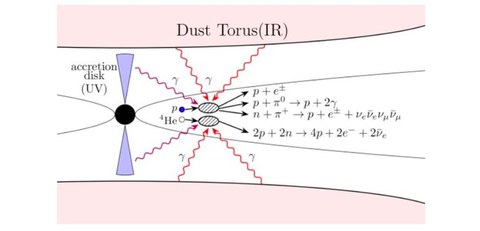
Fig. 1 Diagram of how neutrinos are produced by the decay of neutrons generated by photolysis of atomic nuclei
Credit: Yoshiyuki Inoue
Research Background
Previously, the production of high-energy neutrinos in active galactic nucleus jets was thought to be mainly due to the interaction of protons with photons and gas. In this conventional model, accelerated protons were considered to interact with photons near the active galactic nucleus, producing mesons (particularly pions), whose decay releases high-energy neutrinos. In the interaction between a proton and a photon, high-energy gamma rays are simultaneously produced by the decay of pions. Therefore, it was predicted that the ratio of neutrinos to gamma rays would be similar. However, the IceCube Neutrino Observatory in Antarctica detected a very strong high-energy neutrino signal from active galactic nucleus NGC 1068, and actual observations have shown the gamma-ray radiation from NGC 1068 is extremely weaker than expected, making it difficult to explain the conventional model.
In response to this, Associate Professor Inoue and his team members have proposed a theory that neutrinos originate from the high-temperature plasma region (corona) that exists near the center of active galactic nuclei. However, issues have been pointed out recently regarding the energy balance and particle acceleration, and then the need for a new scenario has been growing.
Research Contents
In this study, the research group focused on the process in which helium nuclei accelerated within NGC 1068 jets undergo photolysis by colliding with ultraviolet light emitted from the center of the galaxy, then releasing neutrons. The emitted neutrons undergo beta decay to produce neutrinos, and the electrons generated at the same time interact with surrounding photons to produce observed weak gamma rays (Fig. 1.) By using this new model, the researchers have succeeded in naturally clarifying the large differences in the observed spectra of neutrinos and gamma rays.
Social Impact of this Research Result
This research theoretically suggests the existence of a previously overlooked hidden neutrino source, providing critical clues toward elucidating the origin of high-energy neutrinos coming from space. Furthermore, this mechanism can be applied to other celestial bodies with active galactic nuclei jets, such as Seyfert galaxies, and is expected to contribute to further developments in high-energy cosmic rays and neutrino astronomy.
In addition to contributing to elucidating the origin of high-energy cosmic neutrinos, understanding the new reaction mechanism in active galactic nuclei is expected to be applied in the fields of astrophysics and particle physics.
1) Applications for cosmic ray physics
The photodisintegration process of helium nuclei proposed in this study will help to elucidate active galactic nucleus jets, their composition, and their origin. A better understanding of the generation and propagation of high-energy cosmic rays is expected to help identify the source of acceleration of extragalactic cosmic rays and clarify the impact of cosmic rays on the environment.
2) Contributions to multi-messenger astronomy
By combining different observational methods, such as neutrinos and gamma rays, it is possible to obtain a new approach to comprehensively understand the physics around black holes and high-energy phenomena in the universe. It is expected to analyze data even more precisely by collaborating with next-generation observation facilities.
3) Suggestion for particle physics and physics beyond the standard model
It will also lead to the search for unknown elementary particles and new physics by understanding the particle reactions that occur in the extreme environment of active galactic nuclei as the most advanced accelerator in the universe.
Observing more active galactic nuclei and neutrino/gamma-ray of high-energy celestial bodies will be continuously conducted in the future, and the research group will not only verify the universality of the suggested model but also advance the search for new physical laws in extreme environments in the universe.
Note
The article, ”Neutrinos and gamma rays from beta decays in an active galactic nucleus NGC 1068 jet,” was published in American journal of Physical Review Letters at DOI: https://doi.org/10.1103/PhysRevLett.134.151005.