About this research

ARASE Hisashi
- Research Institute for Microbial Diseases
- Professor

Taming overactive immune systems with antibodies: hope for autoimmune diseases
Researchers from The University of Osaka discover naturally occurring “TCR-like” antibodies that may curb harmful immune responses, offering a potential strategy for treating autoimmune conditions
The immune system is our frontline protection against infection, continually searching for and destroying unknown pathogens. While typical operation of the immune system scans for threats, some systems attack the body’s own healthy cells, leading to autoimmune diseases, like multiple sclerosis. Treatment of autoimmune diseases is a difficult balance, and one that has not yet been successfully achieved.
Now, a multi-institutional team led by The University of Osaka has discovered a previously unknown immune regulatory mechanism mediated by antibodies that selectively shut down overactive immune responses at their source. The findings have been published this month in Nature Communications.
The immune system relies on T cells, which respond to threats found on fragments of proteins, called antigens, on other cells. However, some T cells perceive threats on healthy cells, and respond to them as if they were harmful invaders. This can lead to autoimmune disorders such as multiple sclerosis.
“We discovered a new immune regulatory mechanism driven by a novel antibody called an ‘immune-induced TCR-like antibody’ or iTab,” says Kazuki Kishida, lead author of the study. “These antibodies selectively suppress the activity of T cells, blocking the immune response to specific antigens.”
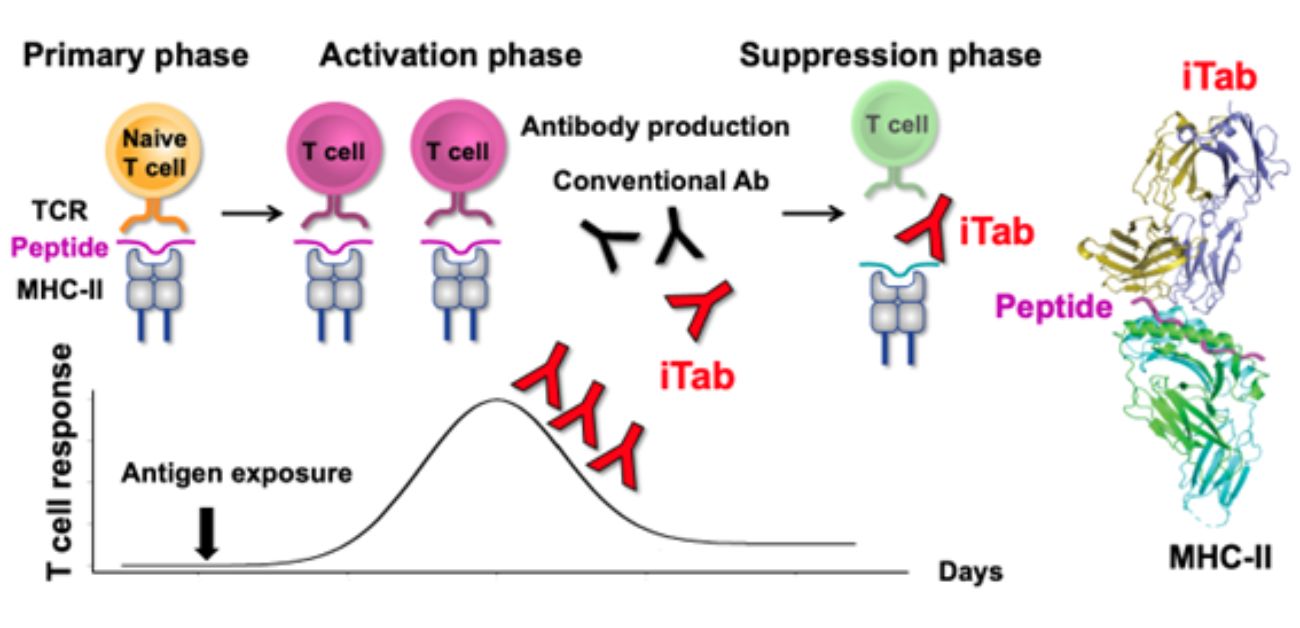
The researchers found that in mice, iTabs are produced naturally during the immune response. They work by mimicking a receptor on the T cell, latching onto a molecule called MHC class II. This prevents the T cell from “plugging in” and activating the immune response. To uncover the mechanism, the team studied how mice responded to different protein fragments.
They discovered that when antigens included extra pieces at the ends of the protein, or flanking regions, the immune system generated iTabs that bind the proteins. This prevented the T cells from recognizing them and avoided the unnecessary attack on healthy cells.
Importantly, the researchers showed that iTabs could reduce harmful immune responses in a mouse model of autoimmune disease, similar to multiple sclerosis. Treatment with iTabs reduced disease severity and delayed its onset. Even more striking, vaccination with peptides designed to induce iTabs also protected against disease.
This opens the door to a new therapeutic approach: instead of suppressing the whole immune system, like many current immunosuppressants, treatments could be designed to generate iTabs that target only disease-causing immune responses.
“By designing vaccines or therapies that promote iTab production,” explains Hisashi Arase, senior author, “it may be possible to treat conditions driven by overactive T cells while leaving the rest of the immune system intact. Conversely, by designing vaccines that avoid inducing iTabs, we may be able to increase vaccine effectiveness.”
These findings suggest that when the immune system can work against itself, iTabs may offer a way to safely calm down an overactive system, focusing only on ensuring the wellbeing of the host.
Fig. 1
Caption: Regulation of T cell response by Immune-induced TCR-like antibody (iTab)
Credit: 2026, Kazuki Kishida et al., Immuno-induced TCR-like antibodies regulate specific T cell response in mice, Nature Communications
Fig. 2
Caption: Immune-induced TCR-like antibody (iTab) specifically recognizes peptide-antigen-MHC complexes.
Credit: Hisashi Arase, The University of Osaka
Fig. 3
Caption: Itab improves experimental autoimmune encephalomyelitis (EAE)
Credit: 2026, Kazuki Kishida et al., Immuno-induced TCR-like antibodies regulate specific T cell response in mice, Nature Communications
Notes
The article, “Immune-induced TCR-like antibodies regulate specific T cell response,” was published in Nature Communications. DOI: https://doi.org/10.1038/s41467-026-71384-1
