About this research

ICHIKAWA Shuhei
- Graduate School of Engineering
- Associate Professor

An advance in single-chip, energy-efficient LEDs
New LEDs structure reduces energy loss and enables compact light sources for AR/VR, 3D displays, and quantum technologies
Researchers at The University of Osaka, in collaboration with ULVAC, Inc. and Ritsumeikan University, have developed a new LED structure that generates circularly polarized light from a single chip. The advance could support smaller and more energy-efficient optical devices for AR/VR, 3D displays, quantum communication, and optical security. By combining a semipolar InGaN light-emitting structure with a stripe-shaped silicon nitride metasurface, the team created a compact light source that reduces energy-conversion loss and operates at room temperature. This advancement could help bring ultra-compact, durable light sources closer to practical use in AR/VR, 3D displays, quantum communication, and optical security.
Circularly polarized light is useful for a wide range of next-generation technologies. However, previous circularly polarized LEDs have struggled to combine high polarization, high efficiency, durability, and scalable manufacturing. In many previous designs, only one circular polarization component can be extracted from unpolarized light, placing a theoretical limit of 50% on conversion efficiency.
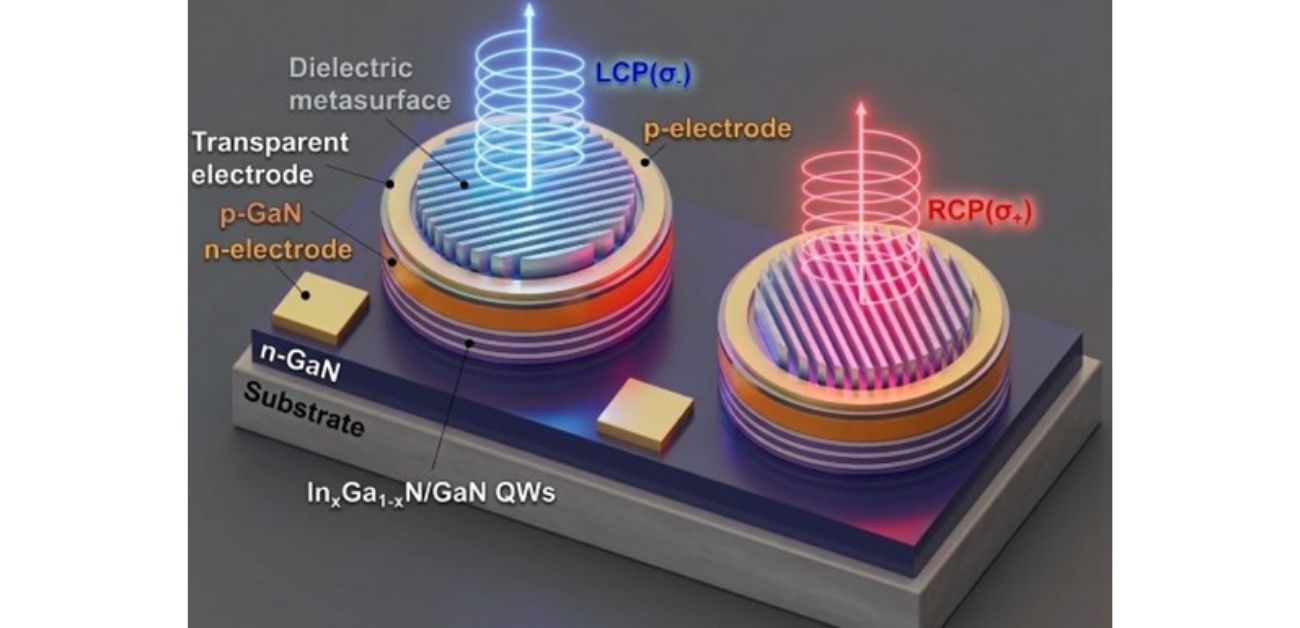
To overcome this limitation, the researchers used semipolar InGaN quantum wells, which naturally emit partially linearly polarized light. They then directly integrated a stripe-shaped SiNₓ metasurface on the LED surface to convert this light into circularly polarized light more efficiently. Optical measurements at room temperature showed a circular polarization degree of 0.27 at 408 nm and a linear-to-circular polarization conversion efficiency of 68%, exceeding the theoretical limit of conventional methods.
The researchers also found that the fabricated device operated close to ideal behavior, based on agreement between experiment and three-dimensional electromagnetic simulations. Because the structure is made entirely of inorganic materials and is compatible with existing semiconductor processes, it may offer a practical route toward durable, compact, and manufacturable polarized light sources.
Prof. Shuhei Ichikawa, senior author, commented, “By utilizing the intrinsic linearly polarized emission of semipolar InGaN LEDs, we achieved high conversion efficiency to circular polarization beyond the limit of conventional approaches. High-efficiency circularly polarized light can be obtained simply by integrating a single-layer metasurface, and we see strong potential for future applications in compact devices and practical photonic systems for next-generation optical applications.”
Fig. 1
Caption: A schematic of semipolar (20-21) InGaN-based CP light LEDs where stripe-shaped metasurfaces are directly integrated on the LED emission surfaces to convert linearly-polarized light into CP light
Credit: Shuhei Ichikawa
Fig. 2
Caption: A scanning electron microscope image of demonstrated metasurface fabricated on a semipolar InGaN LED structure.
Credit: Shuhei Ichikawa
Fig. 3
Caption: An RCP-light spectrum obtained at room temperature.
Credit: Shuhei Ichikawa
Note
The article, “Metasurface-integrated semipolar (20-21) InxGa1−xN quantum wells towards efficient circularly-polarized LEDs,” was published in Optical Materials Express at DOI: https://doi.org/10.1364/OME.588632