

\Developing High‑Quality Delivery Vectors for Gene Therapy Products/ Establishment of an AAV Manufacturing Platform Using Domestically‑Developed HAT Cells
A new step toward the realization and implementation of gene therapy
- By utilizing the domestically‑developed human amniotic epithelial cell line for gene and cell therapy (HAT), the researchers established a high‑quality platform of the adeno-associated viruses (AAVs) manufacturing platform characterized by high productivity and a reduced proportion of empty particles.
- In conventional AAV production, achieving both high productivity and high quality has been challenging, especially due to the excessive generation of empty particles and the difficulty of removing them. By combining the unique properties of HAT cells with Design-of-Experiment (DoE) methodology, these limitations were successfully overcome.
- Comprehensive quality assessment, including state-of-the-art analytical technologies, the research group confirmed that AAV produced in HAT cells possesses physical properties and quality comparable to those of conventional AAV.
- This outcome is expected to reduce manufacturing costs and ensure a stable supply of gene therapy products, thereby facilitating the clinical development and practical application of a wide range of gene therapies, including those for rare diseases.
Outlines
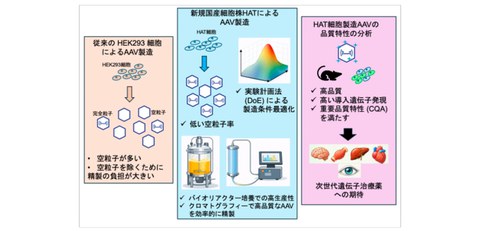
A research group including Specially Appointed Associate Professor (full-time) Yasuo Tsunaka and Professor Susumu Uchiyama of the Graduate School of Engineering, The University of Osaka, in collaboration with Chitose Laboratory Corp., U-Medico Inc., Jichi Medical University, Gunma University, the National Institute of Advanced Industrial Science and Technology (AIST), the National Center for Child Health and Development, and the Manufacturing Technology Association of Biologics, has for the first time in the world demonstrated that gene therapy viral vectors (adeno-associated virus vectors: AAV) produced using a novel domestically‑developed human-derived cell line, HAT cells, exhibit both high quality and high productivity, and has established an AAV manufacturing platform based on HAT cells (Fig. 1).
Until now, it has been considered difficult to achieve both high productivity and high quality in the production of AAV for gene therapy, and effective methods to reduce the generation of empty particles, which lack therapeutic efficacy, have been extremely limited.
In this study, the research group successfully optimized the manufacturing conditions for adeno-associated virus (AAV) production using HAT cells through the application of Design-of-Experiment (DoE) methodology and established a cultivation and production process utilizing a bioreactor. As a result, they achieved a substantial reduction in the generation of empty particles while maintaining high productivity. Furthermore, comprehensive evaluation of critical quality attributes (CQAs) demonstrated that the AAV produced by this method possesses high-quality characteristics. Collectively, these findings led to the establishment of a high-quality AAV manufacturing platform based on HAT cells.
These findings are expected to make manufacturing processes of gene therapy products more efficient, reduce production costs, and ensure a stable supply of high-quality gene therapy products, thereby accelerating clinical development and practical implementation.
Fig. 1 Conceptual diagram of a high-quality, high-productivity AAV manufacturing platform using HAT cells
Credit: Susumu Uchiyama
Research Background
AAV-based gene therapy products have already gained significant attention as a foundational technology supporting next-generation medicine, with eight products currently approved worldwide. However, to achieve successful clinical application of gene therapy products, it is essential to establish technologies that enable the efficient and cost-effective manufacturing of AAV while ensuring both safety and quality. To date, AAV for gene therapy products has been primarily manufactured using insect cells or human-derived HEK293 cells. Although production using insect cells offers high productivity, there have been concerns regarding quality and safety, particularly due to differences in post-translational modifications. In contrast, AAV produced using human-derived HEK293 cells is considered to be of higher quality compared to that produced using insect cells; however, it is associated with the limitation of lower productivity. Furthermore, it is well recognized that both insect cells and HEK293 cells produce a substantial proportion of empty AAV particles that do not contain the therapeutic transgene and thus lack therapeutic efficacy. The presence of these empty particles reduces treatment efficacy and may induce unintended immune responses, making their removal a major challenge in AAV manufacturing.
Research Contents
In this study, the research group conducted AAV production using HAT cells, a new domestically developed, human-derived cell line. The manufacturing conditions of AAV were optimized using Design-of-Experiment (DoE) methodology to identify manufacturing conditions that maintain high productivity while suppressing the generation of non-therapeutic empty particles. As a result, the researchers identified optimal conditions for AAV production using HAT cells that achieve high productivity while reducing the generation of empty particles. Under these optimized conditions, AAV derived from HAT cells was found to exhibit higher productivity compared with conventionally produced AAV derived from human HEK293 cells that were similarly optimized using DoE. Furthermore, even in large-scale cultures using bioreactors, HAT cells demonstrated high productivity, confirming their strong applicability to scale-up manufacturing. In addition, because AAV produced in HAT cells inherently contains fewer empty particles, it was confirmed that, during purification processes commonly used in clinical manufacturing—namely affinity chromatography and anion exchange chromatography—empty particles are almost completely removed, enabling efficient purification of high-quality AAV. In addition, a comprehensive evaluation of critical quality attributes (CQAs)—including the proportion of empty particles, post-translational modifications, and transgene expression capability—was performed for the purified AAV. The results confirmed that AAV derived from HAT cells exhibits quality attributes comparable to, and in some cases superior to, those of conventional HEK293 cell-derived products.
Based on these results, this study demonstrates that HAT cells are a promising cell line capable of producing high-quality AAV for clinical trials with high productivity. Furthermore, the study established a manufacturing platform by defining optimal production conditions and critical quality attributes (CQAs) for high-quality AAV derived from HAT cells.
Social Impacts
These findings offer a new solution to one of the major challenges in the practical application of gene therapy products, the stable and efficient supply of high-quality AAV. The AAV manufacturing platform using HAT cells, which has both high productivity with low empty particle generation, is expected to contribute to reducing manufacturing costs significantly and ensuring a stable supply of gene therapy products by simplifying the production process and alleviating the burden of purification. This is expected to accelerate the clinical development and practical implementation of gene therapy products, including those for rare diseases, for which sufficient supply has been difficult due to manufacturing constraints. Furthermore, the optimal manufacturing conditions and CQAs identified in this study enable a seamless transition from the research stage to clinical trials and ultimately to commercial manufacturing and are expected to contribute to improvements in the quality and safety of gene therapy products. Going forward, the research team will build on the findings of this study to promote practical research through collaboration among academia, industry, and government, with the aim of establishing a domestic ecosystem for the manufacturing of gene therapy products. This will contribute to establishing a stable supply system based on domestic technologies and to strengthening Japan’s international competitiveness in the field of gene therapy.
Notes
The article, “Manufacture of adeno-associated virus vectors by a novel human-derived cell line HAT and comprehensive characterization of the vectors ” was published in American scientific journal of Molecular Therapy Advances (online) at DOI: https://doi.org/10.1016/j.omta.2026.201700