

Generating light that deeply penetrates the body by engineering molecular shape
Realizing highly efficient near-infrared (NIR) emissive materials with bowl-shaped molecular frameworks
- Successfully created a new highly efficient near-infrared (NIR) emissive molecules with a quantum yield exceeding 66% in solution, using a bowl-shaped molecule with pronounced electron‑accepting properties as its main backbone.
- In conventional systems based on planar molecule structure, energy contributing to emission is easily lost through intermolecular interactions, making highly efficient NIR emission in solution particularly difficult. However, by employing a bowl‑shaped molecular structure, this limitation has been overcome.
- This result presents a new design guideline for NIR emissive materials utilizing non-planar molecular structures and is expected to have applications in bioimaging and next-generation optoelectronic devices.
Outlines
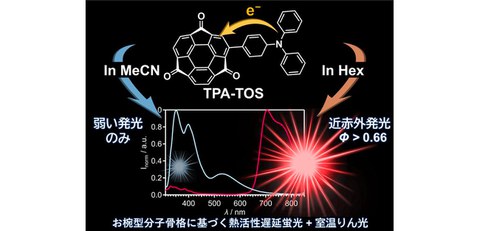
A research group including Junyi Han, a doctoral student at the time of research, Associate Professor Yumi Yakiyama, Associate Professor Youhei Takeda, Professor Hidehiro Sakurai of Graduate School of Engineering at the University of Osaka, Associate Professor Ryohei Kishi at the Graduate School of Engineering Science at the University of Osaka, Assistant Professor Hayato Sakai and Taku Hasobe at Keio University developed a novel near-infrared (NIR) emissive materials with a bowl-shaped molecular framework and succeeded in obtaining a high quantum yield of over 66% in a non-polar solvent (Fig. 1). In this study, bent molecular structures were actively utilized to achieve light behaviors that were previously difficult to replicate.
Near-infrared (NIR) light is expected to have applications in medical imaging and optoelectronic devices due to its property of easily penetrating living organisms and having low background noise. However, planar molecules, which are commonly used, tend to lose energy used for emission, and it has been difficult to obtain strong NIR emission, especially in solutions.
In this study, the research group designed a new molecule, TPA-TOS, by combining a bowl-shaped molecule trioxosumanene (TOS) with a strong electron-receiving property with an electron-donating molecule triphenylamine (TPA), and discovered that the light properties change significantly depending on the solvent environment. In particular, in non-polar solvents, it was found that highly efficient NIR emission is achieved through a synergistic process involving charge transfer within the molecule, followed by re-fluorescence by heat, and complex emission processes accompanied by phosphorescence.
This result demonstrates a new design guideline that allows for the regulation of optical properties by focusing on the shape of molecules, and is expected to have future applications in bioimaging materials and next-generation optoelectronic devices.
Fig. 1 Conceptual diagram illustrating the results of this study
Credit: Yumi Yakiyama
Research Background
Near-infrared (NIR) light with wavelengths of approximately 700 nm or more is attracting attention in a wide range of fields, including medical imaging and optoelectronic devices, because of its characteristics of easily penetrating living organisms and having low background noise. Therefore, the development of organic molecular materials that efficiently emit NIR light has become one of the important research topics in materials chemistry.
Until now, most NIR emissive materials have been designed with planar aromatic molecules as their basic framework. However, these molecules suffer from strong intermolecular attraction, making them prone to quenching, where the energy needed for emission is lost before they can emit. Maintaining highly efficient NIR emission in solutions has been considered particularly difficult because molecules can move freely. On the other hand, in recent years, there has been growing interest in the possibility that deliberately deviating the molecular framework from a planar molecular framework and creating a bent shape may lead to the emergence of electronic states and photophysical properties different from those of conventional materials. However, there have been only a limited number of examples of achieving highly efficient emissions in the near-infrared region using such non-planar molecules, and the emission mechanism was not fully understood.
Research Contents
The research group focused on trioxosumanene (TOS), a molecule with a bowl-shaped structure that they had been researching. TOS is known to have a unique, bent molecular shape, which makes it more prone to receive electrons. The research group designed and synthesized a new molecule (TPA-TOS) by combining TOS as an electron acceptor with triphenylamine (TPA), a molecule that readily donates electrons (Fig. 2).
The researchers performed optical property measurements using the created molecules to find that in highly polar solvents, they only showed weak emission in the ultraviolet region.
However, in non-polar solvents, strong NIR emission spanning 650–850 nm range was found, with an impressive emission efficiency (quantum yield) exceeding 66%, indicating that the emission behavior changes significantly depending on the properties of the solvent (Fig. 3).
Furthermore, analysis using time-resolved spectroscopy and electron spin resonance (ESR) measurements revealed that this highly efficient emission is caused by complex excitation state dynamics in which both thermally activated delayed fluorescence (TADF)—mediated by an intramolecular charge‑transfer state—and room‑temperature phosphorescence operate simultaneously. (Fig. 4). It has been also confirmed that a state of charge separation within the molecule, charge-separated (CS) state, can exist stably for a relatively long period of time, suggesting that the bent molecular framework plays an important role in these unique behaviors.
Fig. 2 Molecular structure investigated in this study
Credit: Yumi Yakiyama
Fig. 3 (a) UV–vis absorption and (b) emission spectra of TPA‑TOS in various solvents
TPA‑TOS in hexane solution under 365 nm UV light: (a) before and (b) after irradiation
Credit: Yumi Yakiyama
Fig. 4 Schematic illustration of the photo-relaxation process of TPA‑TOS in hexane solution
The two peaks seen in the spectrum originate from the fluorescence and phosphorescence components, respectively
Credit: Yumi Yakiyama
Social Impact of Research
The result is significant because it demonstrates that highly efficient NIR emission can be achieved even in solution by actively utilizing bent molecular structures. This indicates a new design guideline for highly efficient NIR emissive materials that does not depend on the planarity of the molecules, unlike conventional designs. In the future, the findings from this study are expected to be applied to medical fluorescent probes that can visualize deep inside the living organisms, as well as to energy-efficient, high-performance optoelectronic devices. Furthermore, understanding the relationship between molecular shape and excited states could lead to the creation of organic materials with unprecedented functions, making this a significant achievement from both a basic science and applied research perspective.
Notes
The article, “High Quantum Yield NIR Emission via Charge Transfer States in Buckybowl-TPA based D–A Systems,” was published in British scientific journal of Materials Chemistry Frontiers at DOI: https://doi.org/10.1080/23294515.2025.2474928.