

\A significant step toward next‑generation implant materials with bone‑like softness/A new design principle for biomedical-alloys utilizing precursors of crystal structure transformation
Elucidating the atomic motions that softens titanium alloys
- For the first time in the world, researchers have elucidated that the origin of the low Young's modulus in titanium alloys, which are considered promising as biomedical implant materials, is stress relaxation caused by atomic migration that precedes a phase transition into another crystal structure.
- By combining molecular dynamics (MD) simulations with precise Young's modules and stress relaxation measurements down to extremely low temperatures, researchers demonstrated that these atomic motions are activated even near room temperature. Furthermore, it has been revealed that Young's modulus can be effectively reduced by controlling these atomic motions.
- The new biomaterial design guideline aimed at lowering Young's modulus is expected to contribute to the development of high-performance implant materials and, ultimately, to improving the quality of life in an aging society.
Outlines
A research group including Professor Masakazu Tane of the Graduate School of Engineering, the University of Osaka, has for the first time in the world elucidated that the origin of the low Young's modulus in body-centered cubic (bcc) titanium alloys, which are important as implant materials, is stress relaxation caused by active atomic motions that precedes a phase transition to another, more stable crystal structure.
In this study, the researchers precisely measured Young's modulus and energy dissipation due to stress relaxation over a wide temperature range from room temperature to extremely low temperatures (approximately -250°C) using a titanium-niobium (Ti-Nb) alloy, which is considered a promising new biomedical implant material. This revealed that Ti-Nb alloys exhibit a distinctive phenomenon, unlike ordinary metallic materials, in which the Young's modulus drops significantly around -120°C.
Furthermore, by analyzing the atomic motion that causes this reduction in Young's modulus using molecular dynamics (MD) simulations, the research team revealed that the trial-and-error process for crystal structure transformations, in which atoms move back and forth between the original and new structural positions, becomes more active at low temperatures, and as a result, stress relaxation causes a significant reduction in Young's modulus.
Also, researchers have revealed for the first time in the world that this atomic motion occurs actively even at or near room temperature, and that this is the main reason for the significant reduction in the Young's modulus of Ti-Nb alloys. This atomic motion occurs in nanoscale regions where the Nb concentration is locally low, which is unavoidable in the alloy. It is demonstrated that the Young's modulus of biomedical titanium alloys can be controlled by manipulating these statistical compositional fluctuations.
This study is expected to lead to the development of implant materials with an ultra-low Young's modulus equivalent to that of living bone. By preventing bone deterioration, it may reduce the risk of reoperation, thereby contributing to improving the quality of life (QOL) of people in a super-aging society.
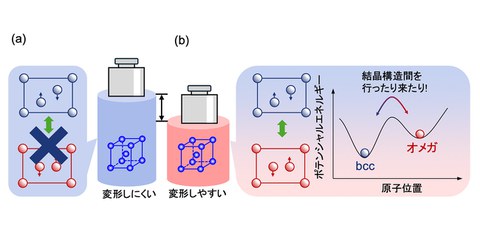
Fig. Schematic diagram of the mechanism of low Young's modulus representation in body-centered cubic (bcc) titanium alloys
Credit: Masakazu Tane
Research Background
In a super‑aging society, the importance of restoring biological function through biomedical implants—such as artificial joints—continues to grow. However, the metallic materials currently used in biomedical implants exhibit a higher Young's modulus than living bone, so a major challenge is resolving the phenomenon known as stress shielding, where load is concentrated on the implant material, causing the surrounding bone to deteriorate.
Beta-type titanium alloys with a bcc structure are considered promising as implant materials due to their high biocompatibility and corrosion resistance, as well as their relatively low Young's modulus. However, developing ideal implant materials requires further reduction of the Young's modulus of β-type titanium alloys. On the other hand, the design guidelines for materials that achieve a low Young's modulus remained unclear for more than 20 years. Therefore, the search for titanium alloys exhibiting a low Young's modulus has been conducted through trial and error.
Research Contents
The research group fabricated Ti-Nb alloys using the arc melting method and precisely measured Young's modulus and energy dissipation due to stress relaxation over a wide temperature range, from room temperature down to the extremely low temperature (approximately -250°C), using the cantilever resonance method. As a result, it was found that the Young’s modulus of Ti–Nb alloys reaches a minimum around −120 °C, revealing behavior that differs markedly from that of ordinary metallic materials Furthermore, energy dissipation due to significant stress relaxation was observed near the temperature at which this Young's modulus exhibits a minimum value, indicating that the reduction in Young's modulus is caused by stress relaxation due to atomic motion.
To elucidate this phenomenon in detail, the research team conducted an analysis of the origin of atomic motion using MD simulations. As a result, it was found that around -120°C, as a precursor to a change to a more stable crystal structure (the omega phase and martensite phase of the hexagonal crystal structure), atoms repeatedly undergo a back-and-forth motion where they move to a different crystal structure and then return to their original crystal structure again, as shown in Fig. (b). This stress relaxation is what causes the reduction in Young's modulus. If the trial-and-error atomic motions necessary for this crystal structure transformation do not occur, the reduction in Young's modulus does not occur (Fig. (b)).
Furthermore, the research team discovered that the energy barrier for the trial-and-error atomic motion required to transform into this new crystal structure is extremely low (around 0.2 eV), and that active atomic motion occurs even at or near room temperature.
In addition, the team revealed that this atomic motion preferentially occurs in nanoscale regions where the concentration of Nb, which stabilizes the bcc structure, is locally low due to statistical compositional fluctuations. This led to the conclusion that atomic motions occurring in the nanoscale region, which are precursors to a transformation to a different, more stable crystal structure, trigger stress relaxation, and that this is the main cause of the reduction in Young's modulus.
Fig. (repost) Schematic diagram of the mechanism of low Young's modulus representation in bcc titanium alloys.
(a) If atoms do not move from their positions in the bcc structure, titanium alloys exhibit a high Young's modulus and are resistant to deformation
(b) When atoms move back and forth between the bcc structure and the omega phase, which is another crystal structure, Young's modulus reduces and the atom becomes more deformable.
Credit: Masakazu Tane
Social Impact
This research clarified that it is possible to develop implant materials exhibiting a low Young's modulus by utilizing atomic motion that occurs as a precursor to a transformation in another crystal structure in titanium alloys. This is a groundbreaking achievement that fundamentally changes conventional guidelines for materials development. Research and development based on these results may lead to the development of implant materials with an ultra-low Young's modulus equivalent to that of living bone. This reduces stress shielding, a drawback of metal implants, and prevents bone deterioration, thereby lowering the risk of reoperation and directly contributing to improving the quality of life (QOL) of people in a super-aging society.
Notes
The article, “Low Young's modulus achieved by anelastic relaxation arising from reversible atomic shuffling in bcc Ti—Nb alloys,” was published in Acta Materialia