About this research

CHIBA Daichi
- SANKEN (The Institute of Scientific and Industrial Research)
- Professor

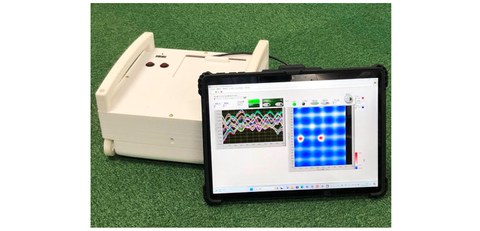
A handheld rebar scanner has been developed
Non-destructive, high-speed, and accurate diagnostics for concrete infrastructure!
- Developed a compact handheld rebar scanner (approx. 2.5 kg) capable of non-destructive, high-speed, and accurate mapping of internal reinforcement arrangements in concrete through simple sweeping motions.
- Conventional non-destructive rebar detection device using ground‑penetrating radar (GPR) requires multiple scanning and cannot be used underwater. The newly developed device addresses these issues by adopting the permanent magnet method.
- Going forward, the research team will prepare for mass production and commercialization based on on-site surveys and feedback from monitor-user companies, also aims to develop technologies that help prevent accidents such as road cave-ins by utilizing the unique advantages of its proprietary permanent magnet method.
Outlines
A research team including Professor Daichi Chiba of SANKEN (The Institute of Scientific and Industrial Research), The University of Osaka, together with Kyoei Sangyo Co., Ltd., has developed a handheld rebar scanner that can comprehensively visualize and map rebar embedded in concrete in a single scan by utilizing the permanent magnet method, a technique originally developed by Professor Chiba.
Fig. Prototype of the completed handheld rebar scanner
Fig. Introduction video on YouTube
https://youtu.be/JcnngMj7U3A
Research Contents
Japan has many concrete infrastructures built during the period of rapid economic growth, and many of them, including bridges, tunnels, and water pipes are now deteriorating.
Concrete structures are prone to deterioration due to cracking, carbonation, and rebar corrosion, but such degradation is often difficult to detect visually. Therefore, accidents caused by these issues have increasingly come to light in recent years. To prevent such accidents, it is essential to establish technologies that can accurately and efficiently assess the deterioration condition of structures.
Ground‑penetrating radar (GPR) has become the most widely used as non-destructive rebar detection device for concrete structures. However, capturing comprehensive internal conditions requires multiple scanning. Furthermore, moisture in concrete and water leakage hinder the propagation and reflection of electromagnetic waves, thereby degrading measurement accuracy, and makes underwater inspection difficult.
To address these issues, Professor Chiba established the permanent magnet method during the Matching Support Phase of NEDO’s “Project for excavating young researchers by the public and private.” Later, in the Joint Research Phase, Professor Chiba began developing a rebar scanner together with Kyoei Sangyo Co., Ltd., aiming toward commercialization. The completed prototype in this study is handheld (approx. 2.5 kg), yet by incorporating a module that integrates multiple sensors, it enables comprehensive visualization of the reinforcement arrangement in a single scan. By sweeping the concrete surface in a motion like mopping, the device enables high-speed, large‑area inspection.
Going forward, the research group will continue to collaborate with institutions such as the Futuristic and Intellectual Co-Creation Town Division and carry out on-site investigations at various locations. At the same time, the research group aims to complete a product prototype within one year and move toward mass production and commercialization within two years, incorporating feedback from field surveys and monitor-user companies.
Furthermore, as the permanent magnet method enables underwater rebar inspection, something that is virtually impossible with GPR, preventive maintenance applications are expected, including the mitigation of road cave‑ins resulting from deteriorating water pipelines. Professor Chiba also plans to collaborate with companies involved in infrastructure inspection and maintenance, and to advance the development of underwater inspection technologies. To this end, Professor Chiba and his research team will continue to explore new measurement principles and advance the development of technologies that enable the assessment of rebar corrosion.
