

Bending a liquid: liquid membranes flex 100 times more easily than cell membranes
Researchers from the University of Osaka have investigated the motion of membrane structures composed entirely of liquids—providing possible insights into protocells
Many structures in biology are bounded by membranes, but not all of them. Droplets of a liquid called a coacervate, which form when oppositely charged molecules come together in water, have attracted attention as models for membraneless compartments inside cells and for “protocells,” hypothetical primitive cells that may have preceded modern ones. Cells today, in contrast, are enclosed by lipid membranes whose behavior is governed by bending elasticity. What happens when these two worlds meet—when a liquid itself is shaped into a membrane—has remained largely unexplored.
In a study published recently in Physical Review Letters, researchers from a multi-institutional team led by the University of Osaka measured, for the first time, how such a lipid membrane bends and fluctuate.
“We know that the behaviors of liquid interfaces and membranes are governed by different physical laws,” explains lead author Rintaro Takahashi, “but we did not know how a membrane that is a liquid would behave.”
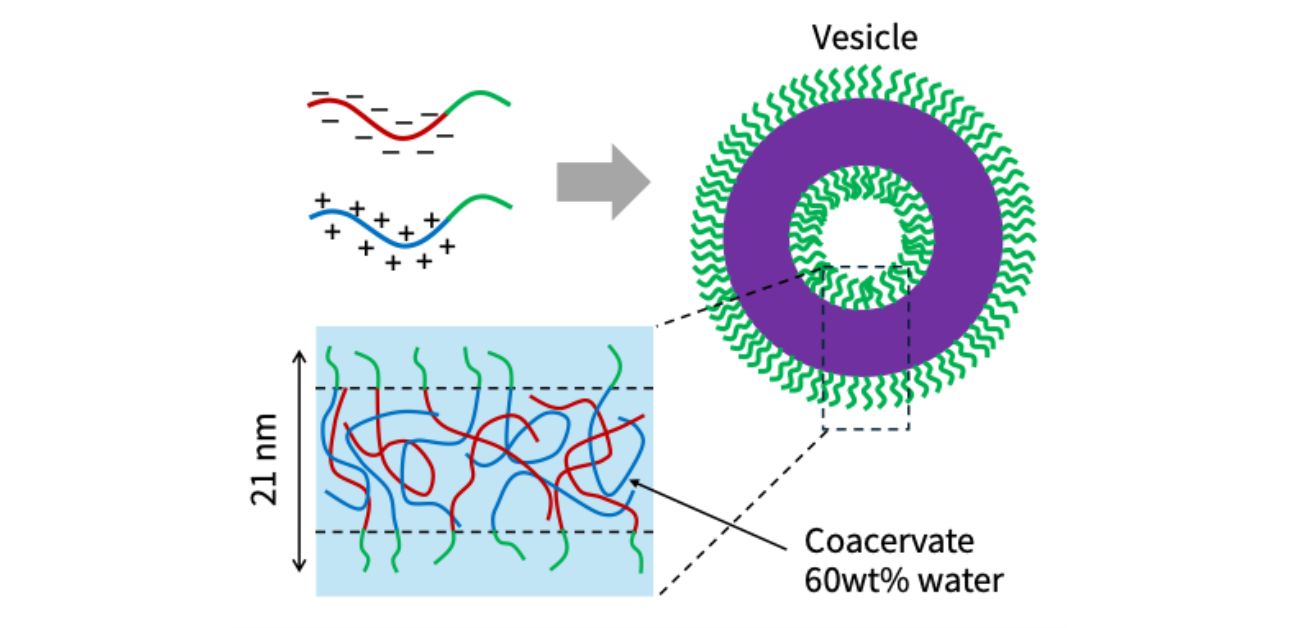
To answer this question, the team used a well-established system: vesicles formed by mixing two oppositely charged block copolymers, each consisting of a charged segment and a neutral segment, in water. In these vesicles, the membrane itself is made of a coacervate, so the structure has a membrane-like shape while its interior remains liquid-like. The team then measured the motion of these membranes using a technique known as neutron spin echo spectroscopy, which tracks how structures fluctuate spontaneously on nanometer and nanosecond scales.
“We found that the liquid membrane was able to bend 100 times more easily than lipid membranes,” reports Rintaro Takahashi. “We also determined that the processes driving the bending elasticity were different. The restorative force after bending deformation for the liquid membrane was entropic in origin, in contrast to the enthalpy-driven processes of lipid membranes.”
The study reveals how a membrane made of liquid behaves, a regime intermediate between liquid interfaces and elastic membranes. The findings could help researchers understand how liquid-based compartments, including those proposed as protocells, behave when they take on membrane-like shapes.
Fig. 1
Caption: Two oppositely charged block copolymers (left) spontaneously assemble in water into hollow spheres called vesicles (center). The magnified view (right) shows the vesicle membrane, in which a liquid coacervate layer is sandwiched between layers of neutral polymer chains.
Credit: Adapted from R. Takahashi et al., When Liquids Form Membranes: Entropy-Dominated Bending Dynamics in Coacervate Vesicles, Physical Review Letters (2026)
Notes
The article, “When liquids form membranes: entropy-dominated bending dynamics in coacervate vesicles” was published in Physical Review Letters at DOI: https://doi.org/10.1103/vl6b-y5gz
