

Discovery of a pathogenic B cell that causes autoimmune diseases
B-cell migration promotes the generation of pathogenic B cells
- Researchers discovered a pathogenic B cell that causes autoimmune diseases.
- Researchers elucidated that the migration of B cells to specific locations within lymphoid tissues promotes the generation of pathogenic B cells.
- The findings may lead to new therapies for autoimmune diseases by targeting B-cell migration.
Outlines
A research group including Professor Kazuhiro Suzuki and Assistant Professor Taichiro Shirai of the Graduate School of Medicine, the University of Osaka, has discovered a novel pathogenic B-cell population that causes autoimmune diseases and revealed that these pathogenic B cells are generated when B cells migrate to specific locations within lymphoid tissues.
In autoimmune diseases, antibody-producing cells differentiated from B cells generate autoantibodies, leading to chronic inflammation and functional impairment of affected organs. However, it remained unclear how pathogenic B cells are generated and subsequently differentiate into cells that produce autoantibodies.
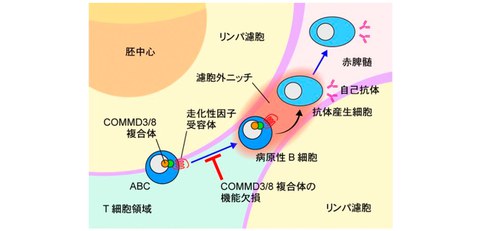
In this study, the research group identified a novel population of pathogenic B cells by analyzing B cells obtained from patients with systemic lupus erythematosus (SLE) and model mice of the disease. They also revealed that this pathogenic B-cell population is generated when B cells migrate to a specific location within lymphoid tissues. Moreover, blocking B-cell migration and thereby suppressing the generation of pathogenic B cells reduced autoantibody production and improved disease outcomes in the mouse model. These findings suggest the potential of new therapies for autoimmune diseases that target B-cell migration (Fig. 1).
Fig. 1 Mechanism underlying the generation of pathogenic B cells
Credit: Kazuhiro Suzuki
Research Background
In autoimmune diseases such as systemic lupus erythematosus (SLE), antibody-producing cells derived from B cells, which normally function to protect the body, produce autoantibodies that attack the body's own tissues, leading to chronic inflammation and dysfunction in a variety of organs. Therefore, antibody-producing cells that generate autoantibodies are considered key drivers of autoimmune disease pathogenesis.
In recent years, age-associated B cells (ABCs) have attracted attention as a precursor B-cell population that differentiates into antibody-producing cells. However, it remained unclear which cells within the ABC population become pathogenic B cells and differentiate into autoantibody-producing cells, and how this process is regulated.
The research group has been investigating the mechanisms by which immune cells migrate throughout the body and are positioned in the appropriate locations. Therefore, in this study, the researchers focused on B-cell migration and sought to elucidate the mechanisms underlying the generation of pathogenic B cells.
Research Contents
The research group analyzed B cells obtained from patients with SLE and from a mouse model of the disease, and identified a novel pathogenic B-cell subset within age-associated B cells (ABCs) that serves as a precursor to antibody-producing cells that produce autoantibodies (Fig. 2A). This pathogenic B-cell population was expanded in the peripheral blood of patients, and its abundance correlated with both disease activity and autoantibody levels, suggesting that it is deeply involved in the pathogenesis of autoimmune disease (Fig. 2B).
Furthermore, the researchers clarified that this pathogenic B-cell population is generated when B cells migrate to a specific location within lymphoid tissues, known as the extrafollicular niche. Thus, it is shown that B-cell migration plays an essential role in the generation of pathogenic B cells, rather than simply changing their location. The study also revealed that the COMMD3/8 complex, which regulates B-cell migration, is essential for the generation of this pathogenic B-cell population.
In SLE model mice, deficiency of the COMMD3/8 complex inhibited the generation of pathogenic B cells, leading to decreased autoantibody production and improvement of disease pathology (Figs. 2C and 2D).
These findings indicate that targeting B-cell migration may represent a novel therapeutic strategy for autoimmune diseases.
Fig. 2 Identification of pathogenic B cells and the therapeutic potential of targeting B-cell migration in autoimmune diseases
(A) Identification of pathogenic B cells in the peripheral blood of patients with SLE. The population of pathogenic B cells (red) is indicated by the arrow. (B) Association between the frequency of pathogenic B cells in the peripheral blood of patients with SLE and disease activity index. (C and D) Effects of COMMD3/8 complex deficiency on autoantibody production (C) and kidney inflammation (D) in an SLE mouse model.
Credit: Kazuhiro Suzuki
Future Development
Current therapies for autoimmune diseases often rely on drugs that broadly suppress immune function or eliminate all B cells. However, these treatments can be associated with side effects, including infections. In this study, the researchers elucidated the mechanism underlying the generation of pathogenic B cells that drive autoimmune diseases and demonstrated that suppressing their generation can improver disease outcomes. The development of strategies to selectively regulate the generation of pathogenic B cells could pave the way for more effective and safer therapies for autoimmune diseases.
Notes
The article, “Migration-dependent extrafollicular programming of pre-plasmablast age-associated B cells drives lupus pathogenesis,” was published in American scientific journal of The Journal of Clinical Investigation at DOI: https://doi.org/10.1172/JCI204095.
