About this research

WATANABE Kei
- Graduate School of Frontier Biosciences
- Associate Professor

The mid-to-posterior regions of lateral prefrontal cortex (LPFC) are responsible for “thinking”
Large-scale massive neuronal dataset challenges long-held view of the frontopolar cortex’s role in thinking
- The frontopolar cortex, located at the very front of the prefrontal cortex, has long been viewed as the key center for higher cognitive functions in the brain’s executive system for thinking and decision-making.In contrast, this study revealed that the mid-to-posterior regions of the lateral prefrontal cortex (LPFC) show robust activation across diverse higher cognitive tasks, whereas neuronal activity in the frontopolar cortex is reduced during task execution.
- Until now, direct neuron-level comparisons between the frontopolar cortex and the LPFC under the same experimental conditions have been difficult to achieve. In this study, monkeys performed eight diverse and demanding cognitive tasks, including working memory, the allocation of processing resources between two simultaneous tasks, and action selection based on spatial or object information. By recording the activity of approximately 5,000 individual neurons across a broad area including the frontopolar cortex, the researchers made this direct comparison.
- The lateral prefrontal cortex (LPFC) is involved not only in higher cognitive functions but also plays a key role in regulating mood and mental states, and it is a key target of brain stimulation therapies for depression and other psychiatric disorders. These findings provide a detailed neuron-level functional map of the LPFC, offering new insights into how this region functions in psychiatric and neurological disorders. The work may contribute to future research aimed at improving the diagnosis and treatment of such conditions.
Outlines
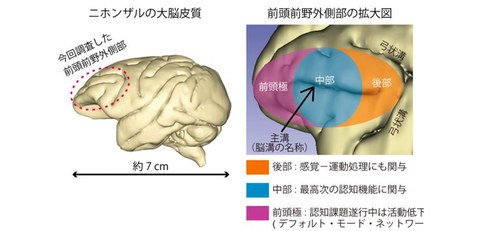
A research group including Associate Professor Kei Watanabe of the Graduate School of Frontier Biosciences at the University of Osaka has discovered that, contrary to the long-held view that the frontopolar cortex—the most anterior region of the LPFC—supports higher cognitive functions, it is instead the mid-to-posterior regions of the LPFC that are most strongly engaged during higher cognitive tasks. (Fig. 1)
Until now, very few studies have directly compared the frontopolar cortex with more posterior regions of the prefrontal cortex at the level of individual neurons under the same task conditions. As a result, key questions have remained unanswered, including whether the frontopolar cortex is truly the central region supporting higher cognitive functions and which regions of the prefrontal cortex are responsible for specific cognitive functions.
In this study, the research group recorded neuronal activity on a large scale across a wide range of the LPFC, extending from the frontopolar cortex to posterior prefrontal regions, while monkeys engaged in multiple higher cognitive tasks. These tasks included performing two processes simultaneously, learning through trial and error in novel situations, and evaluating the outcomes of self-selected actions.
Remarkably, the research team found that neuronal activity in the frontopolar cortex was reduced, rather than enhanced, while monkeys were engaged in complex cognitive tasks, providing the first direct evidence of this phenomenon (Fig. 2). This reduction in activity resembles a key characteristic of the default-mode network (DMN), which is less active when individuals concentrate on external tasks and more active during rest or internal thought. The findings therefore challenge the long-held view that the frontopolar cortex functions as the brain's highest-order cognitive control center and point to the need for a revised understanding of its role.
These findings provide new clues for reexamining the functions of the LPFC at the neuronal level. By shedding light on the neural basis of thought, decision-making, and cognitive control, they may ultimately contribute to a better understanding of both the evolution of higher cognitive functions in humans and the prefrontal cortical dysfunctions associated with psychiatric and neurological disorders.
Fig. 1 Location of the LPFC (left) and the functional allocation revealed in this study (right)
Credit: Kei Watanabe
Fig. 2 Enhanced activity in the mid-to-posterior prefrontal cortex during task performance, contrasted with decreased activity in the frontopolar cortex
Credit:
Kei Watanabe
Research Background
The prefrontal cortex, located at the front of the brain, has long been regarded as the center of higher cognitive functions, including thought, decision-making, planning, and flexible behavioral control. However, the prefrontal cortex is a vast region that accounts for approximately 30% of the human cerebral cortex, and it is thought to contain multiple functionally distinct subregions.
Within the LPFC, a region considered especially important for cognitive functions, a hierarchical model has been widely regarded in which progressively more anterior regions are responsible for increasingly abstract and higher-order cognitive processes. According to this view, the frontopolar cortex, located at the most anterior part of the prefrontal cortex, has been regarded as a key region supporting higher-order cognitive functions required in complex situations, such as coordinating multiple goals, learning in novel situations, and evaluating the outcomes of self-selected actions. It has also been thought to occupy the highest level of the prefrontal hierarchy, integrating and regulating the activity of more posterior prefrontal cortex.
However, studies recording neuronal activity in the monkey frontopolar cortex have been limited, and there have been very few studies that directly compare the frontopolar cortex with more posterior regions of the prefrontal cortex at the level of individual neurons under the same behavioral task conditions. As a result, it has remained unclear whether the frontopolar cortex truly serves as the central hub for higher cognitive functions, and a detailed functional map specifying which regions of the prefrontal cortex are responsible for which cognitive functions has yet to be established.
Research Contents
By having monkeys perform eight diverse and demanding cognitive tasks, the research group carried out large-scale recordings of single-neuron activity across extensive areas of the prefrontal cortex, from the frontopolar cortex to posterior prefrontal regions. The tasks included a diverse set of cognitive functions that have long been thought to involve the frontopolar cortex, such as working memory, the allocation of attention and cognitive resources, action selection based on spatial or object information, learning in novel situations, and reward-based decision-making. By comparing neuronal activity recorded during these tasks, the researchers analyzed which regions within the prefrontal cortex are most strongly involved in specific cognitive functions.
As a result, the researchers found that the regions most strongly engaged during complex cognitive tasks were not the frontopolar cortex, but rather the mid-to-posterior regions. In the mid-to-posterior prefrontal cortex, many neurons encoded task-relevant information, indicating active processing of cognitive tasks. In contrast, neuronal activity in the frontopolar cortex showed a sustained decrease throughout task performance. These findings provide neuron-level evidence that the frontopolar cortex possesses properties similar to those of the default-mode network (DMN).
Social Impact
These findings reveal a new functional map of the prefrontal cortex, showing that its organization cannot be explained by a simple hierarchical model in which cognitive functions become increasingly sophisticated toward the anterior regions. Instead, in monkeys, the posterior and mid-prefrontal cortex play central roles in a wide range of higher-order cognitive functions. These findings call for a re-evaluation of the conventional view that the frontopolar cortex serves as the highest-order center of cognitive control. Furthermore, these findings provide important clues for distinguishing between fundamental features of prefrontal cortex that are shared with humans and functions that may have undergone further development in the human brain. They also offer valuable insights into how the neural mechanisms underlying uniquely human thought and decision-making evolved over the course of evolution.
These findings are expected to contribute not only to a better understanding of the neural mechanisms underlying higher cognitive functions in humans, but also to a deeper understanding of frontopolar cortex dysfunction associated with psychiatric and neurological disorders.
Notes
The article, “Reversed functional gradient in primate prefrontal cortex: posterior dominance and frontopolar task-related deactivation” was published in American scientific journal of Science Advances (online) at DOI: https://doi.org/10.1126/sciadv.aea1094.
