About this research

NAKAGAMI Hironori
- Graduate School of Medicine
- Endowed Chair Professor

What to do when hypertension is identified during a health checkup
Trend analysis of hypertensive patients based on specific health checkup (SHC) data
- A trend survey was conducted using data from specific health checkup participants to clarify the status of blood pressure control among untreated patients with hypertension and to identify factors associated with successful blood pressure control.
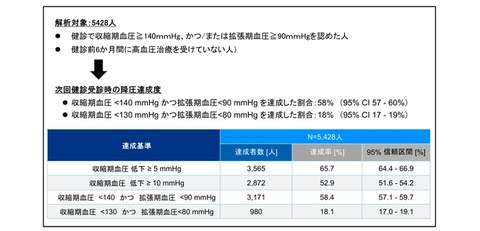
- Approximately 58% of individuals identified with hypertension at a health checkup achieved TBP < 140/90 mmHg at next health checkup.
- Analysis of the characteristics of individuals who achieved the target blood pressure revealed that older age (≥70 years), greater hypertension severity (moderate or severe), residence in agricultural or industrial areas with limited access to medical facilities, a history of hypertension identified at the previous health checkup, and lack of motivation to improve lifestyle habits were associated with lower achievement rates.
- Expected to improve blood pressure target achievement rates through efficient patient lifestyle guidance.
Outlines
A research group including Hironori Nakagami, Endowed Chair Professor of Department of Health Development and Medicine, Graduate School of Medicine, the University of Osaka; Ryoichi Ohara, a graduate student in Geriatric and General Medicine, Graduate School of Medicine, the University of Osaka; Koichi Yamamoto, Professor, Geriatric and General Medicine, Graduate School of Medicine, the University of Osaka; Sachiko Tanaka, Professor at Kobe Pharmaceutical University; and Novartis Pharma K.K. conducted a retrospective cohort study which aimed to clarify the status of blood pressure control among untreated individuals who were identified as having hypertension during Japan's Specific Health Checkups (SHC), as well as the factors associated with achieving blood pressure control.
This study used data from 5,428 residents of Hiratsuka City, Kanagawa Prefecture, who underwent the SHC at least twice between May 1, 2016, and March 31, 2023, were found to have a systolic blood pressure of ≥140 mmHg and/or a diastolic blood pressure of ≥90 mmHg at a health checkup and had not received antihypertensive treatment for at least six months.
Approximately 58% of these individuals achieved the target blood pressure of less than 140/90 mmHg by the time of their next health checkup. However, only about 18% achieved the target of less than 130/80 mmHg. Analysis of the characteristics of individuals who achieved the target blood pressure revealed that older age (≥70 years), greater hypertension severity (moderate or severe), residence in agricultural or industrial areas with limited access to medical facilities, a history of hypertension identified at the previous health checkup, and lack of motivation to improve lifestyle habits were associated with lower achievement rates.
Among those who achieved the target blood pressure of <140/90 mmHg, 1,515 individuals received antihypertensive medication, whereas 1,656 individuals achieved the target without being prescribed the medication. To visually identify the characteristics of these two groups stratified by antihypertensive medication use, the research group conducted the Decision Tree Analysis.
In both groups, the strongest factor associated with achieving the target blood pressure was the absence of a previous indication of hypertension. The second most influential factor was mild hypertension at the time of the health checkup. The third most influential factor differed between the two groups. Among individuals with mild hypertension who achieved the target blood pressure without antihypertensive medication, those with lower γ-glutamyl transpeptidase (γ-GTP) levels showed higher achievement rates. In contrast, age was a major determinant of target achievement among those who achieved blood pressure control with antihypertensive medication.
The findings of this study are expected to improve blood pressure target achievement rates through efficient patient lifestyle guidance.
Research Background
Hypertension is estimated to affect approximately 43 million people in Japan. However, only 12 million (27%) achieve normal blood pressure levels through antihypertensive treatment. In contrast, 12.5 million (29%) remain inadequately controlled despite receiving treatment, 3.4 million (11%) are aware of their hypertension but remain untreated, and 14 million (33%) are unaware that they have hypertension.
This rate is considerably lower than those reported in other developed countries and remains a major public health challenge in Japan. Although health checkups are widely conducted in Japan and many individuals are identified as having hypertension through routine blood pressure measurements, a substantial number of patients still have inadequately controlled blood pressure. To investigate the factors underlying this gap, the research team conducted this study.
Research Contents
In this study, the research team analyzed data from residents of Hiratsuka City, Kanagawa Prefecture, aged 40 to 74 years who participated in the Specific Health Checkup (SHC) program. Between May 1, 2016, and March 31, 2023, a total of 16,184 individuals underwent at least two SHCs. Among them, the team analyzed data from 5,428 individuals who had a systolic blood pressure of ≥140 mmHg and/or a diastolic blood pressure of ≥90 mmHg at a health checkup and had not received antihypertensive treatment for at least six months. To determine whether participants were receiving treatment for hypertension and other lifestyle-related diseases, the researchers also examined health insurance claims data and the National Health Insurance (NHI) beneficiary registry.
A total of 3,171 individuals (58.4%) achieved the target blood pressure of less than 140/90 mmHg, whereas only 980 individuals (18.1%) achieved a blood pressure of less than 130/80 mmHg. Previous studies have reported an achievement rate of approximately 40% for the blood pressure target of <140/90 mmHg. Although the attainment rate in the present study was higher, only 18% of participants achieved the normal blood pressure target of <130/80 mmHg defined by the Japanese Society of Hypertension, indicating considerable room for improvement.
Multivariable analysis of factors associated with achieving the target blood pressure of <140/90 mmHg identified several factors linked to poorer attainment rates: older age (≥70 years), greater hypertension severity (moderate or severe), residence in agricultural or industrial areas with limited access to medical facilities, having been identified as hypertensive at the previous health checkup, lack of motivation to improve lifestyle habits, and the absence of newly diagnosed dyslipidemia.
[Analysis stratified by antihypertensive medication use]
Among the 5,428 individuals identified as having hypertension at a health checkup, 2,468 were prescribed antihypertensive medication before their next health checkup, whereas 2,960 did not receive antihypertensive medication. The target blood pressure of less than 140/90 mmHg was achieved by 1,515 (61.4%) and 1,656 (55.9%) participants, respectively. To visually characterize these two populations, the research group extracted data on age, sex, residential area, hypertension severity, body mass index (BMI), waist circumference, lipid parameters (LDL-C and triglycerides), γ-glutamyl transpeptidase (γ-GTP), motivation to improve lifestyle habits, alcohol consumption, and the presence of hypertension at the previous health examination. They then evaluated their contributions to achieving the target blood pressure using Decision Tree Analysis.
In both populations, the strongest factor contributing to improved achievement rates was the absence of a prior indication of hypertension, followed by mild blood pressure severity at the time of the health checkup. The third most influential factor differed between the two populations. In the group with mild hypertension who achieved blood pressure reduction without antihypertensive medication, lower γ-GTP levels were associated with higher achievement rates. In the moderate-to-severe hypertension group, lower triglyceride levels at the health checkup tended to be associated with higher achievement rates. In contrast, age emerged as a major contributing factor in the group that achieved blood pressure reduction with antihypertensive medication.
Social Impacts
Although health guidance is provided to individuals identified as having lifestyle-related diseases through the SHC program, public organizations often lack sufficient resources to deliver intensive guidance to all eligible participants. Therefore, efficient and targeted lifestyle interventions are needed. The findings may contribute to the development of more efficient lifestyle intervention strategies by identifying the characteristics of individuals who are more likely to achieve successful blood pressure reduction.
Notes
The article, “Modifiable factors to achieve target blood pressure in hypertensive participants.” was published in Hypertension Research Volume 48 Issue and Journal of Cardiology (online) at DOI: https://doi.org/10.1038/s41440-025-02134-x and https://doi.org/10.1016/j.jjcc.2026.01.002 respectively.
