About this research

UCHIDA Yoshiaki
- Graduate School of Engineering Science
- Associate Professor

Magnetic encounters: how intermolecular collisions affect magnetism
Researchers at the University of Osaka explain the anomalous magnetic properties of radical fluids beyond conventional theories
Certain substances can become magnetic when exposed to an external magnetic field. Magnetic susceptibility measures how easily a material can be magnetized. Materials known as organic radicals have been noted to possess an anomalously large magnetic susceptibility. However, researchers have been unable to explain this phenomenon using conventional theories.
Now, researchers at the University of Osaka have developed a theoretical framework to explain this anomalous magnetic susceptibility. This exciting discovery was recently published in The Journal of Physical Chemistry Letters.
An organic radical is a molecule with at least one unpaired electron, giving it a permanent magnetic moment. This spin can align with or against an external magnetic field, and the alignment of these fields from different atoms results in magnetism. Magnetic interactions during collisions between molecules can induce spin polarization – a change in the magnetic moment – which has been neglected by previous researchers.
The magnetism of materials also depends on their phase. In the crystal phase, molecules have fixed positions and orientations. In the liquid crystal phase, molecules retain orientational order but do not have fixed positions. For organic radicals, a larger magnetic susceptibility has been noted for the liquid crystal phase.
“Our experiments on highly concentrated solutions of certain organic radicals revealed an increase in the magnetic susceptibility at the solid-to-fluid transition, accompanied by a drastic rise in the molecular mobility,” explains lead author Yoshiaki Uchida. “This result suggests that the susceptibility is influenced by dynamic magnetic interactions during molecular collisions.”
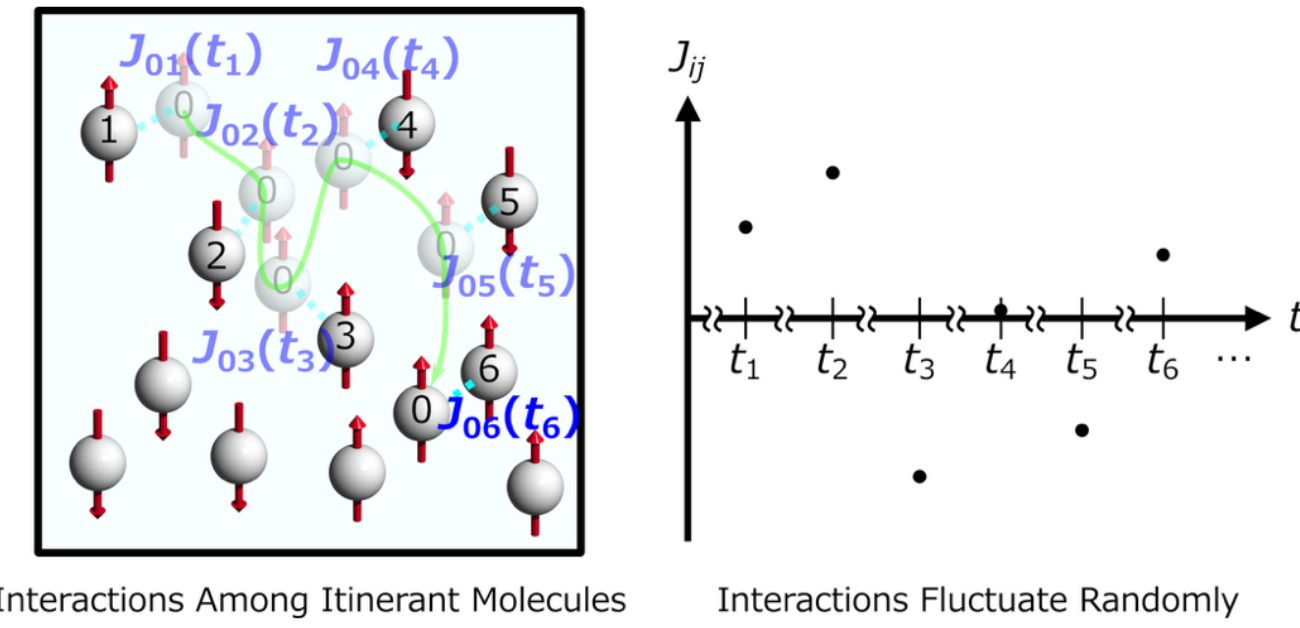
Consequently, The University of Osaka team developed a quantum mechanical model of spin polarization in concentrated radical solutions, considering the effect of stochastic collisions between molecules.
Their calculations show that the first-order contribution to intermolecular interactions is averaged to zero by collisional fluctuations, whereas the second-order term survives and enhances the magnetic susceptibility. In this way, the team has been able to explain the anomalously large magnetic susceptibility of organic radical fluids.
The developed theoretical framework is sufficiently general to apply beyond spin systems. In this, the framework is analogous to classical mean-field theory – which predicts and simplifies how multiple particles interact through an average, or mean, field. Mean-field approaches were first developed to describe magnets and were later extended to other soft materials such as liquid crystals. The present framework follows this tradition while addressing systems whose constituents interact dynamically through collisions, thereby allowing researchers to investigate a broader class of phenomena in soft materials and chemical physics.
Caption: Stochastic exchange interactions arising from molecular collisions in a fluid.
Credit: 2026 American Chemical Society. Reprinted with permission from J. Phys. Chem. Lett. DOI: 10.1021/acs.jpclett.6c01231.
Notes
The article, “Stochastic Collision Theory of Magnetism in Radical Fluids,” was published in The Journal of Physical Chemistry Letters at DOI: https://doi.org/10.1021/acs.jpclett.6c01231