

Researchers identify genetic modifiers that influence the severity of genetic diseases
Results from a 12-year study
- Identified genetic modifiers that influence disease severity in an inherited retinal disease.
- Patients with the same pathogenic mutation often exhibit markedly different genetic disease severity. Although these differences are thought to result from environmental and genetic factors, demonstrating the presence of genetic modifiers has been challenging in most inherited diseases.
- This study revealed that even individuals carrying a pathogenic mutation causing a genetic disease may experience milder symptoms due to the influence of other genetic factors. These findings could lead to new therapeutic approaches for genetically complex disorders such as retinitis pigmentosa, which can be caused by mutations in many different genes.
Outlines
A research group including doctoral student Cong Cui and Professor Motokazu Tsujikawa of the Graduate School of Medicine, The University of Osaka (who also serves as a Visiting Project Leader at the National Institutes of Biomedical Innovation, Health and Nutrition [NIBIOHN]), in collaboration with Professor Yoshihiro Omori of the Graduate School of Integrated Sciences for Life, Hiroshima University, has identified two factors that modulate disease severity in retinitis pigmentosa, a hereditary retinal disorder, in addition to the causative gene mutation.
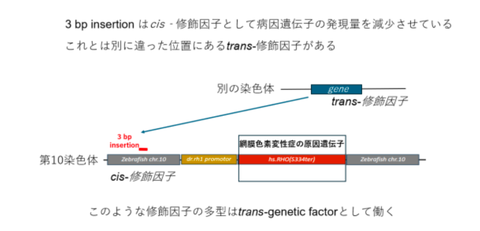
One factor was located close to the causative gene (in cis) and improved disease outcomes by reducing the expression of the disease-causing gene. The other factor was located in trans, separate from the disease-causing gene, and exacerbated disease severity, converting a relatively mild phenotype into a more severe one. This study is the first to demonstrate, in an animal model, the existence of both cis- and trans-acting genetic modifiers that influence the effects of a pathogenic mutation in a single inherited disease.
Although genetic modifiers that influence the severity of such inherited diseases have long been recognized as a theoretical concept, their existence has remained unproven except in a few exceptional cases.
Using a fish model of human retinitis pigmentosa, the research group identified two genetic modifiers, one acting in cis and the other in trans. These findings establish a foundation for prediction and controlling disease severity by using genetic modifiers, not only in inherited diseases but also in a broader range of disorders.
These findings are expected to facilitate the discovery of genetic modifiers that influence symptoms, disease severity, and prognosis in inherited diseases, and to promote their application in the development of new therapeutic strategies.
Figure: Genetic modifiers outside the disease-causing gene influence disease severity
Credit:
Research Background
Genetic diseases are disorders resulting from pathogenic mutations in a single gene. Therefore, affected individuals from the same family (for example, siblings) carry the same genetic mutation. However, for many genetic diseases, it has long been recognized that disease severity shows considerable variation even among patients carrying the same pathogenic variant. Retinitis pigmentosa is a representative inherited retinal disease that exhibits such clinical variability.
So far, differences in disease severity have been thought to result from environmental and genetic factors. For example, environmental factors such as light exposure have been extensively investigated using experimental animal models. In contrast, the influence of genetic factors has remained largely a matter of theoretical discussion, and proving its existence has been challenging.
Research Contents
The research group investigated multiple generations of a transgenic zebrafish model of human retinitis pigmentosa over a 12-year period. As a result, the researchers discovered the emergence of a family line that exhibited remarkably mild symptoms despite carrying the same pathogenic mutation. This was because the mild lineage carried a three-base difference located in cis near the disease-causing mutation.
Furthermore, when the mildly affected lineage was crossed several times with wild-type normal fish, it was found that the lineages in which approximately half of the offspring reverted to a severe phenotype. The descendants of these severely affected fish continued to segregate into severe and mild phenotypes in an approximately 1:1 ratio in subsequent generations. These findings provide strong evidence for the existence of a genetic modifier located at a site distinct from the disease-causing gene. This study provides the first demonstration that both cis- and trans-acting modifiers of disease severity can be identified in a monogenic disease. It is also the first to demonstrate, in an animal model, the existence of both cis- and trans-acting genetic modifiers that influence the effects of a pathogenic mutation in a single inherited disorder.
Social Impact
These findings are expected to facilitate the discovery of genetic modifiers that influence symptoms, disease severity, and prognosis not only in retinitis pigmentosa but also in other inherited disorders. These findings may not only enable the prediction of disease severity but also open the possibility of controlling disease progression and prognosis. In particular, in retinitis pigmentosa, which is caused by mutations in many different genes, trans-acting modifiers that mitigate disease severity may exist regardless of the pathogenic mutation. Such modifiers could represent promising therapeutic targets.
Notes
The article, “Cis‐ and Trans‐Regulatory Factors Independently Shape Phenotypic Heterogeneity of Retinitis Pigmentosa,” was published in German journal of Advanced Science