About this research

SHIRAISHI Yasuhiro
- Graduate School of Engineering Science
- Associate Professor

Simply deposit and dry: a new photocatalyst sheet for hydrogen peroxide production
Development of a polymeric photocatalyst that turns into a semiconductor when solidified
- The researchers have developed poly23DHN, a linear polymer photocatalyst that can be easily processed and formed into sheets and other shapes, enabling the production of hydrogen peroxide (H₂O₂) from water and oxygen (O₂).
- Conventional organic semiconductor photocatalysts are composed of highly cross-linked network structures, making them insoluble in solvents and therefore difficult to form and process into desired shapes.
- The researchers demonstrated that a photocatalyst sheet can be easily fabricated by simply depositing a poly23DHN solution in an organic solvent onto a substrate and allowing it to dry. The resulting sheet stably produces hydrogen peroxide (H₂O₂) from water and oxygen (O₂) under visible-light irradiation.
- This result is expected to pave the way for the development of low-cost, scalable hydrogen peroxide (H₂O₂) production technologies based on photocatalytic devices.
Outlines
A research group including third-year doctoral student Koki Yoshida, Associate Professor Yasuhiro Shiraishi, and Professor Takayuki Hirai of the Research Center for Solar Energy Chemistry, Graduate School of Engineering Science, The University of Osaka, has developed poly23DHN, a linear polymer that produces hydrogen peroxide (H₂O₂) from water and oxygen (O₂) under visible-light irradiation. Because this polymer is soluble in common organic solvents but insoluble in water, it can be easily formed and processed into practical shapes such as sheets.
Hydrogen peroxide (H₂O₂) is an important chemical widely used as a bleaching agent, disinfectant, and oxidizing agent. It has also attracted attention as potential liquid energy carrier alternative to fuel for fuel cells. Conventional H₂O₂ production relies on energy-intensive processes. In contrast, photocatalytic reactions can synthesize H₂O₂ from water and oxygen (O₂) using solar energy, making this approach a promising energy-efficient technology. Organic semiconductor photocatalysts have been widely researched because of their high selectivity for H₂O₂ production. However, their highly cross-linked network structures render them insoluble in solvents, making it difficult to process them into sheet-form photocatalysts.
The linear polymer poly23DHN developed in this study contains far fewer cross-links than conventional linear polymers and is therefore soluble in common organic solvents. However, it is insoluble in water and spontaneously forms a semiconducting solid through hydrogen (H)-bonding interactions and π–stacking. The researchers found that efficient H₂O₂ production is possible when this suspension is irradiated under visible light in the presence of O₂.
Furthermore, a photocatalytic sheet can be easily fabricated by simply depositing a poly23DHN solution in an organic solvent onto a substrate and allowing it to dry. By placing this sheet in water and irradiating it with light, pure hydrogen peroxide (H₂O₂) solution can be recovered.
This result is expected to pave the way for the development of a low-cost, scalable H₂O₂ production technology based on photocatalytic devices.
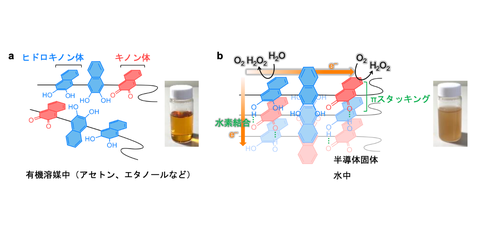
Fig. 1 Structure of poly23DHN in solvent
Poly23DHN is insoluble in water and forms a semiconducting solid through H-bonding interactions and π–stacking
Credit: Yasuhiro Shiraishi
Research Background
As hydrogen peroxide (H₂O₂) is an important chemical widely used as a bleaching agent, disinfectant, and oxidizing agent, it has attracted attention as potential liquid energy carrier alternative to fuel for fuel cells. However, conventional H₂O₂ production relies on energy-intensive processes, so the development of energy-efficient technologies is highly desirable.
Photocatalytic reactions enable the synthesis of H₂O₂ from water and oxygen using solar energy (H₂O + 1/2O₂ → H₂O₂). In particular, organic semiconductor photocatalysts exhibit high selectivity for H₂O₂ production and have therefore been actively developed as promising photocatalytic materials. For the practical implementation of H₂O₂ production technology, photocatalysts, which are conventionally used in powder form, must be formed and processed into recoverable and reusable shapes such as sheets. However, conventional organic semiconductor powders possess highly cross-linked network structures and are therefore insoluble in solvents, making them difficult to process into desired shapes. As a result, there has been a strong demand for new organic semiconductors that can be easily fabricated and processed.
Research Contents
This study sought to develop a semiconducting solid that is soluble in organic solvents. First, a linear polymer poly23DHN, was synthesized as a powder by the oxidative polymerization of inexpensive 23DHN under ambient temperature and pressure. As shown in Fig. 1a, poly23DHN has a structure in which hydroquinone–quinone units are randomly arranged. Because poly23DHN is a linear polymer, it is soluble in common organic solvents such as acetone and ethanol. However, it is insoluble in water, and as illustrated in Fig. 1b, the hydroquinone–quinone units assemble through H-bonding and π–stacking interactions to spontaneously form a semiconducting solid.
As shown in Fig. 2a, H₂O₂ was efficiently produced when poly23DHN powder was dispersed in water and irradiated under visible light in the presence of O₂. The semiconducting solid formed as shown in Fig. 1b absorbs light and transports electrons along both the π-stacking and linear directions. As a result, water oxidation (2H₂O → O₂ + 4H⁺ + 4e⁻; 2H₂O → H₂O₂ + 2H⁺ + 2e⁻) and oxygen reduction (O₂ + 2H⁺ + 2e⁻ → H₂O₂) proceed simultaneously, leading to the production of H₂O₂. In contrast, as shown in Fig. 2b, little H₂O₂ was produced when poly23DHN powder was dissolved in a mixed solvent of acetonitrile and water and irradiated with light. This is because, as illustrated in Fig. 1a, dissolution in the solvent prevents the hydroquinone–quinone units from assembling, causing poly23DHN to lose its semiconducting nature. In contrast, when the solvent was evaporated from the solution, the recovered poly23DHN powder was redispersed in water and irradiated with light, H₂O₂ was again produced, as shown in Fig. 2c. These results show that poly23DHN spontaneously forms a semiconducting structure upon becoming insoluble.
As shown in Fig. 3, a photocatalyst sheet can be easily fabricated by simply depositing a poly23DHN solution in an organic solvent onto a substrate such as glass or cotton fabric and allowing it to dry at room temperature. The researchers found that, upon immersion in water and irradiation with light in the presence of O₂, the photocatalyst sheet continuously produced H₂O₂ without any detachment of poly23DHN from the substrate. By simply removing the sheet, a pure H₂O₂ solution can be collected. These experiments demonstrated that a stable photocatalyst sheet can be fabricated through the simple process of depositing and drying.
Fig. 2 Changes in H₂O₂ production amount by poly23DHN under light irradiation in different solvents
Poly23DHN (50 mg) was added to a solvent (30 mL) and irradiated with light for six hours in the presence of O₂
Credit: Yasuhiro Shiraishi
Fig. 3. Fabrication of a poly23DHN photocatalyst sheet and H₂O₂ production
A photocatalyst sheet was fabricated simply depositing a poly23DHN solution onto a substrate and allowing it to dry. The graph on the right shows the changes of H₂O₂ amount produced when the sheet was immersed in water and irradiated with light in the presence of O₂
Credit: Yasuhiro Shiraishi
Social Impacts
In this study, the researchers developed for the first time a polymer semiconductor that is soluble in organic solvents yet functions as a photocatalyst in water. Photocatalyst sheets can be easily fabricated simply by depositing a substrate with a solution of this polymer and allowing it to dry. When the photocatalytic sheet is immersed in water and irradiated with light, H₂O₂ is stably produced. In addition, a pure H₂O₂ solution can be easily recovered simply by removing the sheet. This approach is expected to pave the way for the development of a low-cost, scalable H₂O₂ production technology driven by solar energy.
Notes
The article, “Photocatalytic Solar Hydrogen Peroxide Production on Donor+Acceptor Linear Polymer Semiconductor Powders Reconfigurable by H-Bonding and p-Stacking Interactions,” was published in German journal of Angewandte Chemie International Edition at DOI: 10.1002/anie.1682982