

First large-scale genome-wide association study (GWAS) of myasthenia gravis (MG) in an Asian population
Elucidating genetic backgrounds among different subtypes of MG
- The research group established the first large-scale genomic dataset of an Asian population, comprising 1,434 myasthenia gravis (MG) in Japanese and 42,913 controls, and conducted a genome-wide association study (GWAS).
- Through GWAS, researchers discovered a novel genetic locus in the TERT gene region on chromosome 5 that is linked to the development of MG.
- Stratified GWAS analyses by clinical subtype revealed different genetic backgrounds among patients positive for anti-acetylcholine receptor (AChR) antibodies. Specifically, the TERT gene was associated with the thymoma-associated subgroup, whereas the HLA gene was associated with the non-thymoma subgroup.
- The research group also demonstrated that the MG risk allele of TERT is associated with treatment resistance, and that the TERT gene is expressed in a cell type-specific manner in immature T cells within thymomas, where it regulates TERT expression in a risk allele-specific manner.
- These findings are expected to contribute to the advancement of new drug discovery for MG and the realization of personalized medicine.
Outlines
A research group including Hiroyuki Ueda (doctor course in Statistical Immunology at the time of the study / Department of Metabolic Medicine), Associate Professor Tomoya Kubota of Clinical Neurophysiology, Professor Iichiro Shimomura of Department of Metabolic Medicine), Professor Masanori Takahashi of Clinical Neurophysiology, at the Graduate School of Medicine, the University of Osaka, and Professor Yukinori Okada of Statistical Immunology at the time of the study; Professor at the Center for Advanced Modalities and DDS, the University of Osaka, at the time of the study; Professor of Department of Genome Informatics, Graduate School of Medicine, The University of Tokyo; and Team Leader of the Laboratory for Systems Genetics, RIKEN Center for Integrative Medical Sciences Laboratory for Systems Genetics, together with Kimiaki Utsugisawa, Director of General Hanamaki Hospital, conducted a genome-wide association study (GWAS) using the first large-scale genomic dataset of an Asian population in the world for myasthenia gravis (MG), comprising 1,434 Japanese MG cases and 42,913 control individuals without the disease. As a result, they newly identified a genetic locus in the TERT gene region on chromosome 5 that is associated with susceptibility to MG.
Furthermore, stratified GWAS analyses by clinical subtype revealed that, among patients with generalized anti-acetylcholine receptor (AChR) antibody-positive MG, the thymoma-associated subgroup showed a significant association with the TERT gene, whereas the non-thymoma-associated subgroup showed a significant association with HLA genes. These findings demonstrate that distinct clinical subtypes have subtype-specific genetic backgrounds.
Also, the single nucleotide polymorphism (SNP) showing the strongest association at the TERT locus (the lead SNP) was also associated with treatment resistance in certain disease subtypes. Phenome-wide association study (PheWAS) further demonstrated associations with multiple traits, including lung cancer and telomere length, indicating that this variant exerts pleiotropic effects.
Analysis of publicly available single-cell datasets from thymoma specimens associated with MG, together with immunohistochemical staining of pathological tissue samples, revealed that the TERT gene is expressed in a cell type-specific manner in immature T cells within thymomas. RNA sequencing analysis further demonstrated that the risk allele associated with the development of MG was linked to reduced TERT gene expression.
These findings advance the understanding of the genetic basis underlying the development and pathogenesis of MG and are expected to contribute to the future drug discovery and the realization of personalized medicine.
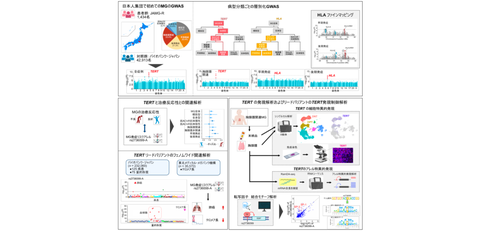
Fig. 1 Schematic overview of the study
Credit: Masanori Takahashi
Research Background
Myasthenia gravis (MG) is an autoimmune disease in which autoantibodies targeting the neuromuscular junction impair signal transmission at the neuromuscular junction. The main symptoms are ptosis (drooping of the eyelids) and muscle weakness. In severe cases, the disease can lead to respiratory difficulties and impaired walking ability. In addition to reducing patients’ quality of life (QOL), MG generally requires long-term treatment, and in some cases the cost of treatment can be substantial. As a result, the disease imposes a significant social and economic burden on patients.
Both genetic and environmental factors are believed to play a role in the development of MG. Although several studies have investigated the genetic factors associated with the development of MG, primarily through genome-wide association studies (GWAS), all of them were conducted in populations of European ancestry, and no GWAS had been reported in Asian populations. MG is known to exhibit substantial clinical heterogeneity among its subtypes, with marked differences in treatment outcomes, prognosis, and associated complications. However, previous genetic studies have been limited to analyses of only certain MG subtypes.
Research Contents
The research group conducted a genome-wide association study (GWAS) using the first dataset established for MG in an Asian population. The dataset comprised 1,434 Japanese patients with MG recruited from 14 institutions participating in the Japan Myasthenia Gravis Registry (JAMG-R; Director: Kimiaki Utsugisawa, Director of General Hanamaki Hospital) and 42,913 unaffected controls from BioBank Japan (BBJ) Project. As a result, in addition to the previously reported HLA region, the researchers newly identified a genetic locus in the TERT gene region on chromosome 5 that is associated with MG development (Fig. 1 and 2).
In addition, the researchers performed subtype-stratified GWAS covering all disease subtypes according to the O/g-ELTMuN classification, a disease classification system proposed in the Japanese clinical guidelines for MG. The analyses revealed that the TERT gene was significantly associated with thymoma-associated MG (g-TAMG) among patients with generalized AChR antibody-positive MG (g-AChR-Ab(+) MG), whereas HLA genes were significantly associated with non-thymoma-associated MG (g-TA(-) MG) (Fig. 1 and 2).
Furthermore, association analyses of HLA polymorphisms imputed from SNP genotyping data using a Japanese reference panel revealed distinct subtype-specific associations. Among patients without thymoma, amino acid polymorphisms in HLA-A showed the strongest association with early-onset MG (g-EOMG), whereas the HLA-DRB108:03 allele exhibited the strongest association with late-onset MG (g-LOMG). These findings demonstrate that MG development is influenced by subtype-specific genetic factors (Fig. 1).
Fig. 2 Results of the GWAS in the overall MG cases and subtype-stratified analyses
Credit: Masanori Takahashi
Next, the researchers investigated the association between the lead SNP at the TERT locus and treatment response. The presence of the MG risk allele was found to be significantly associated with treatment resistance in both generalized AChR antibody-positive MG (g-AChR-Ab(+) MG) and early-onset MG (g-EOMG). Furthermore, a phenome-wide association study (PheWAS) was performed using data from BioBank Japan (BBJ) and the Tohoku Medical Megabank Organization, covering 125 diseases and 76 quantitative traits. The analysis revealed that carriers of the MG risk allele had an increased risk of lung cancer and tended to have shorter telomere length. These findings indicate that the lead SNP exerts pleiotropic effects, being associated with a variety of other traits and diseases (Fig. 1).
Finally, the research team performed an expression analysis of the TERT gene using resected thymoma specimens from patients with MG. Publicly available single-cell transcriptomic data and immunostaining analyses of pathological tissue specimens revealed that TERT gene expression was barely detectable in peripheral blood cells. In contrast, within thymomas, TERT gene was expressed in a tissue- and cell type-specific manner, predominantly in immature T-cell populations, including double-negative (DN) and double-positive (DP) T cells (Fig. 1).
Moreover, by performing RNA sequencing of thymoma tissues using RamDA-seq, a technique capable of capturing full-length messenger RNA transcripts, it was found that the MG risk allele was associated with reduced TERT gene expression in an allele-specific manner. The lead SNP is known to reside within a binding site for the transcription factors SP1 and SP3. Motif analysis of transcription factor binding revealed that the MG risk allele was associated with reduced binding affinity for both SP1 and SP3 (Fig. 1). These findings indicate that the lead SNP at the TERT locus has a functional role in regulating TERT expression.
Social Impacts
This study is the first GWAS of MG conducted in an Asian population, and it revealed that MG has subtype-specific genetic backgrounds. The researchers also demonstrated that the TERT gene may play a role in treatment response and disease pathogenesis in MG. This study is expected to contribute to the development of future therapeutic strategies for MG, including drug discovery and the realization of personalized medicine.
Notes
The article, “Elucidating genetic backgrounds of myasthenia gravis in Japanese by genome-wide association studies and multi-omics analyses of thymoma,” was published in Nature Communications at DOI: https://doi.org/10.1038/s41467-026-70376-5.
