About this research

MURAKAMI Michio
- Center for Infectious Disease Education and Research
- Professor
A comparative study of the effects and unintended consequences of infection prevention posters in Japan and the United States
Justifications may encourage action but could also trigger resistance
- The side message effects accompanying infection prevention posters vary by country and recipients' pre-existing tendencies.
- Among individuals with a positive attitude toward infection prevention, messages combining social norms with additional justifications were more likely to increase behavioral intentions in Japan, whereas messages emphasizing public health perspectives were more effective in the United States.
- The posters were perceived as coercive and stressful, particularly among individuals with low baseline compliance of infection prevention measures.
- Campaign designers should consider crafting visual messages to avoid reinforcing resistance and stigma.
Outlines
A research group including Associate Professor Tomoyuki Kobayashi of the School of Sociology at Kwansei Gakuin University, and Professors Michio Murakami and Asako Miura of the Center for Infectious Disease Education and Research (CiDER), The University of Osaka (with Professor Miura also serving in the Graduate School of Human Sciences), has revealed how side messages explaining “why such actions are recommended” in infection-prevention posters influence people’s intentions to engage in preventive behaviors, their attitudes toward those holding different views, and their perceptions of the posters themselves.
The results showed that the effectiveness of these side messages varied depending on the country and recipients’ baseline propensity for infection-prevention behaviors. In Japan, messages that combined social norms with additional justifications were more likely to increase intentions to engage in preventive behaviors, whereas in the United States, messages emphasizing a public health perspective were more effective. On the other hand, the study also revealed that among individuals with low baseline propensity of infection prevention measures, such posters were more likely to be perceived as coercive and stressful.
These findings suggest that, when designing infection-prevention messages, it is important not only to maximize their effectiveness in promoting preventive behaviors, but also to ensure that they do not inadvertently increase resistance, stigma, or social polarization.
Research Background
During infectious disease outbreaks, government agencies and health organizations often use posters to communicate messages that encourage preventive behaviors, such as handwashing and mask wearing. These messages sometimes include not only instructions on what people should do, but also justifications explaining why they should do it. For example, such messages may explain that the recommended actions are necessary to protect oneself and others, to safeguard public health, or to comply with social norms.
However, while such justifications may encourage infection-prevention behaviors, they may also increase negative attitudes toward people with different views and contribute to social polarizations. To address this issue, the study examined how messages promoting infection-prevention behaviors influence not only people’s behavioral intentions, but also their attitudes toward others who hold different views and their perceptions of the posters themselves.
Research Contents
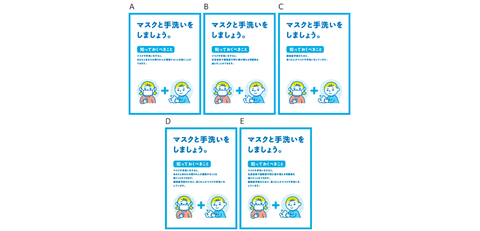
The research group conducted three repeated cross-sectional online surveys in Japan and the United States in September, November, and December 2024. Participants were presented with posters promoting wearing masks and washing hands. The posters were accompanied by side messages that justified these behaviors by emphasizing reasons such as protecting oneself and others (“by wearing masks and washing hands, you can prevent yourself and people around you from getting infected.”), public health (“by wearing masks and washing hands, you can reduce the possibility of increasing the number of infections and deaths in society as a whole.”), norms (“many people are wearing masks and washing hands to prevent infectious diseases.”), or combinations of these rationales (Figure).
As a result, in Japan, among individuals who were already engaged in infection-prevention behaviors, messages that combined social norms with either self- and other-protection or public health rationales (Figure D, E) were more likely to increase intentions to adopt preventive behaviors. In the United States, among individuals who were already engaged in infection-prevention behaviors, messages emphasizing the public health benefits of protecting the health of society as a whole (Fig. B) were relatively effective. In contrast, among individuals who were less inclined to engage in infection-prevention behaviors, messages that combined public health and social norms (Fig. E) were more effective in increasing preventive behavioral intentions than messages emphasizing social norms alone.
The research also clarified that these posters were more likely to be perceived as coercive and stressful, particularly among individuals who were less inclined to engage in infection-prevention behaviors. These findings indicate the need for public communication campaigns promoting infection-prevention behaviors to be carefully designed so as not to reinforce criticism of, or backlash against, minority viewpoints.
Figure: Posters used in this study
Posters encourage washing hands and wearing masks, accompanied by messages that justified these infection-prevention behaviors.
A) Self/Other Protection
B) Public Health
C) Norms
D) Self/Other + Norms
E) Public Health + Norms
Note that English-language versions of the posters were used in the U.S. survey.
Credit: Michio Murakami
Future Developments
This study showed that the effectiveness of infection-prevention messages varies not only by country and cultural background, but also by recipients' pre-existing attitudes toward infection prevention. Further research should determine what types of messages can effectively promote preventive behaviors while minimizing the risk of provoking resistance, reinforcing stigma, or exacerbating social polarizations. In particular, for individuals who are less inclined to engage in infection-prevention behaviors, it is important not only to select messages with high average effectiveness, but also to consider message framing that is less likely to be perceived as coercive or prescriptive and that respects recipients’ sense of autonomy. Future research will expand its scope beyond infectious diseases to encompass risk communication in disasters and public health emergencies more generally, with the goal of informing the design of more inclusive communication strategies that are less likely to generate social polarization and conflict.
Notes
The article, “Side messages, side effects: Justifying infection prevention but fuelling social polarisation,” was published in SSM - Population Health at DOI: 10.1016/j.ssmph.2026.101922
