

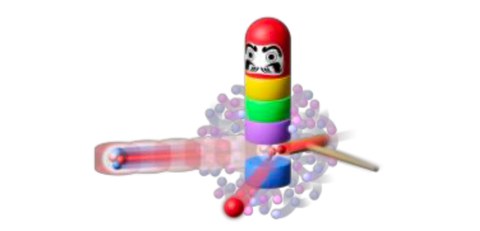
Initial results from a project exploring atomic nuclei through Quantum Daruma-otoshi
Deuteron clusters found in carbon and oxygen atomic nuclei
An international research team including Director Tomohiro Uesaka, and Researcher Yuki Kubota of the Nuclear Dynamics Research Group at RIKEN Nishina Center for Accelerator-Based Science; Associate Professor Juzo Zenihiro, and Ryotaro Tsuji, a graduate student at the time of the study, of the Graduate School of Science, Kyoto University; Assistant Professor Junki Tanaka of the Research Center for Nuclear Physics, the Universityof Osaka; and Professor Kazuyuki Ogata of the Graduate School of Science at Kyushu University, has discovered that deuteron clusters, consisting of a bound proton-neutron pair, exist within the nuclei of carbon-12 (12C)and oxygen-16 (16O) with significantly higher probabilities than previously thought.
Atomic nuclei have been regarded as having the liquid-drop model in which protons and neutrons are distributed uniformly and independently inside the nucleus. However, it has also been suggested that small groupings, or clusters, may exist within the nucleus, indicating inhomogeneity. To investigate the internal structure of atomic nuclei, the researchers launched the ONOKORO Project, which makes use of knockout reactions. In a manner like the Japanese game Daruma-otoshi, incident protons collide with a nucleus and knocks constituent particles out of it, allowing the nuclear structure to be examined.
As the first achievement of the project, the international research team conducted experiments in which deuterons were knocked out of carbon-12 (12C) and oxygen-16 (16O) nuclei using a proton beam. The results clarified that deuteron clusters exist in these nuclei with a probability of at least 30-40%. This finding provides new insight into the question of how atomic nuclei are structured, and is expected to contribute to a deeper understanding of the origin of nuclear stability and the mechanisms underlying alpha decay. The ONOKORO Project has also yielded new experimental data on alpha clusters, triton clusters, and helium-3 clusters. These findings capture signs that inhomogeneity within atomic nuclei emerges in a much wider variety of forms and with substantially higher probabilities than previously thought.
Fig. 1 Conceptual illustration of a knockout reaction as a quantum version of the traditional Japanese game of Daruma-otoshi
Credit: Junki Tanaka
Research Background
When we look around us, we find that the world takes different forms depending on what we observe and the scale we choose to examine. Above us lies the atmosphere, a low-density gas, while beneath our feet is the ground, a high-density solid. The term “inhomogeneity” describes the variation in physical state or structure from one place to another. In this sense, our world is filled with inhomogeneity wherever we look. On a cosmic scale, inhomogeneities created by the gravitational concentration of interstellar gas lead to the formation of stars. Meanwhile, within our bodies, inhomogeneities associated with local variations in the subtle concentration gradients of chemical substances play an essential role in sustaining life.
Does such inhomogeneity also arise in the quantum world, far smaller than atoms? The atomic nucleus, located at the center of an atom and is about one hundred thousand times smaller than the atom itself, is generally regarded as a uniform and homogeneous form of matter, like a liquid, composed of protons and neutrons. On the other hand, alpha rays, one of the forms of radiation found at the end of the nineteenth century, are emitted when an alpha particle (⁴He nucleus), a small cluster of nucleons, separates from otherwise homogeneous proton-neutron nuclear substances and escapes from the nucleus. This phenomenon is regarded as one manifestation of nuclear inhomogeneity (Fig. 1). Particles that emerge within an atomic nucleus, such as alpha particles, are called clusters, and the research on nuclear clustering has become one of the central themes of nuclear physics. A well-known example is the Hoyle state, an excited state of the carbon-12 (12C). This state is composed almost entirely of three alpha particles and is known to play a crucial role in the synthesis of carbon in the universe.
Fig. 1 Schematic illustration of the emergence of inhomogeneity in atomic nuclei
Atomic nuclei have been regarded as uniform and homogeneous substances composed of protons (red spheres) and neutrons (blue spheres). However, they are now regarded to exhibit internal inhomogeneity through the formation of clusters such as deuterons (one proton and one neutron), alpha particles (⁴He nucleus; two protons and two neutrons), tritons, and helium-3 clusters.
Credit: Junki Tanaka
The international research team launched the ONOKORO Project in 2021 to investigate how inhomogeneous structures emerge inside atomic nuclei. The project makes use of proton-induced knockout reactions, in which incident protons eject nuclear clusters from the nucleus, allowing researchers to probe the manifestation of internal inhomogeneity. The project name ONOKORO is derived from the Kojiki (Records of Ancient Matters), Japan’s oldest chronicle. In the myth of the creation of Japan, drops falling from the heavenly jeweled spear (Ame-no-Nuboko) formed Onokoro Island, the first island to emerge from the primordial, chaotic sea. The project was named after this legend because it bears a striking resemblance to the phenomenon in which cluster-like structures, resembling “islands,” emerge from a chaotic quantum “sea” (liquid) composed of protons and neutrons.
The ONOKORO Project frequently utilizes knockout reactions, a technique often compared to the traditional Japanese game Daruma-otoshi. Daruma-otoshi is a traditional Japanese game in which a player strikes one of the stacked wooden pieces with a small hammer, knocking it out from the structure. When executed carefully, the Daruma doll on top simply drops down into the vacated position while the overall stack remains intact, as if unaware that a piece has suddenly disappeared. This behavior closely resembles a knockout reaction, in which a nucleon is abruptly removed from a nucleus while the remaining system is left largely undisturbed. Knockout reactions are an experimental technique in which a high-energy particle, in this case a proton, is directed at a nucleus with sufficient momentum to knock out a constituent cluster, much like striking a piece in a game of Daruma-otoshi. By analyzing the ejected cluster and the remaining nucleus, researchers can investigate the structure and properties of the cluster itself (Fig. 2).
Fig. 2 The knockout reaction as a quantum Daruma-otoshi game
The hammer on the right represents the proton beam, the piece knocked out corresponds to the knocked-out cluster, and the Daruma together with the remaining pieces represents the residual nucleus.
Credit: Junki Tanaka
The knockout reaction is most effectively employed at the energy range of 200 to 400 megaelectronvolts (MeV) per nucleon (1 MeV = 1 million electronvolts), which is covered by Japan’s world-leading accelerator facilities, the RIKEN Radioactive Isotope Beam Factory (RIBF) and the Research Center for Nuclear Physics (RCNP) Cyclotron Facility at the University of Osaka. The knockout reaction has been used to discover alpha clustering in tin isotopes (atomic number 50), and is thought to be one of the most powerful methods for cluster studies. In the ONOKORO Project, the researchers are effectively utilize the knockout reactions to explore cluster structures medium-mass nuclei, which differ markedly from conventional expectations, as well as novel types of clusters such as deuterons and tritons in addition to alpha particles.
Research Contents
In this study, the international research team carried out deuteron knockout reaction experiments on carbon-12 (12C) and oxygen-16 (16O) nuclei using the proton beam at RCNP. At RCNP, proton beams were accelerated to 226 MeV (approximately 60% of the speed of light) using the AVF Cyclotron and Ring Cyclotron. The beams were then directed onto a 12C target and a polyester-film target containing 16O, and the protons and deuterons emerged in the knockout reactions were analyzed (Fig. 3). To analyze protons scattered to the left of the carbon and oxygen targets positioned at the center of the experimental equipment, the Grand Raiden spectrometer was employed, while deuterons scattered to the right were analyzed using the Large-aperture Spectrometer. This configuration enabled measurements with high energy resolution.
Fig. 3 Equipment used for the analysis of particles emerged by knockout reactions
Credit: Junki Tanaka
The Grand Raiden spectrometer was used to analyze protons scattered to the left, while the Large-aperture spectrometer was used to analyze deuterons scattered to the right. The experimental data from this study revealed multiple prominent peaks indicating the presence of deuteron clusters (Fig. 4). In this study, the researchers focused on the most prominent peaks observed for 12C and 16O and compared them with state-of-the-art theoretical calculations for knockout reactions. As a result, they found that the 12C and 16O nuclei contain at least 1.6 and 1.9 deuteron clusters, respectively. Because the maximum number of deuteron clusters that can be included in the outermost shell is four for 12C and six for 16O, these results indicate that 40% of proton-neutron pairs in 12C and 32% of those in 16O form deuteron clusters. Previous nuclear physics had not predicted the existence of such many deuteron clusters. This finding demonstrates that inhomogeneity within atomic nuclei emerges in a greater variety of forms and with higher probabilities than previously thought.
Fig. 4 Deuteron knockout spectra for 12C and 16O nuclei. The horizontal axis represents the excitation energies of the residual nuclei boron-10 and nitrogen-14 produced by deuteron removal, while the vertical axis indicates the number of detected events. The peak enclosed in red is the primary focus of the present analysis and corresponds to a deuteron cluster strength of 1.6 in 12C and 1.9 in 16O. Credit: Junki Tanaka
Future Development
This study revealed that cluster formation, a manifestation of nuclear inhomogeneity, occurs in a much wider variety of forms and with significantly higher probabilities than previously thought. These findings provide a new perspective on the possible forms and structures of atomic nuclei. They are expected to have a significant impact on the understanding of nuclear decay processes, such as alpha decay and nuclear fission, which are closely related to modern human society, as well as on the properties of low-density nuclear matter produced in supernova explosions.
In addition to the results from this study, the ONOKORO Project has produced a wealth of data shedding light on previously unexplored aspects of nuclear cluster structures. These include experiments that observed alpha clustering in the 40Ca nucleus, reported in a companion paper published simultaneously, as well as the discovery of triton and helium-3 clusters in stable calcium isotopes.
The international research team is currently working to extend studies of nuclear clustering using knockout reactions to unstable nuclei that do not occur naturally on Earth. RIBF is a world-leading accelerator facility for the production of unstable nuclei and for research utilizing them. The team has been developing a new detector system, TOGAXSI (Fig. 5), specifically designed for knockout-reaction research of unstable nuclei. In June 2025, as its first experiment, TOGAXSI was installed at the SAMURAI magnetic spectrometer of the RIBF, and data were obtained for nuclei in the vicinity of neutron-rich calcium-52 (52Ca); atomic number 20, mass number 52). This experiment achieved the first successful acquisition of data on deuteron, triton, helium-3, and alpha clusters in these nuclei.
Fig. 5 TOGAXSI detector array
A new detector system specifically designed for knockout-reaction research of unstable nuclei
Credit: Junki Tanaka
In the future, the research team will expand the scope of their studies to collect data across a broad mass range, from stable to unstable nuclei, and pursue a deeper understanding of the mechanisms responsible for the emergence of inhomogeneous structures within atomic nuclei.
Notes
The article, “Proton-induced deuteron knockout (p,pd) on 12C and 16O at 226 MeV,” was published in Progress of Theoretical and Experimental Physics at DOI: https://doi.org/10.1093/ptep/ptag046
