About this research

SHIMADA Shoichi
- United Graduate School of Child Development
- Specially Appointed Professor

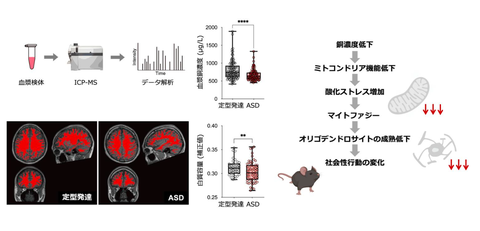
Elucidated the mechanism by which low copper level associated with autism spectrum disorder (ASD) affect white matter formation and social behavior
- In individuals with ASD, decreased plasma copper concentrations were observed, and an association with symptom index was identified.
- In individuals with ASD, reduced white matter volume was observed, and an association with symptoms related to social behavior was identified.
- Demonstrated that copper deficiency impairs oligodendrocyte (OL) maturation and myelination.
- Identified dysregulated mitophagy and inhibition of mTOR signaling as underlying molecular structure.
- Proposed a new perspective on the pathology of ASD from the viewpoint of trace element metabolism and white matter formation.
- This finding is expected to provide new insights into ASD.
Outlines
A research team consisted of Professor Noriyoshi Usui and Assistant Professor Miyuki Doi, Department of Developmental Neuroscience, Dentistry and Health Sciences, Graduate School of Medicine, Niigata University, Professor Shoichi Shimada, Neuroscience and Cell Biology, Graduate School of Medicine, The University of Osaka, Professor Taiichi Katayama, Molecular Biology and Genetics Research Area, United Graduate School of Child Development, The University of Osaka, Professor Manabu Makinodan, Department of Neuropsychiatry, Faculty of Life Sciences, Kumamoto University, and Professor Hideo Matsuzaki, Division of Development of Functional Brain Activities, Research Center for Child Mental Development, University of Fukui identified an association between low plasma copper levels and symptom index in individuals with ASD, and, by analyzing the underlying molecular structure with a mouse model, demonstrated that copper deficiency relates to impaired oligodendrocyte (OL) maturation involved in white matter formation and to altered social behavior. Using a mouse model, the researchers found that copper deficiency leads to reduced myelination, along with dysregulation of mitophagy, a quality control mechanism that selectively eliminates damaged mitochondria, and suppression of mTOR signaling, which regulates cell growth and metabolism. This study provides a new perspective on the pathology of ASD by examining it from the viewpoint of trace element metabolism and white matter formation.
Research Background
Autism spectrum disorder (ASD) is a neurodevelopmental disorder characterized by differences in social communication and patterns of restricted or repetitive behaviors. Although alterations in neural circuit development are thought to be involved in the pathogenesis of ASD, recently, attention has expanded beyond neurons to include changes in glial cells, which play a key role in the formation of the brain's white matter. Oligodendrocytes are glial cells that wrap axons with myelin, playing an important role in enhancing the efficiency of neuronal signal transmission. Changes in their maturation may have a significant impact on brain development.
Copper is an essential trace element in the body and is involved in energy metabolism, redox regulation, and the maintenance of enzymatic activity. In recent years, alterations in the balance of trace elements in the body have been reported in individuals with ASD. However, it has remained unclear how changes in copper levels affect symptoms and brain development, particularly white matter formation, and what molecular and cellular mechanisms underlie these effects.
Research Contents
In this study, the research group conducted the metabolome analysis of plasma from individuals with ASD using inductively coupled plasma mass spectrometry (ICP-MS), and identified a decrease in copper levels that was associated with symptom index assessed by the Autism Diagnostic Observation Schedule, Second Edition (ADOS-2). Therefore, focusing on the decrease in copper levels suggested to be associated with ASD, the research team aimed to elucidate how a low blood copper level affects brain white matter formation and social behavior by using a mouse model. The research group conducted a multifaceted analysis by combining behavioral, histological, and molecular biological approaches to investigate the maturation of oligodendrocytes (OL), white matter formation, and alterations in intracellular signaling under conditions of copper deficiency.
As a result, the researchers found that copper deficiency impairs the maturation of oligodendrocytes (OL), responsible for white matter formation, leading to reduced myelination. Furthermore, they revealed that these effects involve dysregulation of mitophagy, a mitochondrial quality control mechanism, and suppression of mTOR signaling, which regulates cell growth and metabolism. In addition, MRI analyses of individuals with ASD confirmed that reduced white matter volume is associated with symptoms related to social behavior. These results suggest a pathway by which alterations in trace element metabolism affect brain function through the regulation of intracellular metabolism and the maturation of glial cells. Furthermore, these findings demonstrate that the mechanisms analyzed in animal models support the significance of reduced copper levels and white matter alterations observed in humans.
Credit: Shoichi Shimada
Social Impact
This study is significant in that it addresses the pathophysiology of ASD from an integrative perspective that links multiple levels, including trace element metabolism, mitochondrial regulation, and white matter formation. Going forward, it will be important to integrate analyses of human samples and clinical data to examine whether alterations in the balance of trace elements, including copper, can be utilized for the stratification and pathological assessment of ASD.
Furthermore, investigating whether changes in white matter formation and metabolic regulation are reversible is expected to provide a foundation for the development of novel therapeutic strategies targeting nutrition, metabolism, and intracellular signaling. In addition, combining plasma trace element profiles with imaging findings is expected to provide new insights into the understanding of ASD.
Notes
The article, “Copper deficiency impairs oligodendrocyte maturation and social behavior via mitophagy and mTOR suppression in ASD,” was published in Science Advances at DOI: 10.1126/sciadv.adz3398.
