About this research

NAGAI Masaya
- Graduate School of Engineering Science
- Associate Professor

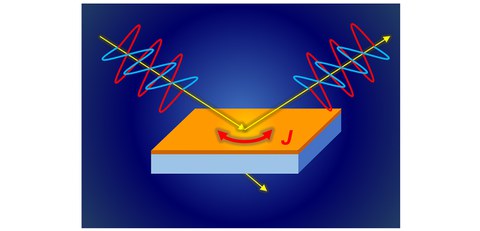
\Electrode-free measurement of the electrical properties of semiconductor thin films/Real‑time evaluation of semiconductor thin‑film performance through a reformulation of the optical reflection coefficient
Terahertz-based analytical technologies to speed up the development of next generation semiconductor devices
- By treating a semiconductor thin film as sheet current, the research group discovered that a simplified expression enabling the direct derivation of its electrical properties from the optical reflection coefficient.
- Conventional methods require electrode fabrication, risking material damage and contamination. By treating the multiple reflected light within the thin film as interface currents and returning to the fundamental electromagnetic boundary conditions for electric and magnetic fields, the researchers achieved a simple and rapid evaluation of properties of semiconductor thin films.
- This technique enables noncontact, nondestructive, and simple evaluation of electrical properties of semiconductor thin films, and is expected to serve as an essential foundational technology for the development of next-generation semiconductor devices.
Outlines
A research group including Akihiro Okamoto (master course), Associate Professor Masaya Nagai, and Professor Masaaki Ashida at Graduate School of Engineering Science, the University of Osaka, in collaboration with Nippo Precision Co., Ltd., has proposed for the first time in the world a new optical analysis model which can evaluate the electrical properties of semiconductor thin films in a noncontact and nondestructive manner.
This model reexamines the Fresnel coefficients, which describe the reflection of light, from the fundamental principles of electromagnetism. By treating the multiple reflections within a thin film whose thickness is much smaller than the wavelength as an interface current, the researchers derived a simple formula that directly determines the sheet conductance of a conductive thin film from its reflection coefficient. Conventional methods required the fabrication of electrodes, risking material damage and contamination. In contrast, the new method eliminates the need for complex numerical calculations and complicated analyses previously required, enabling the electrical properties of thin films to be extracted easily and rapidly. When the reflection coefficients of n-type and p-type GaAs thin film samples were evaluated using terahertz waves and this model, results consistent with those from conventional contact-based measurements were obtained, thereby confirming its validity.
This outcome resolves a major analytical bottleneck in the noncontact and nondestructive evaluation of the electrical properties of semiconductor thin films, and it is expected to become a fundamental technology that will significantly contribute to the research and future electronic and photonic device development.
Fig. 1 Schematic illustration of the proposed model. By reformulating the reflection coefficient by treating multiple reflections of light within a semiconductor thin film as a current of the interface, it becomes possible to easily evaluate the electrical properties of the material from the terahertz-wave reflection coefficient.
Credit: Masaya Nagai
Research Background
Next-generation semiconductors that surpass the limitations of silicon, such as SiC, GaN, and two-dimensional materials, are expected to be applied to cutting-edge devices including EV inverters, 6G communication modules, and qubit devices. Accurate evaluation of electrical properties such as carrier density and mobility is essential for the development of these materials. However, conventional electrical measurements require an electrode fabrication process, which carries the risk of damaging or contaminating the sample. Therefore, establishing a noncontact and nondestructive evaluation method that does not damage the sample is a critical challenge.
Given this background, terahertz time-domain ellipsometry has attracted attention as a promising optical technique. Terahertz waves have frequencies close to the response frequency of semiconductor carriers, allowing them to sensitively capture electrical parameters such as carrier concentration and mobility through changes in the polarization of reflected light. Furthermore, by applying a magnetic field to the sample, the polarization change of the terahertz wave is influenced by carrier motion (the Hall effect), enabling, in principle, the acquisition of carrier information equivalent to that is obtained from conventional Hall measurements.
On the other hand, when applying this method to ultrathin films or multilayer structures, a strict analysis based on a multilayer model based on fundamental optical principles is required. This is because it is necessary to use the Fresnel coefficients, which describe the reflection and transmission of light at interfaces between different media, and to strictly consider multiple reflections of light within the thin film. As a result, it involves complex numerical calculations with assumption of multiple parameters, such as film thickness and the dielectric constant spectrum. This complexity has posed a significant barrier to researchers who are not specialized in optics.
Research Contents
The research group, in collaboration with Nippo Precision Co., Ltd. (CEO: Toshihiko Furuya), has proposed an innovative analytical model, the conductive sheet approximation, which can evaluate the electrical properties of semiconductor thin films from optical spectra by returning to the fundamental principles of electromagnetism.
Semiconductor thin films whose thickness is much smaller than the wavelength of terahertz electromagnetic waves (approximately 30 μm to 3 mm), particularly those thinner than 1 μm, can be approximately treated as an interface with zero thickness through which electric current flows. In this case, the light that undergoes multiple reflections within the thin film can be represented as an interface current. Returning to the boundary conditions of electromagnetism, the relation that the discontinuity in the tangential component of the magnetic field is equal to the surface (sheet) current flowing on the interface, in the general optical reflection coefficient (Fresnel coefficient), the result is derived under the ideal condition that the interfacial current is zero. In contrast, the proposed model incorporates this interfacial current directly into the complex reflection coefficient.
What is particularly groundbreaking is the simplification of the analysis for semiconductor thin films while applying a magnetic field. Because the current induced by the Hall effect can be easily described, information that is obtained through Hall measurements can also be directly extracted from the reflection coefficient of semiconductor thin films. As a result, it becomes possible to significantly simplify the conventional complex numerical calculations and fitting procedures required in multilayer thin-film models.
Therefore, the research group independently improved a terahertz time-domain ellipsometry and developed a system that can perform high-precision measurements while applying a magnetic field to the sample. The researchers measured and analyzed n-type and p-type GaAs thin-film samples by using this system, and the results showed the complete agreement with those from conventional contact-based standard evaluation methods. This demonstrates that the conductive sheet approximation is a practical analytical tool for achieving reliable noncontact evaluation.
Fig. 2 Sheet conductance of an n-type GaAs thin film analyzed using the proposed model under an applied magnetic field of 0.3 T. The triangles (▲) indicate results obtained using the conventional contact-based standard evaluation method.
Credit: Masaya Nagai
Social Impacts
In this research, by reevaluating the Fresnel coefficients described in textbooks as a foundation of optics, the researchers established a method that enables the simple, noncontact, and nondestructive evaluation of the electrical properties of semiconductor thin films from their optical reflection response, without the need to fabricate electrodes and using only light. By overcoming the analytical bottleneck in the noncontact and nondestructive evaluation of the electrical properties of semiconductor thin films, this approach is expected to contribute to prompt material development and improved measurement reliability. In particular, it is effective for advanced functional materials that were difficult to evaluate using conventional methods, such as two-dimensional materials and topological insulators.
Notes
The article, “Modeling Terahertz Magneto-Optical Spectroscopic Ellipsometry with Conductive Sheet Approximation for Semiconductor Thin Films,” was published in Optics Letters at DOI: https://doi.org/10.1364/OL.583047.