

Elucidating the relationship between oral caries-causing bacteria levels and chronic kidney disease (CKD)
The effect of chlorhexidine-containing mouthwash on improvement in proteinuria
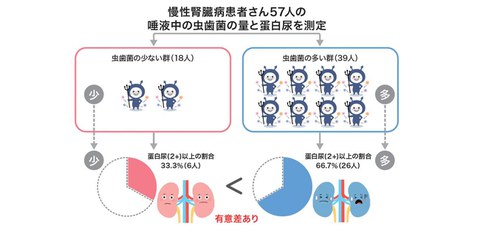
- Measuring oral caries-causing bacteria in the saliva of patients with chronic kidney disease (CKD) revealed that the group with higher levels of oral caries-causing bacteria had significantly higher levels of proteinuria.
- It was found that CKD patients who rinsed with chlorhexidine-containing mouthwash may reduce the number of oral caries-causing bacteria and may also reduce proteinuria.
- It is expected that rinsing with chlorhexidine-containing mouthwash may improve CKD.
Outlines
A research group including Professor Kazuhiko Nakano of the Joint Research Laboratory for Oral and Systemic Connection, Graduate School of Dentistry, the University of Osaka, and Visiting Academic Staff of the laboratory Taro Misaki, Director of the Division of Nephrology at Seirei Hamamatsu General Hospital, discovered that among patients with chronic kidney disease (CKD), those with higher levels of oral caries-causing bacteria in their saliva had significantly higher levels of proteinuria (Fig. 1). They also demonstrated that rinsing with chlorhexidine-containing mouthwash can reduce the amount of oral caries-causing bacteria and may lead to an improvement in proteinuria (Fig. 2).
In recent years, a relationship has been reported between oral caries-causing bacteria and immunoglobulin A (IgA) nephropathy (IgAN), one of the causes of CKD, however the effects of rinsing with chlorhexidine-containing mouthwash on both oral condition and the systemic health remained unclear.
Although this is still in the preliminary stages of research, it is expected that in the future, CKD patients rinsing with chlorhexidine-containing mouthwash will not only reduce the number of oral caries-causing bacteria but also improve their symptoms of CKD.
Fig. 1 Relationship between oral caries-causing bacteria levels and proteinuria at the start of the study
Credit: Kazuhiko Nakano
Fig. 2 Gargling with chlorhexidine-containing mouthwash may reduce the oral caries-causing bacteria levels and proteinuria
Credit: Kazuhiko Nakano
Research Background
In recent years, a relationship has been indicated between oral caries-causing bacteria and IgAN, one of the causes of CKD.
Tooth decay is caused by a type of oral caries-causing bacteria called Streptococcus mutans (S. mutans), and can be prevented by reducing the number of bacteria through treatment at a dental clinic and home oral care practices such as brushing and rinsing. However, the effects of rinsing with chlorhexidine-containing mouthwash on both oral condition and the systemic health remained unclear.
Research Contents
Patients with CKD who used chlorhexidine-containing mouthwash for rinsing over 12 months showed a significant reduction in the average proteinuria level compared to after six months. Furthermore, the group whose oral caries-causing bacteria count decreased to less than 1000 CFU/mL after 12 months showed a significantly higher rate of achieving proteinuria below 0.3 g/gCr compared to the other groups. This suggests that reducing the number of oral caries-causing bacteria may improve proteinuria.
Social Impact of Research
Gargling is one of the simplest oral care methods that can be done at home, making it easy to incorporate into daily oral care routines. Although this is still a preliminary study, it is expected that if CKD patients receive professional care at a dental clinic and also engage in self-care practices such as rinsing with chlorhexidine-containing mouthwash, it will not only improve the oral environment but also contribute to the improvement of CKD symptoms.
Notes
he article, “Association between oral Streptococcus mutans counts and proteinuria in patients with chronic kidney disease: a pilot study using chlorhexidine,” was published in JMA Journal at DOI: 10.31662/jmaj.2025-0375
