

\Read spin phase with electricity!/ Spin-phase detection of helimagnets using spin current
Proposed a new readout method for nanoscale magnetism
- It was discovered that the spin phase of a helimagnets can be electrically detected using spin current.
- Until now, spin-phase detection of helimagnets required ultrahigh vacuum or synchrotron radiation facilities. However, by utilizing surface-sensitive spin currents, it has become possible to detect the phase electrically in a laboratory setting.
- This is expected to lead to development of low-power devices utilizing the phase degree of freedom of helimagnets instead of the magnetization of ferromagnetic materials.
Outlines
A research group including Assistant Professor Nan Jiang and Professor Yasuhiko Niimi of the Department of Physics, Graduate School of Science, the University of Osaka, in collaboration with Professor Jun-ichiro Ohe of the Department of Physics, Faculty of Science, Toho University, and Professor Yoshihiko Togawa of the Department of Physics and Electronics, Graduate School of Engineering, Osaka Metropolitan University, has succeeded for the first time in the world in electrically detecting the spin phase and magnetic fluctuations of the helimagnets Cr1/3NbS₂ by nonlocal spin valve (NLSV) measurements using spin current.
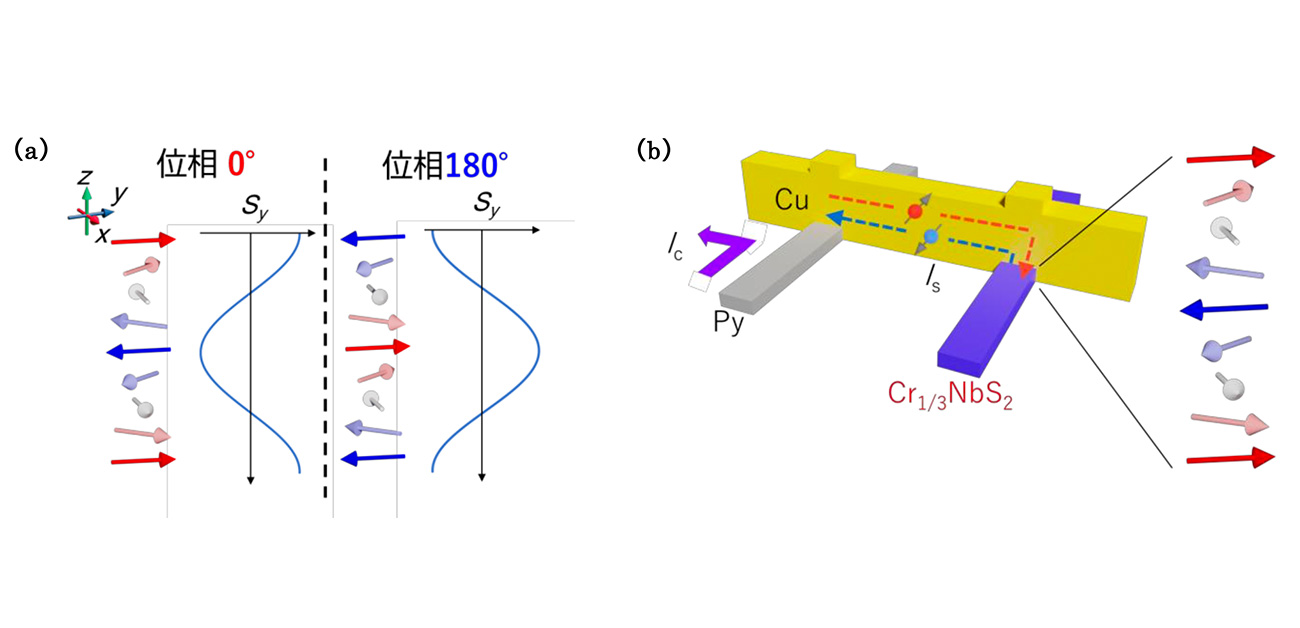
Helimagnets are a new type of material with the property that magnetic moments are arranged in a spiral. Because they are non-magnetizable, a characteristic not found in conventional ferromagnetic materials, they can be highly integrated and are expected to be a next-generation information medium. Cr₁/₃NbS₂ has a helimagnetic structure, and when a spin current is injected into the surface of this helimagnetic material, the spin current interacts primarily with the surface magnetic state. Taking advantage of this surface-sensitive property, the researchers electrically detected the spin phase (the phase of the helimagnetic structure) of a helimagnet (Fig. 1). Furthermore, the experimental results were also reproduced by numerical simulation (micromagnetic simulation).
Until now, spin-phase detection of a helimagnet, which is the direction of the magnetic moment on the sample surface, has been thought to require techniques with special environments, such as surface-sensitive X-ray magnetic circular dichroism or spin-polarized scanning tunneling microscopy. Consequently, electrically detectable methods suitable for device applications have not been elucidated.
In this study, the research group successfully demonstrated the electrical spin-phase detection of the van der Waals (vdW) chiral helimagnet Cr₁/₃NbS₂ by incorporating it into a nonlocal spin valve (NLSV) element. This demonstrates that the spin phase can be read without using large-scale equipment.
This demonstrates that it is possible to electrically manipulate the phase of nanoscale magnetism, which is expected to lead to the development of low-power devices and high integration in the future that utilize the spin phase of helimagnets as the degree of information freedom instead of the magnetization of ferromagnetic materials.
Fig. 1 (a) Schematic diagram of the spin phase (b) Schematic diagram of a nonlocal spin valve (NLSV) element incorporating the helimagnet Cr1/3NbS₂
Credit: Nan Jiang
Research Background
Until now, spintronics has used the magnetization direction of ferromagnetic materials as an information medium. However, the influence of the leakage magnetic field emitted by the ferromagnetic materials themselves has been a barrier to high integration. Helimagnetic materials are made by magnetic substances in which magnetic moments are arranged in a spiral. They have no magnetization as a whole and are suitable for high integration, so they are attracting attention as an alternative to ferromagnetic materials.
Such helimagnetic materials have two internal degrees of freedom: helicity (how the helix is wound) and spin phase (the phase of the helimagnetic structure: see Fig. 1(a)). If these can be manipulated effectively, they may be useful as new information medium. In particular, spin-phase detection corresponding to the direction of the magnetic moment on the sample surface was thought to require techniques with special environments, such as surface-sensitive X-ray magnetic circular dichroism or spin-polarized scanning tunneling microscopy, and electrical detection method applicable to devices had not been clarified. In conventional Hall effect measurements, the average magnetization is measured, so other methods had to be devised for the direct spin-phase detection.
Research Contents
The research group succeeded in detecting the spin phase of the helimagnet using a spin current by incorporating helimagnetic Cr₁/₃NbS₂ into a nonlocal spin valve (NLSV) element (see Fig. 1(b)).
First, experiments using NLSV elements revealed that the spin diffusion length (the distance over which spin current flows) of the helimagnetic Cr₁/₃NbS₂ is approximately 5 nm. This is about 1/10 of the length of one helical cycle (about 48 nm), and the researchers found that the spin current mainly picks up magnetic information from the sample surface. Then the researchers measured the electrical signal of the spin current in the helimagnet, obtaining a magnetic field dependence corresponding to the magnetization direction on the sample surface, i.e., the spin phase (Fig. 2).
Fig. 2 NLSV signals obtained using the helimagnet Cr1/3NbS₂ and the magnetic structure of the helimagnet at each magnetic field. Its spin signal corresponds to the magnetization direction on the sample surface (top surface).
Credit: Nan Jiang
This magnetic field dependence of the spin phase could also be reproduced by micromagnetic simulations, confirming the electrical spin-phase detection by spin current.
Social Impact of Research
The results of this research enabled the electrical spin-phase detection of helimagnets without relying on l large-scale equipment. The spin phase is a new information medium that can replace the magnetization of ferromagnetic materials, and it is expected that the spin phase of helimagnetic materials will be used to develop highly integrated, low-power devices.
Notes
The article, “Spin phase detection by spin current in a chiral helimagnet,” was published in Physical Review B (online) at DOI: https://doi.org/10.1103/mfrs-6whs.