
The brain decides what tastes good according to the body status
Flexible value calculation in the dopamine system
- The research group discovered that dopamine neurons calculate the value of water and salt intake according to the body's water and sodium balance.
- Although it has not been known how the value (palatability) of food and drink perceived by animals is calculated in the brain based on the body’s internal state, it became possible to approach this by using new behavioral assessment methods and neural recording techniques.
- It is expected to be applied to the development of an objective evaluation method for the palatability of food and to the treatment of psychiatric disorders accompanied by eating disorders.
Outlines
A research group including Assistant Professor Takaaki Ozawa, Issei Nakagawa (a doctoral student at the time of the research), Professor Takatoshi Hikida at the Institute for Protein Research of the University of Osaka, and Researcher Yuuki Uchida (at the time of the research) and Section Cheif Yuichi Yamashita of the National Institute of Neuroscience, National Center of Neurology and Psychiatry, has revealed, for the first time in the world, that dopamine neurons in the brain calculate the respective values of ingesting water or salt depending on the water and sodium balance in the body.
The value (palatability) of food and drink perceived by animals when eating, including humans, changes depending on the state of their bodies. However, how the value is calculated in the brain has been unknown.
This study revealed that the palatability of water and salt perceived by mice, as well as the dopamine response patterns in their brains, were reversed when they were thirsty and in the salt restriction phase. This tendency can be explained by a reinforcement learning model that considers the water and sodium balance in the body.
This discovery is expected to develop an objective evaluation method for the palatability of food according to the body's internal state, as well as in the treatment of psychiatric disorders accompanied by eating disorders.
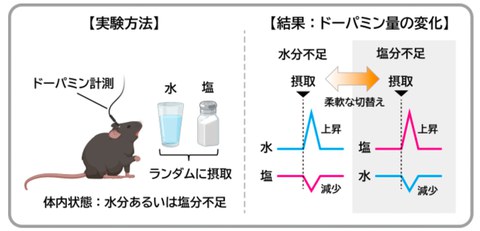
Figure The dopamine response induced by water or salt intake is reversed depending on the body's internal state
Credit: Takatoshi Hikida
Research Background
Humans feel thirsty and want to drink water or eat something salty. This is because of homeostasis, a natural process that tries to restore the water and sodium balance in the body when it is disrupted. These appropriate eating behaviors require a proper evaluation of the value of food and drink. The activity of the neurotransmitter dopamine in the brain has been thought to function as an emotional center and reflect the preference and aversion to food. However, how dopamine response to food and drink intake changes depending on the body's internal state has been unknown.
Research Contents
By combining a unique mouse behavioral evaluation system with the latest dopamine measurement methods, the research group was the first in the world to elucidate that dopamine neurons calculate the respective values according to the water and sodium balance in the body.
First, the researchers established a method to evaluate the palatability of liquids perceived by animals by analyzing the licking behavior of mice from a water supply tube. Next, this method was used to evaluate the palatability of water and salt water, and found that when mice were dehydrated, they perceived water as tasty and salt water as distasteful. On the other hand, when the mice were lacking salt in their bodies, they perceived salt water as tasty and plain water as disgusting. Interestingly, when dopamine activity in the brain was measured using imaging techniques, intaking water during drought induced high dopamine activity, while drinking salt water suppressed dopamine. Conversely, intaking salt water in a salt-lacking state increased dopamine, while intaking only plain water suppressed dopamine. In this way, the researchers found that the palatability of water and salt perceived by mice and their dopamine response were completely opposite depending on the water-salt balance in their bodies.
Furthermore, the research group simulated the brain's value information for water and salt using a reinforcement learning model that considers homeostasis and found that the calculated value information in the brain matched the dopamine response pattern observed in the mouse brain. These results suggest that the dopamine response to water or salt water, which varies depending on the body’s internal state, represents the value information.
Social Impact of the Research
The results of this research are expected to develop objective method for evaluating the palatability of food according to the body's internal state, as well as in applying this method to the treatment of psychiatric disorders accompanied by eating disorders.
Notes
The article, “Flexible value coding in the mesolimbic dopamine system depending on internal water and sodium balance,” was published in an American scientific journal of npj Science of Food (online) at DOI: https://doi.org/10.1038/s41538-025-00558-w.