About this research

ICHIKAWA Satoshi
- Research Center for Ultra-High Voltage Electron Microscopy
- Specially Appointed Professor (full-time)

Elucidated the mechanism of the thinness and brilliance of Kanazawa Gold Leaf, a UNESCO Intangible Cultural Heritage
Traditional crafts meet material science, leading to new discoveries
- It has been clarified that the beating and rolling process of Kanazawa Gold Leaf causes the entire leaf to have a cubic crystal texture, a state in which the crystal orientation of the crystal grains is concentrated in a specific direction.
- By placing Japanese washi paper on top and bottom of the gold leaf before beating, it prevents the temperature from rising, recrystallization, and recovery.
- The slip system, a mechanism that atomic layers move by slipping and is normally not active, is specially activated, realizing a uniform thinness and brilliance across the entire foil.
Outlines
A research group including Yuanzhe Xu, a doctoral student in the Nanomaterials and Devices Research Department at the Japan Advanced Institute of Science and Technology (JAIST), Lecturer Kohei Aso, Professor Hideyuki Murata, Professor Yoshifumi Oshima, and Specially Appointed Professor Satoshi Ichikawa (full-time) at the Research Center for Ultra-High Voltage Electron Microscopy at the University of Osaka, has used the latest electron microscope technology to successfully identify the techniques to prevent recrystallization and recovery and the function of the special sliding surface used in the foil-beating process of Kanazawa Gold Leaf, which is registered as a UNESCO Intangible Cultural Heritage, and has become the first in the world to elucidate the mechanism that maintains the thinness and brilliance of Kanazawa Gold Leaf. This results not only contributes to the preservation and inheritance of Kanazawa Gold Leaf, but may also lead to the development of nanomaterials and highly functional thin films in the future.
Research Contents
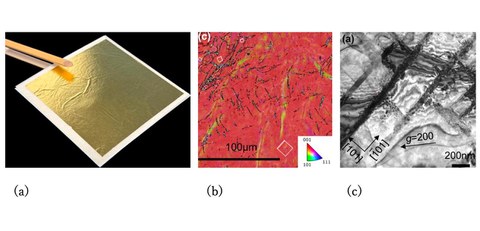
Kanazawa Gold Leaf (Fig. 1(a)) is not only used to decorate temples, shrines, and traditional crafts, but is also an essential material for the restoration of cultural properties. Its characteristics include ultra-thinness, known as the world's thinnest metal foil (only 100 nanometers, or about 1/1000 the thickness of a human hair), and its unchanging luster. Because of these features, it has been registered as a UNESCO Intangible Cultural Heritage. Previous research has shown that Kanazawa Gold Leaf forms a stable texture, but its process was unknown. In ordinary metals, the texture develops by foil stamping, but it was thought that recrystallization and recovery occur at the same time, causing the crystal orientation within the plane to become random. Therefore, it has long not been understood the reason why Kanazawa Gold Leaf exhibits a uniform and stable texture. Elucidating this mystery is an important challenge for both the inheritance of traditional craftsmanship and the advancement of materials science. In this study, the researchers systematically analyzed Kanazawa Gold Leaf without processing, using cutting-edge technologies such as electron backscatter diffraction (EBSD) and an ultra-high voltage electron microscope (UHVEM) with the world's highest accelerating voltage (accelerating voltage 2MV). As a result, it was clarified that a special deformation called a non-octahedral slip system, which was not expected in conventional metallurgy, is activated during the hammering process at room temperature, aligning the crystal orientation of the Gold Leaf.
In this study, the research group investigated the local crystalline of the gold (approximately 1 μm) at the intermediate stage of production and the gold foil (approximately 100 nm) at the final stage using EBSD and UHVEM. As a result, it was found that the in-plane crystal orientation of the original gold was random texture, but the dislocation density was high and recrystallization had not occurred. On the other hand, the gold foil at the final stage had a texture with a high in-plane crystal orientation (Fig. 1(b)). However, the dislocation density extremely increased, suggesting that recovery and recrystallization were not occurring. Additionally, they found numerous slip bands parallel to the plane, many of which were perpendicular to each other (Fig. 1(c)). This fact suggests that the non-octahedral slip system is activated. In ordinary face-centered cubic (FCC) metals, such non-octahedral slip systems do not move, and so it was found that gold foil is in a special deformation state.
Considering the above results, it was found that Kanazawa Gold Leaf forms a unique texture through a deformation mechanism different from that of conventional FCC metals. Specifically, unlike metal materials that are hot-rolled or annealed, Kanazawa Gold Leaf is processed without recrystallization or recovery. Therefore, dislocations become entangled during the foliation process, suppressing the slip systems that are normally activated. Furthermore, when the film thickness is about 200 nm, which is close to the size of the dislocation loop, some parts of the dislocation loops penetrate through the surface, leaving many screw dislocations that penetrate the entire thin film. These screw dislocations are easy to move and therefore prone to occur cross-slip systems. As a result of the evolution of these cross-slips, non-octahedral slip systems become active. This slip system can gradually rotate crystal orientation relative to the direction of foliation. During processing, the gold leaf is sandwiched between layers of Japanese washi paper to reduce surface friction and prevent the temperature from rising. In other words, it can be said that this temperature control suppresses recrystallization and recovery, and the special deformation described above is achieved.
The research results will deepen the scientific understanding of Kanazawa Gold Leaf, an Intangible Cultural Heritage, and provide solid evidence for the preservation and inheritance of traditional techniques. This will make it possible to improve the reliability of cultural property restoration and provide technical support for a stable supply. Furthermore, knowledge of the special deformation mechanisms in ultra-thin metal films is expected to be applied to the development of next-generation structure-sensitive nanomaterials and high-performance thin-film devices with unprecedented performance and design aspects, such as electronic materials, sensors, and decorative materials.
Fig. 1 (a) Kanazawa Gold Leaf (b) Orientation map of Kanazawa Gold Leaf obtained from EBSD whose color indicates the crystal orientation relative to the direction of foliation process (red indicates the orientation) (c) TEM image of Kanazawa Gold Leaf at the final stage. The slip bands along the direction corresponding to the black bands are perpendicular to each other.
Credit: Satoshi Ichikawa
Notes
The article, “Deformation mechanism behind the unique texture of Kanazawa gold leaf,” was published in npj Heritage Science at DOI: 10.1038/s40494-025-02055-5
