About this research

ISHIWATA Shintaro
- Graduate School of Engineering Science
- Professor

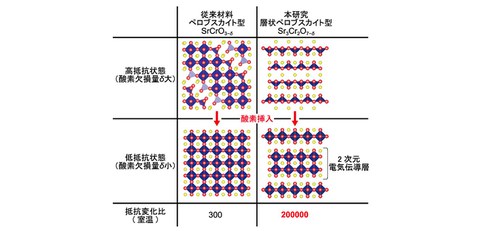
A simple oxidation reduces the electrical resistivity of layered Sr₃Cr₂O₇-δepitaxial thin films to 1/200,000!
- The research group has succeeded in synthesizing perovskite-type layered Sr₃Cr₂O₇-δ epitaxial thin films containing oxygen vacancies (VO) by pulsed laser deposition (PLD).
- When oxygen was inserted into the Sr₃Cr₂O₇-δ thin film by heating in air while maintaining the layered structure, the electrical resistivity at room temperature decreased by approximately 1/200,000.
- It has been revealed that giant resistivity change in Sr₃Cr₂O₇-δ thin films is the result of the concerted action of oxygen vacancy arrangements and changes in valence state of Cr ions.
Outlines
There are many transition metal oxides (TMOs) whose properties change significantly depending on their crystal structure and chemical composition. In particular, materials depended on the insertion and removal (intercalation) of oxygen are expected to be applied to next-generation memory and highly sensitive sensors.
A research group including Associate Professor Daichi Oka of the Graduate School of Science at Tokyo Metropolitan University, Zhaochen Ma (graduate student) of the Graduate School of Engineering Science at the University of Osaka, Professor Tomoteru Fukumura of the Graduate School of Science at Tohoku University who is also serving at the Advanced Institute for Materials Research (WPI-AIMR), and Professor Hiroshi Kumigashira of the Institute for Multidisciplinary Research for Advanced Materials at Tohoku University who is also serving at the High Energy Accelerator Research Organization (KEK), has discovered a new oxide material whose electrical resistivity at room temperature drops dramatically to about 1/200,000 by a simple oxidation process.
In this research, the researchers succeeded in synthesizing high-quality thin films of chromium oxide Sr₃Cr₂O₇-δ, which has a two-dimensional layered structure, using a unique method. Immediately after synthesis, this thin film barely conducts electricity, but when heated in air, oxygen is incorporated into the crystals, reducing the electrical resistivity to approximately 1/200,000. The magnitude of this change is more than 600 times greater than that of similar chromium oxides with conventional three-dimensional structures (Fig. 1). Further detailed investigation of the electronic state clarified that two factors, the position where oxygen escapes and the valence state of Cr ions, have a strong influence on the movement of electrons flowing through this material. It is thought that the combination of these effects resulted in a very large change in electrical resistance. This research is expected to provide guidelines for material design in the development of variable resistance materials, which will be further demanded in the future.
Fig. 1 Crystal structure and resistance change ratio before and after oxygen insertion for the conventional material SrCrO3-δ and the Sr₃Cr₂O₇-δ synthesized in this research.
Credit: Shintaro Ishiwata
Research Background
Transition metal oxides (TMOs), which have strong electron correlation effects, exhibit significant property changes when their crystal structure or chemical composition is modulated by temperature, electric field, or magnetic field, and are therefore being widely researched as functional materials. In particular, TMOs, which have the oxygen off-stoichiometry content, are expected to be utilized in next-generation memory and highly sensitive sensors since their electronic properties, including electrical resistance, can be controlled by chemically inserting and removing oxygen. Previous research has shown that epitaxial thin films of TMOs with a three-dimensional perovskite-type crystal structure exhibit a large resistance change ratio. However, as the magnitude of the change of resistance is suppressed when devices are made, it is needed to develop materials that indicate a larger resistance change ratio than conventional materials.
Research Contents
In this research, the researchers focused on the perovskite-type layered Sr₃Cr₂O₇-δ. Conduction electrons confined in a two-dimensional electron conduction layers are strongly affected by scattering due to oxygen vacancies. Therefore, the researchers predicted that Sr₃Cr₂O₇-δ would exhibit a larger change of resistance than SrCrO3−δ, which has a three-dimensional perovskite-type structure. They then synthesized high-quality Sr₃Cr₂O₇-δ epitaxial thin films using pulsed laser deposition (PLD). The thin film immediately after synthesis contained many oxygen vacancies δ and exhibited high electrical resistivity.
When oxygen was inserted into the thin film by simply heating in air, the lattice constants changed with increasing heated temperature, but the layered perovskite-type structure was maintained (Fig. 2). This non-monotonic change in the lattice constant is thought to indicate that the oxygen vacancy arrangement, which was previously ordered in the crystal, became disordered, and then the oxygen insertion reaction proceeded.
On the other hand, the electrical resistivity ratio changed significantly, dropping to about 1/200,000 of the value immediately after synthesis when heated to 400°C. This is more than 600 times larger than the resistance change ratio reported for SrCrO₃.
Precise electronic state evaluation at the beamline BL-2A of the Photon Factory at KEK revealed that the Sr₃Cr₂O₇-δ thin film is in a mixed valence state of Cr³⁺ and Cr⁴⁺ ions, and that the Cr³⁺ ions significantly increase the Mott gap compared to the Cr⁴⁺ ions (Fig. 3). Therefore, the giant resistance change of Sr₃Cr₂O₇-δ is thought to be induced by the concerted action of oxygen vacancy arrangement and changes in valence state of Cr ions in the two-dimensional structure.
Fig. 2 Heating temperature dependence of the lattice constant and electrical resistivity of Sr₃Cr₂O₇-δ epitaxial thin films
Credit: Shintaro Ishiwata
Fig. 3 Schematic diagram of the band structure of Sr₃Cr₂O₇-δ before and after heating in air
Credit: Shintaro Ishiwata
Future Development
This research shows that the change in electrical resistance of TMOs can be increased by reducing the dimensionality of their crystal structures. Furthermore, the successful synthesis of epitaxial thin films of layered oxides, which has been rarely reported until now, is an important achievement from a chemical perspective. TMOs are known to have a wide variety of chemical compositions and crystal structures, so by utilizing the material design guidelines obtained in this study, it is expected that new materials indicating even larger resistance changes will be developed. Materials whose electrical resistance changes depending on the insertion and removal of oxygen are being considered for application in memristors, which mimic the function of synapses in artificial intelligence (AI), and may lead to the development of next-generation devices that will contribute to reducing computers’ power consumption, which is expected to increase in the future.
Notes
The article, “Oxidation-Induced Giant Resistivity Change Associated with Structural and Electronic Reconstruction in Layered Sr₃Cr₂O7−δ Epitaxial Thin Films,” was published in Chemistry of Materials at DOI: 10.1021/acs.chemmater.5c00810.
