

The University of Osaka D3 Center Commences Operation of New Computing and Data Infrastructure Built by NEC
~Promoting Open Science Through Technology to Record and Manage Computational History~
The University of Osaka D3 Center will begin trial operations of the “Osaka University Compute and sTOrage Platform Urging open Science” (OCTOPUS), a computational and data platform promoting open science built by NEC Corporation (NEC; TSE: 6701), starting this September, with full-scale operations commencing in December.
OCTOPUS is a supercomputer with a theoretical computational performance of 2.293 petaflops, centered around 140 computing nodes of the “NEC LX201Ein-1” (*1). Compared to the previous system, it not only offers approximately 1.5 times the performance, but also incorporates a provenance management function (*2), which automatically records and manages processes such as data generation, jointly developed by both parties. This contributes to promoting open science, where research data is shared across society as a whole.
NEC LX201Ein-1 used in OCTOPUS
Credit: NEC Corporation
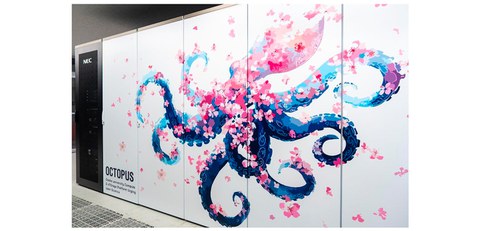
OCTOPUS Exterior View
(Winning design from a public competition rendered on the rack)
Credit: The University of Osaka D3 center
Recent academic research involves the daily analysis and generation of vast amounts of data using supercomputers. However, the research process and results are often left to manual recording and management by researchers, raising concerns regarding reproducibility, fairness, and efficiency. Furthermore, from the perspective of promoting open science, there is a demand for greater transparency in the research process and the implementation of an audit trail management system.
In response, a research group led by Susumu Date, Director at the Collaborative Research Center for High-Performance Computing and Data Analysis Integration—established in 2021 by The University of Osaka D3 Center and NEC—developed SCUP-HPC (*3), a new technology that records and manages the computational history executed on supercomputers.
SCUP-HPC tracks, records, manages, and visualizes computational provenance—tracking what data is accessed by which programs and what data is generated—in cluster-type supercomputers where multiple high-performance computers are connected via high-speed networks, while minimizing the impact on the supercomputer's performance.
This enables “Scientific Computing Unifying Provenance – High Performance Computing,” which integrates computational provenance on supercomputers, and is expected to dramatically improve the productivity of researchers using supercomputers for scientific computing tasks such as simulations and AI training.
Furthermore, by utilizing the history management and search service provided by SCUP-HPC, authorized users will be able to perform searches using history IDs and view visualized computational histories. This will enable researchers to include the computation history ID in their paper acknowledgments (*4), confirming that the research results were computed using OCTOPUS, thereby helping to ensure the integrity of academic research.
NEC plans to commercialize a provenance management system for supercomputers utilizing SCUP-HPC in the future.
Conceptual Flow of Recording the Computational History and Utilization
Credit: NEC Corporation
The University of Osaka D3 Center and NEC will continue to promote the introduction and utilization of next-generation high-performance servers as a foundation for industrial applications and AI/big data utilization, in addition to traditional supercomputer application areas, thereby contributing to cutting-edge technological development.
Furthermore, under its value creation model “BluStellar” (*5), NEC will pursue the “BluStellar Scenario” for “Enhancing Research Capabilities through the Advancement of Research Information Infrastructure,” centered on research information infrastructure, to realize open science and support research activities in the academic field.
(*1) Intel Xeon 6900 P-core series equipped
https://download.intel.com/newsroom/2024/data-center/Fact-Sheet-Xeon-6-P-Core.pdf
(*2) The provenance management function is scheduled to be available starting in December 2025.
(*3) System for Constructing and Utilizing Provenance on High-Performance Computing Systems
This research result was published online in the U.S. scientific journal IEEE Access on August 11, 2025.
Title:“SCUP-HPC: System for Constructing and Utilizing Provenance on High-Performance Computing System”
Author:Yuta Namiki, Takeo Hosomi, Hideyuki Tanushi, Akihiro Yamashita, and Susumu Date
DOI:https://doi.org/10.1109/ACCESS.2025.3597361
This research was conducted as part of collaborative work at the Center for High-Performance Computing and Data Analysis Integration established by The University of Osaka D3 Center and NEC.
(*4) For example, the following may be included in the acknowledgments section of a paper: “Part of the results of this research were obtained using the OCTOPUS facility at the The University of Osaka D3 Center. (Computational history ID=whoami-123456789)”
(*5) NEC BluStellar is a value creation model that leverages NEC’s cutting-edge technologies, developed and refined through years of experience and proven cross-industry expertise. It aims to transform business models, address social challenges, resolve management issues faced by customers, and lead them into a brighter future.
https://www.nec.com/en/global/necblustellar/index.html
