

Reaches one giga electron volt by laser-driven carbon ion acceleration
Leads to miniaturization of cancer treatment devices and the reproduction of extreme conditions of space
- The result has been achieved using J-KAREN-P, Japan's largest ultrashort pulse/ultra-high intensity laser.
- Thanks to the advancement of J-KAREN-P, it becomes possible to emit laser light with 150% higher intensity than conventional levels.
- This was achieved by creating a laser irradiation target with thickness controlled to nanometer (nm = 10⁻⁹ meters) precision and irradiating it with a high-intensity laser.
- This will lead to the miniaturization of heavy particle therapy devices and experiments to reproduce the extreme conditions of space, which are difficult to observe.
Outlines
A research team including Senior Principal Researcher Yuji Fukuda of the Kansai Photon Science Institute (KPSI) of The National Institutes for Quantum Science and Technology (QST, President: Shigeo Koyasu), Professor Yasuhiro Kuramitsu of the Graduate School of Engineering at the University of Osaka, and Associate Professor Masato Kanasaki of Kobe University, has achieved a laser-driven carbon ion acceleration of one giga electron volt (G = 10⁹) by utilizing J-KAREN-P at QST’s KPSI, the Japan’s largest ultrashort pulse/ultra-high intensity laser in Japan.
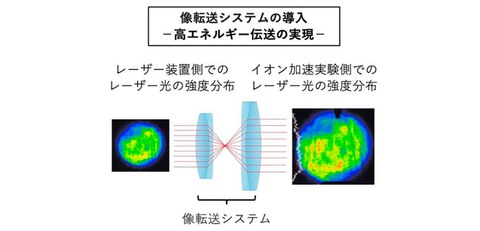
With an eye toward miniaturizing heavy particle therapy devices, KPSI has been working to advance J-KAREN-P by developing and introducing a laser light image transmission system (Fig. 1), making it possible to irradiate laser light at an intensity 150% higher than conventional levels. Furthermore, the research team established a technology for depositing gold with controlled thickness to nanometer precision onto a stack of graphene sheets, creating an optimal target for J-KAREN-P (Fig. 2). These synergistic effects have resulted in highly efficient carbon ion acceleration. One giga electron volt corresponds to the world's highest energy for carbon ion acceleration using an ultrashort pulse laser. This result will take a major step forward toward the energy (approx. 5 GeV) required for heavy particle therapy using carbon ions, leading not only to a significant reduction in the size of devices for the therapy, but also to the possibility that the resulting plasma containing high-energy carbon ions may experimentally reproduce plasma conditions in space, which are difficult to observe directly.
This result was presented orally at the 80th Annual Meeting of the Physical Society of Japan on September 17th, under the title “Carbon ion Acceleration of the world's highest energy Using J-KAREN upgrade”.
Fig. 1 By introducing an image transmission system into the beam transmission section of J-KAREN-P, a 150% increase in intensity compared to conventional levels has been achieved
Credit: Yasuhiro Kuramitsu
Fig. 2 A method was established to stack multiple graphene sheets and coat them with gold, allowing the thickness of the target to be controlled with nanometer precision
Credit: Yasuhiro Kuramitsu
Research Background
The Chirped Pulse Amplification invented in the mid-1980s gave rise to ultrashort pulse/ultra-high intensity lasers. By focusing these laser pulses, it becomes possible to generate plasma at ultra-high temperatures/pressures that humanity has never experienced before. Laser plasma acceleration using this plasma can generate short pulses of charged particles and is therefore expected to be applied to a variety of fields as a next-generation particle accelerator technology.
Problems of Previous Research
Among the technologies for accelerating ions by lasers, in acceleration using a thin film as a target, it has been theoretically shown that ions can be accelerated to higher energies by increasing the laser energy and thinning the target that is irradiated with the laser. To achieve this, it is necessary to increase the laser intensity and control the target thickness and composition with nanometer precision, optimized for the laser conditions, but it has been difficult to achieve both simultaneously so far.
Research Contents
The laser development team, led by Hiromitsu Kiriyama, Leader at KPSI, developed and introduced an image transmission system into the laser pulse transmission section of the ultra-high intensity laser J-KAREN-P, and succeeded in transmitting the laser intensity distribution to the focusing mirror right before the target without degrading it at the exit of the laser device. This significantly improved the focusing conditions and achieved high-intensity laser irradiation with a transmittable laser pulse energy that was 150% higher than conventional levels. In developing the target, with the cooperation of Professor W. Y. Woon of National Central University in Taiwan, they established a technology to stack multiple sheets of large-area, one-atom-thick graphene sheets and gold deposition onto the surface, successfully controlling the thickness and composition with nanometer precision for the first time. Gold, which has a large atomic number and contains many electrons, increases the electron density in the plasma, which has the effect of increasing the electric field strength of laser-driven plasma acceleration, making it possible to accelerate high-energy ions. In this study, thanks to the synergistic effect of increasing the laser intensity and improved target manufacturing technology, the research group succeeded in accelerating carbon ions to one giga electron volt, the world's highest energy ever achieved by ion acceleration using an ultrashort pulse laser.
This is a significant improvement over the previous record of 0.6 GeV (South Korea, 2019). By using the target manufacturing technology developed in this study, it is expected to accelerate even higher energy carbon ions in line with future advances in J-KAREN-P sophistication.
Social Impact of the Research
The result of this study represents a major step forward toward achieving the energy required for heavy particle therapy using carbon ions (approx. 5 GeV) and will lead to a significant reduction in the size of its equipment. Furthermore, the plasma containing high-energy carbon ions obtained in this research may experimentally reproduce conditions which are difficult to observe directly, such as plasma conditions in space. In particular, by simulating the plasma state near a supernova remnant and reproducing the process by which the magnetic energy of the plasma is converted into the kinetic energy of accelerated ions, which has been difficult to achieve so far, it is expected that this will elucidate the unsolved problem of cosmic ray acceleration.
Fig. 3 The J-KAREN-P, Japan's largest ultra-high intensity laser developed at KPSI https://www.qst.go.jp/site/kansai/2525.html
Credit: Yasuhiro Kuramitsu
Fig. 4 Graphene is a sheet-like material in which carbon atoms are bonded in a honeycomb-like hexagonal pattern. It has the strength of a diamond and is also flexible
Credit: Yasuhiro Kuramitsu
Fig. 5 Comparison of carbon ion acceleration results using an ultrashort pulse laser. Results from this study (red circle) and previous experiments (black circle)
Credit: Yasuhiro Kuramitsu
Fig. 6 Schematic diagram of laser plasma acceleration using a thin film target
Credit: Yasuhiro Kuramitsu
Fig. 7 Supernova remnant SN1006. It appeared in 1006 AD and is located approximately 7,200 light-years from the Earth. It is the brightest celestial object ever recorded, excluding the Sun and the Moon. It is believed that high-energy cosmic ray acceleration occurs in the vicinity of a collisionless shock (wave) generated by the supernova remnant
Credit: Yasuhiro Kuramitsu
Fig. 8 Schematic diagram of an experiment simulating the environment of a supernova remnant where cosmic ray acceleration occurs
Credit: Yasuhiro Kuramitsu
