About this research

TAYA Naohiro
- Graduate School of Medicine
- Endowed Chair Assistant Professor

Discovered blood lipid diacylglycerol involves in the progression of diabetic arteriosclerosis
Application to risk assessment of arteriosclerosis and development of new treatments are expected
- It was discovered that diacylglycerol in the blood is involved in the progression of arteriosclerosis in diabetic patients.
- In the diabetic state, with higher risks of both abnormalities in lipid metabolism and arteriosclerosis, it was not clear which blood lipids are involved in the progression of arteriosclerosis.
- In this study, it is clarified that several diacylglycerols and their total amount are related to indicators of the degree of arteriosclerosis by comprehensively measuring lipids in the blood of diabetic patients.
- It is also suggested that measuring diacylglycerol in the blood will be effective in determining the likelihood of progression of arteriosclerosis.
- It is expected that this will lead to deeper understanding of the mechanism by which arteriosclerosis progresses in diabetic patients.
Outlines
A research group including Endowed Chair Assistant Professor Naohiro Taya (Diabetes Care Medicine), Associate Professor (Lecturer) Naoto Katakami, and Professor Iichiro Shimomura (Department of Metabolic Medicine) at Graduate School of Medicine of the University of Osaka, together with Professor Takeshi Bamba (Division of Metabolomics, Medical Research Center for High Depth Omics), at Medical Institute of Bioregulation (MIB), Kyushu University, has revealed that diacylglycerol in the blood is involved in the progression of arteriosclerosis in diabetic patients.
It has been known that various blood lipids are involved in the progression of arteriosclerosis, but it was not well understood which blood lipids are involved in that of diabetic patients, which are prone to both abnormalities in lipid metabolism and arteriosclerosis.
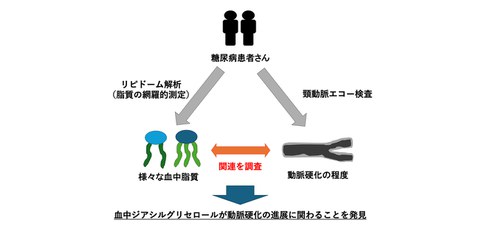
In this study, the research group conducted comprehensive measurements of approximately 350 types of lipids in the blood of diabetic patients currently receiving treatment at the University of Osaka Hospital and investigated changes in the arterial walls (progression of arteriosclerosis) using carotid ultrasonography examinations. As a result, they clarified that diacylglycerol in the blood is involved in the progression of arteriosclerosis in diabetic patients. It was also suggested that measuring diacylglycerol in the blood could more accurately identify patients who are likely to develop arteriosclerosis.
Fig. 1 Overview of this research
Credit: Naohiro Taya
Research Background
Diabetes is a disease characterized by hyperglycemia, but it is also known to cause abnormalities in lipid metabolism. Diabetic status generally leads to the progression of arteriosclerosis, which affects the patient's healthy life expectancy. Most lipids have a structure in which fatty acids are bonded to a basic skeleton, and due to the diversity of these two, there are many types of lipids in the human body. It was known that various blood lipids are involved in the progression of arteriosclerosis, but it was not fully understood which blood lipids are involved in arteriosclerosis in diabetic conditions. In addition, because many blood lipids have similar structures, there were technical challenges in accurately measuring multiple types of lipids simultaneously.
Research Contents
The research group comprehensively measured approximately 350 types of lipids in the blood of diabetic patients receiving treatment at the University of Osaka Hospital using a method developed by the research group at Kyushu University. In addition, carotid ultrasonography was used to observe the arterial wall and evaluated carotid intima-media thickness (MIT), which indicates the degree of arteriosclerosis.
These results were statistically analyzed and the researchers revealed that multiple diacylglycerols (diacylglycerols containing various fatty acids) and total diacylglycerol amount were related to carotid IMT. Furthermore, they examined changes in the arterial walls over a five-year period and found that the higher the blood diacylglycerol level, the greater the rate of increase in carotid IMT. It was also found that the increasing speed of carotid IMT could be more accurately predicted by using blood diacylglycerol levels.
Social Impact of the Research
Arteriosclerosis is one of the serious complications that affects the healthy life expectancy of diabetic patients. The results of this study suggest that measuring diacylglycerol in the blood may be effective in assessing the likelihood of progression of arteriosclerosis. In recent years, antidiabetic agents that are effective against complications caused by arteriosclerosis in diabetic patients have been identified. Therefore, if diacylglycerol measurement can identify patients at high risk of arteriosclerosis, it will be possible for them to receive treatment to use such medications. Although it is not yet clear how diacylglycerol accelerates arteriosclerosis, elucidating this mechanism may lead to the discovery of new treatments for arteriosclerosis.
Notes
The article, “Plasma Diacylglycerols Are Associated with Carotid Intima-Media Thickness Among Patients with Type 2 Diabetes: Findings from a Supercritical Fluid Chromatography/Mass Spectrometry-Based Semi-Targeted Lipidomic Analysis,” was published in British scientific journal of International Journal of Molecular Sciences (Online) at DOI: https://doi.org/10.3390/ijms26146977.